

Passover is a very special feast, not only because of the dramatic story it tells, but also because of the way it is structured, including these intermediate days—Chol HaMoed—when we find ourselves in a kind of “in-between” time: after redemption has already begun, and yet before its meaning has been fully revealed. These are not the moments of departure, nor the moments of fulfillment; they are quieter, less defined days, days of transition, when something has already happened, but has not yet been fully understood. And it is precisely for this time that the Torah gives us a very unexpected reading.
What Happens After Exodus?
On the intermediate Shabbat of Passover, we read not about the Exodus itself, but about what comes after: Exodus 33–34. This is one of those places where the choice of reading is not accidental at all—it is deeply midrashic in its logic, almost as if the Torah itself is interpreting Passover for us. Because Passover speaks of redemption—but this passage quietly asks a deeper and more difficult question: what happens after redemption?
When we turn to the text, we immediately find ourselves in the aftermath of one of the greatest failures in Israel’s history—the sin of the golden calf. Israel has just been redeemed from Egypt; they have seen miracles, experienced deliverance, and entered into covenant with God, and yet almost immediately everything collapses: the covenant is broken, the tablets are shattered, and the relationship itself seems to stand on the verge of dissolution.
At the end of the previous chapter, Moses intercedes for the people, pleading, arguing, standing in the gap; and at the beginning of this chapter he receives God’s answer: yes, the people will continue their journey toward the Promised Land. And yet, something is not the same, because in God’s words we still hear the echo of His wrath: “Go up to a land flowing with milk and honey; for I will not go up in your midst… for you are a stiff-necked people.” This is not a small detail. God promises the land, but withdraws His presence—and in many ways, this is worse than judgment, because the true promise is not the land, but God’s presence.
And then—almost unexpectedly, almost impossibly—we read something that seems to overturn everything that has just been said: “My Presence will go with you, and I will give you rest.” How can this be? Just a few verses earlier, God said He would not go with them, and now He says that He will. We know that God does not change, that there is no “shadow of turning” with Him, and so we are left with a question that cannot be ignored: what are we seeing here?
This is the profound mystery of this passage. At first, it appears to speak only about God’s holiness—about the impossibility of His presence dwelling among a sinful people—and that is indeed true. But as we continue to read, another dimension begins to emerge, and we realize that this passage is not only about God’s holiness, but also about His mercy. His holiness is such that He cannot dwell with sin, and yet, in His mercy, He chooses to dwell with His people.
It is not accidental at all that it is here—of all places! —that we encounter the words that later Jewish tradition would recognize as the Thirteen Attributes of Mercy, the very heart of God’s self-revelation: “The LORD, the LORD, merciful and gracious, slow to anger, abundant in lovingkindness and truth…” At the very moment when Israel deserves rejection, God reveals not His power, but His mercy!
Seeing from Behind
Yet, before this revelation is spoken, something else happens—something mysterious and difficult to understand.
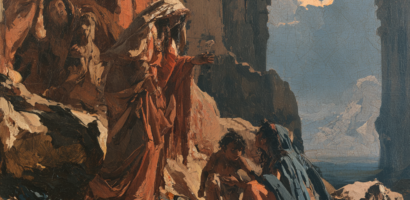
Moses asks: “Show me Your glory.” This is not curiosity, and not a philosophical question; it is the cry that comes after failure, when the relationship has been shaken and must somehow be restored. And God answers him in a way that is both revealing and concealing at the same time: “You cannot see My face… but you shall see My back.” The Hebrew word אחרי (acharai) means “what is behind Me”; we translate it as “back,” but in truth we do not know what it means, and perhaps we are not meant to. God cannot be seen directly—only in passing, only afterward.
But for the attentive reader of Scripture, this moment may sound familiar.
Much earlier, in Genesis 16, we meet Hagar—a woman who could not be more different from Moses. She is alone, fleeing, a foreigner, a servant, a woman without protection, and yet it is precisely there, in the wilderness, that she encounters God. And after this encounter, she says: “Have I also here seen Him who sees me?” But in Hebrew, her words are far more enigmatic; they can be read as: “Have I also here seen after the One who sees me?”—or even—“Have I seen the back of the One who sees me?”
True, when we are reading it in our modern Tanach, vowels are inserted and they make two different words from the same Hebrew letters: The same consonants read as “my back” in Moses’ case are seen as “after” in case of Hagar. However, the original text contained no vowels, so the same Hebrew letters stand behind both expressions: אחרי.
Could it be that Hagar is describing the same kind of experience that Moses later had—the same kind of encounter, the same kind of “seeing,” not face to face and not fully, but from behind?
This is astonishing. Moses—the great leader of Israel, standing on Sinai—and Hagar—a poor and distressed Egyptian slave, alone in the wilderness—and yet the same God, “merciful and gracious, slow to anger,” reveals Himself to both.
And it is here that everything comes together.
The passage in Exodus reveals who God is—merciful, gracious, patient. The story of Hagar shows how far that mercy reaches—not only to the covenant people, not only to the righteous, but also to the forgotten, the outsider, the one who does not even know how to ask. Even from behind, His mercy reaches everyone.
And perhaps this is also the deeper message of Passover itself.
In Egypt, Israel is redeemed—but redemption is not the end of the story. Because what follows redemption is not perfection, but failure, confusion, brokenness—and then, mercy. This is why we read this passage during these intermediate days, because these are days that reflect our own lives: days lived in between, after something has begun, but before it has been fully understood.
And so this text inevitably becomes personal.
Have you ever felt that you are not worthy of God’s presence? Have you ever wondered how God can still be patient with you, still be merciful—when you yourself would have already given up? Each of us knows many reasons why God could say: “I will not go up with you … for you are stiff-necked.” Each of us knows that these words are true—and yet, more than anything, each of us longs to hear something else: “My Presence will go with you, and I will give you rest.”
And the astonishing thing is that this is exactly what He says.
This is the mystery of His mercy: we do not deserve His presence, and yet He goes with us; we do not see Him fully, and yet we recognize Him afterward— even if only from behind.
If you like the insights on this blog, you might enjoy my books, you can find them here: books. As always, I would be happy to provide more information (also, a teacher’s discount for new students) regarding our wonderful courses (juliab@eteachergroup.com)