

Dear friends,
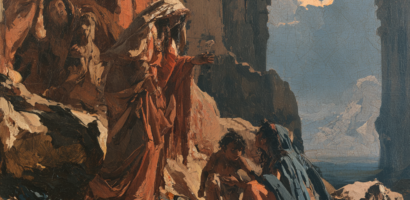
In our last post, we left Abraham standing before the Lord, “dust and ashes” daring to plead for Sodom and appealing to the righteousness of the Judge of all the earth; this week, the story moves into the terrible morning after that conversation, when Abraham returns to the very place where he had stood before God and looks toward the cities for which he had interceded.
“And Abraham went early in the morning to the place where he had stood before the LORD. Then he looked toward Sodom and Gomorrah, and toward all the land of the plain; and he saw, and behold, the smoke of the land which went up like the smoke of a furnace.”
—Genesis 19:27–28
The Hebrew opening of this scene is striking:
וַיַּשְׁכֵּם אַבְרָהָם בַּבֹּקֶר — vayashkem Avraham baboker — “Abraham rose early in the morning.”
These words appear three times in Abraham’s story, and each time they introduce a moment of extraordinary pain: here, in Genesis 19, when Abraham looks toward Sodom after the destruction; in Genesis 21, when he rises early to send Hagar and Ishmael away; and in Genesis 22, when he rises early to begin the journey on which he believes he will have to sacrifice Isaac.
Lot was Abraham’s nephew, but he had traveled with him from the beginning and had become almost like a son to him; Abraham had already risked his life to rescue Lot in Genesis 14, and now, after pleading for Sodom, he stands in the morning light and sees only smoke rising from the plain.
What did Abraham think at that moment? What did he feel?
The Torah does not tell us, but the repetition of vayashkem Avraham baboker places this morning among the deepest and most painful mornings of Abraham’s life.
And yet, while Abraham is standing on the mountain looking toward Sodom, another story has already unfolded below—a story not only of judgment, but also of astonishing mercy.
Lot has been warned that the city is about to be destroyed and that he must leave immediately, but he cannot bring himself to go.
He hesitates.
He lingers.
He delays at the very edge of destruction.
And finally, the angels seize him by the hand.
“And while he lingered, the men took hold of his hand, his wife’s hand, and the hands of his two daughters, the LORD being merciful to him; and they brought him out and set him outside the city.”
—Genesis 19:16
It is difficult to imagine a more vivid picture of divine mercy—and, at the same time, of human hesitation.
Lot is being offered salvation, yet he is still reluctant to leave behind the life he knows; the judgment is already approaching, and he is still standing there asking, in effect, whether he really has to let go.
The text says explicitly why the angels take him by the hand: “the LORD being merciful to him.”
Lot is not rescued because he acts decisively.
He is rescued despite the fact that he cannot.
And Genesis itself later connects Lot’s deliverance with Abraham: “God remembered Abraham, and sent Lot out of the midst of the overthrow.” Abraham’s intercession did not preserve Sodom, but it was not forgotten; in the middle of judgment, God remembered the man who had stood before Him and pleaded.
Yet Lot’s story carries a sobering message as well, because being taken out of Sodom does not automatically mean that Sodom has been taken out of Lot.
He leaves the city physically, but inwardly he is still struggling to let go.
This is why the story of Lot’s escape is so disturbing. We tend to imagine salvation as the moment when danger is removed from us, but sometimes the greater question is whether we are willing to leave behind the thing from which God is rescuing us.
Lot had lived among the wicked and, remarkably, had apparently preserved a measure of righteousness there; Peter even calls him “a righteous man.” Yet when the moment came for an absolute decision—when God’s command required him to leave everything behind without knowing what would come next—Lot hesitated.
And that hesitation did not end at the gates of Sodom.
The story that follows is tragic. Lot eventually ends up in a cave, drunk and isolated, and through his daughters becomes the father of Moab and Ammon, peoples who would later become bitter enemies of Israel. The man who had been rescued from one of the greatest judgments in Scripture reaches the end of his story in one of its saddest scenes.
What a contrast with Abraham.
Lot hesitates even when obedience concerns his own survival; Abraham repeatedly says yes to God even when obedience seems to threaten everything he loves.
Lot has to be pulled out of Sodom.
Abraham rises early in the morning.
The same expression, vayashkem Avraham baboker, will appear again when Abraham sends Ishmael away and again when he goes toward Mount Moriah, and this repeated image tells us something essential about him: when God speaks, Abraham acts, even when obedience tears through his heart.
This does not mean that Abraham never struggles, questions, or suffers. Last week we saw him arguing with God Himself, pleading for Sodom with astonishing boldness; but once the moment of decision arrives, Abraham’s questions do not become an excuse for disobedience.
He can argue—and still obey.
Lot hesitates—and has to be dragged.
Perhaps this is why the contrast between these two men is so powerful. Both know God. Both have received His mercy. Both have seen His intervention in their lives. Yet their responses are profoundly different, and those responses gradually shape the direction of their stories.
There is a spiritual law here that is difficult to avoid: we choose much more than a single action when we respond to God; again and again, through our yes or our hesitation, we are also choosing the direction in which our life will move.
Sometimes God, in His mercy, takes us by the hand and pulls us away from destruction even while we hesitate.
But Abraham’s story shows us another way—the way of the man who rises early in the morning because, however painful the road ahead may be, he has already decided whom he will follow.
In Genesis 18, Abraham stood before the Lord and dared to argue because he trusted God’s character.
In Genesis 19, Lot stands at the edge of Sodom and struggles to leave because he still cannot release what lies behind him.
Perhaps faith is revealed not only in what we believe about God, but also in what we are willing to leave when He says, Go.