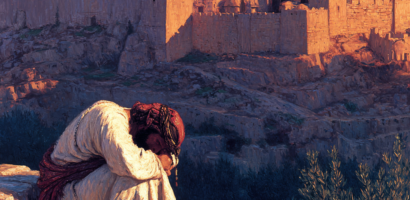



THE JEWISH SCENE IN THE TIME OF JESUS
Those readers who have followed my blog for a while, know that I love series. There have been many series on this blog already: As Though Hiding His Face (The Hidden Messiah), Biblical Portraits (of Rebecca and of Judah), The Bible Stories You Did Not Know, The Torah Portion in Real Time, etc. Today we begin a new series, and the title of this series is inspired by a short sentence from the well-known Jewish-American scholar, Daniel Boyarin: “The Jesus folk were not alone on the Jewish scene.”[1] Hence the title of this new series: “The Jewish Scene in the time of Jesus”. We will try to understand who else was on this scene besides the followers of Jesus, and what was going on there.
The “Jesus folk” were definitely not alone: there were many different directions and teachings in Judaism before the destruction of the Temple. All these streams differed significantly, both in theology and practice, but they all firmly believed that the Torah was given by God to Moses at Mt. Sinai, and the Torah was an unshakable and unquestionable foundation for all these directions and teachings, without exception. Many of the Second Temple Jewish texts present an expanded retelling of the Torah. However, even though those texts or teachings were built on the Torah and around the Torah, they had very different understandings and different interpretations of the Torah. Thus, our point in studying such texts is to grasp the ideas and the interpretations that were alive on the Jewish scene in the times of Jesus—to get a feel for this Jewish scene. “The New Testament writers, being predominantly Jewish and products of the Second Temple Period,” were definitely influenced by these ideas. “We just can’t see it because, frankly, we don’t have Second Temple Jewish eyes. We miss what the original audience would have seen.”[2] To choose a more academic designation, we want to understand the historical and cultural context of the New Testament. Our first text, will be the First Book of Enoch—undoubtedly the most important apocalyptic work outside the canonical Scriptures.
FIRST ENOCH
1 Enoch is a collection of Jewish apocalyptic texts dating from the last three centuries before the Common Era. Most scholars believe that 1 Enoch was originally written in Aramaic and that its oldest parts were written as early as the third century B.C. Some scholars consider the rediscovery of Enochic Judaism to be one of the major achievements of contemporary research into Second Temple Judaism, and almost everyone recognizes the importance of Enochic Judaism in the development of ancient Jewish thought.
The First Book of Enoch, or Ethiopic Enoch, is in fact a compilation of five books, each of which appears with its own title and usually its own conclusion. These five books, known as the Book of the Watchers (chaps. 1-36), the Similitudes (also known as Parables, chaps. 37-71), the Book of the Luminaries (chaps.72-82), the Book of the Dreams (chaps. 83-90), and the Epistle of Enoch (chaps. 92-105), are combined into a single work in the Ethiopic version, in which alone, the whole is preserved. In addition to the Ethiopic text, extensive parts of the book have survived in Greek. Fragments of each section of the book, except the Similitudes, have also been found in Qumran (all in Aramaic).
Many scholars of early Christianity see the main value of this book in providing additional insights into the New Testament: thanks to the Book of Enoch, we can see “to what extent the ideas surrounding what we call Christology, the story of Jesus as the divine-human Messiah, were also part (if not parcel) of Jewish diversity at this time”.[3] Of course, later we will discuss these insights and these ideas as well. However, we will begin with the first part of the Book of Enoch which will help us understand one of the most enigmatic passages in the Torah: the Book of Watchers.
WHO WERE THE SONS OF GOD?
Not many Bible passages raise as many questions as the infamous beginning of chapter 6 of the book of Genesis:
1 Now it came to pass, when men began to multiply on the face of the earth, and daughters were born to them, 2 that the sons of God saw the daughters of men, that they were beautiful; and they took wives for themselves of all whom they chose… 4 There were giants[4] on the earth in those days, and also afterward, when the sons of God came in to the daughters of men and they bore children to them. Those were the mighty men who were of old, men of renown.
These verses in Genesis 6 have been the subject of discussions for a long time. For centuries, people have debated whether the “sons of God” expression refers to angels or to men, and who these Nephilim/giants were. Many respected scholars have commented on this topic over the years, and the identity of the Nephilim and the sons of God is still being debated today.
The Hebrew words translated “the sons of God” are b’nai ha Elohim, בְנֵי־הָֽאֱלֹהִים֙. Does the Torah mean angels, or just “the sons of rulers,” or “the sons of the nobles,” as some Jewish translations translate b’nai ha Elohim here? Many of you probably know that the noun הָֽאֱלֹהִים֙ (Elohim) is in a plural form, and it can be read not only as “God”, but also as “gods” or even “lords, rulers”, and this is exactly how the Jewish commentaries choose to read this word in this particular verse. We have “the sons of the princes” in Targumim, and “the sons of the Judges” in Midrashim—in fact the “angelic interpretation” (that they were angels, or some kind of divine beings), while not very popular in modern Christianity, is almost non-existent in modern Judaism. However, it was completely different in Second Temple Judaism. Second Temple Judaism saw in Genesis 6:1-4, not only the story of a supernatural rebellion, but one of the most important passages in biblical theology. While in Genesis it occupies just a few verses, during the Second Temple Period it receives great attention, as we can see from the Watchers story of 1 Enoch, which is just an expansion of this episode.[5] Next time, we will see how the Book of Watchers understood and interpreted this story, and also how the Enochian understanding of this story finds its way into the New Testament, in the letters of Peter and Jude.
[1] Boyarin, Daniel. The Jewish Gospels (Kindle Location 1103). The New Press. Kindle Edition.
[2] Heiser, Michael S. Reversing Hermon: Enoch, the Watchers, and the Forgotten Mission of Jesus Christ (Kindle Locations 110-112).
[3] Boyarin, Daniel. The Jewish Gospels (Kindle Locations 487-489). The New Press. Kindle Edition
[4] Some translations have here Nephilim instead of Giants.
[5]“Watchers” is the Enochian term for the “sons of God.”
If you like my articles on this blog, you might enjoy also my books, you can get them through my page on this blog, https://israelbiblicalstudies.com/blog/author/juliablum/