

The Hebrew Bible presents a vivid vision of divine kingship. The mashiach—the anointed one—was always a real, tangible figure: a reigning monarch or consecrated priest, chosen to rule or serve visibly among the people. This is the world of David and Solomon, of priests and temple rituals, all conducted within the historical and geographical frame of ancient Israel. The title mashiach appears thirty-nine times in the Hebrew Scriptures, but only once with any clear eschatological meaning. So where did the idea of a hidden, end-time redeemer come from?
That journey—from an earthly king to a heavenly, transcendent savior—is one of the most profound transformations in Jewish religious thought. And the vehicle for this transformation was a new kind of literature—apocalyptic.
Apocalyptic Literature: A New Kind of Hope
The genre of apocalypse was born in crisis. When kings failed and the righteous suffered under unjust rulers, the old theological framework could no longer explain reality. In such moments, Jewish authors turned not to history but to revelation—to visions, angelic messengers, and cosmic secrets hidden from the world but revealed to the righteous few.
It is in these apocalyptic texts that the transformation of the messianic idea takes place. No longer is the mashiach simply a king descended from David who will restore the kingdom of Israel. Now, he becomes a heavenly deliverer, a pre-existent being who will descend at the end of time to judge the wicked, reward the righteous, and restore divine justice once and for all.
The earliest and most influential apocalyptic text to develop this new messianic vision is the Book of Daniel.
Daniel’s Son of Man
The seventh chapter of Daniel contains one of the most enigmatic and powerful visions in the Hebrew Bible. Amid beasts and thrones, we read:
“Behold, one like a Son of Man came with the clouds of heaven… and there was given him dominion, and glory, and a kingdom, that all peoples, nations, and languages should serve him.” (Daniel 7:13–14)
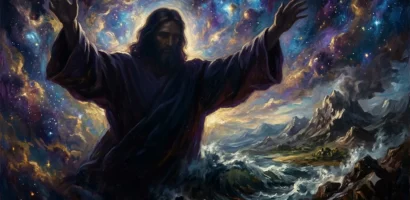
This figure—“like a Son of Man”—is not just another ruler. He comes on the clouds, a phrase typically reserved for God Himself. He receives an eternal kingdom. He transcends national boundaries. He appears to be both human and more than human.
Daniel’s vision marks a turning point. Here, the messianic hope begins to detach itself from politics and geography. It becomes eschatological—concerned with the end of time—and cosmic in scope. The mashiach is no longer simply a future king; he becomes a heavenly savior, a divine-human figure who appears at the end of days.
This vision set the stage for later apocalyptic writings, which would take Daniel’s Son of Man and develop him into a fully formed savior.
1 Enoch
Having said all that, let us now turn to the First Book of Enoch. 1 Enoch is a collection of Jewish apocalyptic texts dating from the last three centuries before the Common Era. Many scholarly opinions regard 1 Enoch as one of the most important Jewish texts of the Greco-Roman period. Some scholars consider the rediscovery of Enochic Judaism to be one of the major achievements of contemporary research into Second Temple Judaism, and almost everyone recognizes the importance of Enochic Judaism in the development of ancient Jewish thought. The Book of Enoch is undoubtedly the most important apocalyptic work outside the canonical Scriptures.
The First Book of Enoch, or Ethiopic Enoch, is in fact a compilation of five books, each of which appears with its own title and usually its own conclusion. These five books, known as the Book of the Watchers (chaps. 1-36), the Similitudes (also known as Parables, chaps. 37-71), the Book of the Luminaries (chaps.72-82), the Book of the Dreams (chaps. 83-90) and the Epistle of Enoch (chaps. 92-105), are combined into a single work in the Ethiopic version, in which, alone, the whole is preserved. In addition to the Ethiopic text, extensive parts of the book have survived in Greek. Fragments of each section of the book, except the Similitudes, have also been found in Qumran.
The Book of the Watchers
In the first part, the Book of the Watchers, we encounter familiar biblical characters—Enoch, Noah, the fallen angels—but with unfamiliar twists. When the earth is corrupted by the sin of the Watchers, God intervenes, but His first command is unexpected: “Hide yourself!” (1 Enoch 10:2).
This brief command, directed to the “son of Lamech” (Noah), is profoundly significant. Unlike the Genesis account, which tells Noah to build an ark, here God’s first response is concealment. The righteous man is to hide before the judgment comes. He is also to be shown the secrets of the future: “Reveal to him the end of what is coming.”
This is more than an alternate version of the flood story. It’s the beginning of a pattern—one that will repeat throughout apocalyptic literature. Judgment is coming. The wicked will be punished. But first, the righteous one is hidden. First, he receives divine knowledge. Then, and only then, does the plan of salvation unfold.
This is the seed of what I call the Hidden Savior motif—a structure that appears again and again in Jewish apocalyptic writings, and later in Christian theology. A chosen figure is concealed. He is entrusted with divine wisdom. He will reappear at the appointed time. And through him, the righteous will be saved.
Enoch: The First Hidden One
Later in the Book of the Watchers, Enoch himself becomes the hidden one. “Before these things Enoch was hidden, and no one of the children of the people knew by what he was hidden.” (1 Enoch 12:1) This is not a reference to Enoch’s ultimate translation into heaven, as in Genesis 5:24 (“God took him”). Rather, it refers to a temporary concealment—a period during which he was separated from humanity and given access to heavenly secrets.
Enoch becomes a prototype of the hidden righteous one. He is shown the workings of creation, the boundaries of the heavens, and the fate of the wicked. He is entrusted with eschatological knowledge for a future generation: “I look not for this generation, but for the distant one that is coming.” (1 Enoch 1:2)
But Enoch, like Noah before him, is not the Savior himself. He is a witness, a messenger. The true Savior—the ultimate Son of Man—is yet to be revealed.
The Similitudes: A Savior Emerges
In the Similitudes of Enoch, a new figure takes center stage. This section of 1 Enoch, often called the Book of Parables, introduces a transcendent individual who bears striking resemblance to the Son of Man from Daniel. But here, his identity and role are even more developed.
This Son of Man, we are told, has been hidden since before creation:
“He was concealed in the presence of the Lord of Spirits prior to the creation of the world, and for eternity.” (1 Enoch 48:6)
Not only is he hidden, he is also named before creation, chosen for a specific purpose, and preserved until the time of his revealing. When the time comes, he is shown to the “holy and the elect ones,” and it is through him that salvation comes:
“In those days, there will be a change for the holy and the righteous ones… through his name they shall be saved.” (1 Enoch 48:7)
The Son of Man is also entrusted with the revelation of hidden wisdom: “He shall reveal light to the righteous and the elect who dwell upon the earth.” (1 Enoch 45:4) He is, in a sense, the righteous counterpart to the Watchers—he reveals hidden things, but he does so under divine commission, for the sake of salvation, not corruption.
And he is the one who judges. Over and over, we are told that this Elect One, this hidden and now revealed Savior, will sit on the throne of glory, execute judgment, and bring peace to the righteous.
Thus, in the Similitudes, we see all the components of the apocalyptic messianic pattern in place:
The Hidden One — concealed before creation, revealed at the end of days.
The Bearer of Heavenly Wisdom — not merely learning divine secrets, but chosen to disclose them.
The Righteous Judge — seated on the throne, executing divine justice.
The Savior — through whose name the elect are saved.
What began as a transformation of Israel’s political hopes has now blossomed into a full eschatological theology. The savior is no longer a future king but a cosmic redeemer. His identity is hidden until the appointed time. His authority comes not from lineage but from pre-existence. And salvation is not through armies or laws, but through recognition: those who see and acknowledge him are the ones who will be saved.
In our next posts, we will trace how this hidden heavenly Savior appears in the Gospels—how Jesus takes up the title “Son of Man,” what it meant to His audience, and why this Second Temple backdrop is essential for understanding the earliest Christian messianic claims.
But for now, we stand with Enoch—between heaven and earth—watching the unfolding of a vision that would shape not only Jewish apocalypticism but also the very heart of the Christian message: the hidden one is coming. And with him, salvation. For the first time in Jewish apocalyptic thought, salvation is explicitly tied to this revealed savior: “Through his name they shall be saved” (1 Enoch 48.7). Not only is the Savior hidden and later revealed, but the ones who are saved are those who are able to recognize him. The echoes of the New Testament are unmistakable here, and yet this theology develops fully within Jewish thought, long before the birth of Christianity.
We often think of the idea of a divine messiah as something unique to the Gospels, but it is already here, in these ancient Jewish texts, long before the New Testament was written. The Son of Man in 1 Enoch is a cosmic figure of judgment and redemption. He is preexistent, transcendent, and divine—and his revelation marks the turning point in history.
If you like the articles of this series, you might enjoy my book about Hidden Messiah, “As Though Hiding His Face“. You can find it here: books. And, as always, I would be happy to provide more information (and also a teacher’s discount for new students) regarding our wonderful courses (juliab@eteachergroup.com)