


Deepen your understanding
Uncover what ancient artifacts reveal about the biblical world.
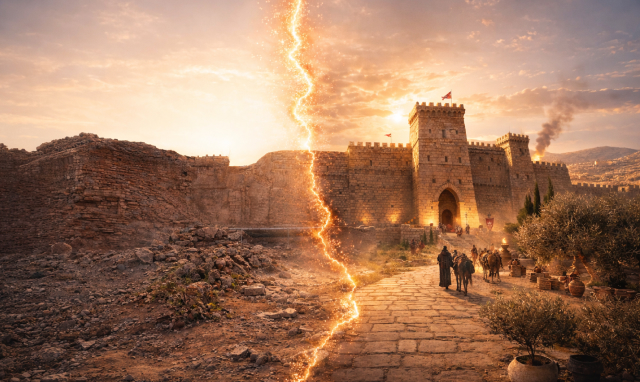
This eye-opening course invites you to witness how archaeological discoveries confirm and clarify a wide variety of famous biblical stories. Journey through the ancient world—from Israel’s entrance into the Promised Land to the early Jewish Jesus movement—as inscriptions, artifacts, and ancient cities bring new dimensions to the biblical stories. Connecting the Bible and archaeology, this course deepens your confidence in Scripture while enriching your understanding of the world in which God’s redemptive story unfolded.
Listen to inspiring student testimonials revealing the life-changing insights and profound growth gained through their biblical studies journey.
"Nothing is perfect in life, but many things are excellent. eTeacher offers much, including growth and understanding not only about the subject material, but different teaching styles ... and different…
"The quality teaching given by Francois has been as asset to learning and comprehension. The clarity of my understanding has been enriched and I am the richer. Having opened up…
"The Biblical Hebrew course is in a league if it's own. My teacher is amazing and very encouraging. It is a delight to return to class week after week and…
"Up to now I have had excellent teachers. My classmates have been very supportive and the atmosphere has been very good. Not always easy but with the right commitment everybody…
"This is an excellent way to extend one's knowledge of the Bible and it puts biblical stories in context helping us not only to imagine where these took place but…
Through ancient stones, inscriptions, and cities, this course uses archaeology to bring the Bible to life and transform how you experience God's Word.
Uncover what ancient artifacts reveal about the biblical world.
Build confidence in Scripture's historical reliability through material evidence.
Explore the cultures and daily life that shaped the biblical narrative.
Reading Scripture in Hebrew transforms your Bible study as ancient words reveal God's deeper message, strengthening your connection to faith's foundational roots.
Get to know our experienced faculty members, specializing in Biblical studies with degrees from prestigious universities worldwide. They will support your learning journey every step of the way.
Chat with our academic advisors to help find the path that best aligns with your goals.
This course is a comprehensive study of Biblical Archaeology that uncovers the material world behind Scripture, from ancient Israel's emergence to the early church. Each lecture focuses on how archaeology illuminates key biblical events, from the Assyrian campaigns and Babylonian conquest to life in ancient Israelite homes and temples. By correlating archaeological evidence with biblical texts, the course will strengthen your understanding of the historical reality of Scripture.
What is archaeology — and why does it involve so much careful destruction? We introduce the archaeological method as practiced in Israel and the Middle East, define what we mean by "biblical," and set up the geographical and chronological framework for the whole course.
We survey the great Canaanite city-states of the Late Bronze and Early Iron Ages — Ugarit, Megiddo, Jerusalem, Shechem — before tracing the collapse of the Bronze Age world and Egypt's retreat from Canaan. We close with the Merneptah Stele: the earliest known mention of Israel outside the Bible.
The era of David and Solomon is one of the most hotly debated periods in the field. We weigh the material evidence — monumental architecture, writing, population data, international contacts — and ask what archaeology can and cannot tell us about the early Israelite kingdom.
We are introduced to the Kurkh Monolith and the reign of Ahab — a king who appears powerfully in the Assyrian record yet is portrayed as a failure in the Bible. We explore what biblical historiography is actually doing when it tells us about Ahab, Jezebel, and the spread of Baalism.
We turn to two remarkable objects: the Mesha Inscription — with its wild discovery story — and the Black Obelisk of Shalmaneser III, which shows an Israelite king bowing before Assyria. Together they help us reconstruct the fall of the House of Omri and the rise of Jehu.
We situate the book of Jonah in its historical context: the court of Jeroboam II and the era of Assyrian weakness. We then take a close look at Nineveh itself — its enormous dimensions, its pantheon of a thousand gods, and what a "three-day walk" might actually have meant.
We trace the sequence of events — Tiglath-Pileser III's Syrian campaigns, the Israelite-Aramean alliance, Ahaz's submission to Assyria, and the eventual fall of the Northern Kingdom — that ended Israel's existence as an independent state.
Sennacherib's siege of Judah is the most thoroughly corroborated event in the Hebrew Bible. We compare the biblical, Assyrian, and archaeological records — including the Siloam Tunnel inscription, the lmlk seal impressions, and the stunning Lachish reliefs — and ask what they agree and disagree on.
We follow Judah's final decades: Josiah's fateful gamble at Megiddo, the rise of Babylon, and the first wave of deportations — documented in the Babylonian Chronicle and the biblical record.
We examine the archaeological evidence for Babylon's final campaigns against Judah: the Arad Ostraca, the Lachish Ostraca, and the destruction layers of Jerusalem itself. What does it look like when a city is destroyed?
We walk through the most characteristic dwelling of ancient Israel room by room — from the courtyard and stables to the storage areas and roof — exploring what domestic objects tell us about everyday life: locks and keys, mills, lamps, and more.
What did ancient Israelites eat? We examine the material remains of an agricultural society — wheat, barley, grapes, figs, olives, dates — alongside animal husbandry and the evidence for daily rations, with reference to Deuteronomy 8.
We move from the home to the city, exploring the two-part tel model: the upper citadel with its palaces, temples, and administrative buildings, and the lower residential quarters, connected by walls, gates, sewage systems, and street networks.
From the Tabernacle to the Solomonic Temple, we examine Israel's sacred spaces through their physical remains — comparing them with contemporary temples at Tel Tayanat and elsewhere — and study the cultic objects found within them.
The archaeological record reveals a religious world far more diverse than the Bible alone suggests. We look at evidence for Yahweh's consort Asherah, pillar figurines, incense altars, and ancestor cults — and ask why Josiah felt the need to reform all of it.
We explore the nomadic and semi-nomadic cultures south of Israel — the Midianites, Old South Arabian kingdoms, and the trade networks that carried spices across the ancient world.
We cross the Jordan to examine the material cultures of Edom, Moab, and Ammon — peoples who appear throughout the biblical text as rivals, relatives, and neighbors.
We look north to the Aramaean tribal states — Bit Guzana, Bit Adini, and the Luwians — examining key sites and the cultural remains of peoples who were both Israel's enemies and trading partners.
The Phoenicians gave the world alphabetic writing and dominated Mediterranean trade. We explore their city-states, their maritime networks, and the deep cultural connections between Phoenicia and Israel.
We take stock of the Neo-Assyrian empire — its history, its magnificent capital cities of Nineveh and Khorsabad, and the traces it left inside Judah itself, from governors' palaces to distinctive art and architecture.
We survey Egyptian history and examine the physical footprint Egypt left in Canaan — from art and burial practices to administrative centers in Abydos, Luxor, and the Nile Delta.
On a Nile island in southern Egypt, a Jewish military colony left behind a remarkable archive of Aramaic letters. We explore the site, its history, and what these documents reveal about Jewish life far from Jerusalem.
We enter the world of Israelites and Judahites exiled to Babylonia — their communities at Gozan and elsewhere, the administrative documents that record their lives, and the beginnings of the Talmud and other foundational religious writings.
Persia's conquest of Babylon changed everything. We examine Persian foreign policy — including the famous Cyrus Cylinder — and trace the physical evidence of the Judahite return: the rebuilding of Jerusalem's walls and the reconstruction of the Temple.
We visit one of the most famous archaeological sites in the world, examining the nature of the Qumran community, its material remains, and the extraordinary biblical and non-biblical texts found in the caves nearby.
We map the political and religious landscape of Roman Palestine — the Pax Romana, Herodian rule, and the remarkable diversity of Jewish groups (Essenes, Pharisees, Sadducees, and others) who populated the world of the Gospels.
We explore first-century Jewish burial customs — wrapping, bench burials, and ossuaries — and examine the proposed locations for Jesus' tomb, weighing the archaeological evidence for Golgotha, the Garden Tomb, and the Church of the Holy Sepulchre.
We begin examining the material remains of the earliest Christian communities.
We continue our exploration of the archaeology of early Christianity.
For those who want to go deeper: we survey the best archaeological encyclopedias, report sites, major academic journals, and key conferences (ASOR, SBL) to help you continue your studies independently.
In addition to the course you will gain access to both our live and recorded webinars discussing fascinating Biblical topics. It’s time to deepen your connection to the bible through Biblical Hebrew.
We teach live classes online: a teacher and a small group of students meet once a week through their home computer. We use video conference technology that allows live student-teacher interaction. You can fully participate in the lesson by using the microphone or the chat box.
Don’t worry! All the live lessons are also recorded and available on-demand. You can review them at any time.
All our teachers have a teaching certificate and are approved by the Hebrew University of Jerusalem. They are all scholars from leading universities around the world, including the Hebrew University of Jerusalem, Harvard and Durham University.
To read our full cancellation policy, click here.
We teach Sunday to Friday according to your local time zone. You are welcome to check the schedule and assign yourself to a time that’s most suitable to you.
All you need is a working computer with an internet connection and you’re set! We work with Windows and Mac operating systems.
The total tuition for the course is $1399.
Yes, you can pay in 5 or 8 monthly installments, depending on the duration of your course.
Fill in your details and we will contact you shortly