

When Did Jesus Enter Jerusalem?
As Passover and Easter are approaching, we once again find ourselves drawn into the events of those momentous days in Jerusalem two thousand years ago. These are days we return to year after year—days so familiar, and yet so deep, that each time we revisit them, new layers are revealed.
Christians around the world know that Palm Sunday marks the beginning of Passion Week. But have you ever asked why Jesus entered Jerusalem on that particular day?
The answer takes us back to the opening verses of Exodus 12.
At the very beginning of this chapter, God commands Israel that the Passover lamb—the lamb that would be slain on the eve of the Exodus—must be set apart four days in advance:
“On the tenth day of this month every man shall take for himself a lamb…
Your lamb shall be without blemish…
and you shall keep it until the fourteenth day of the same month; then the whole assembly… shall kill it at twilight.”
(Exodus 12:3–6)
From this, we learn that on the 10th of Nisan, the Passover lamb was chosen and set apart. Preparation for its sacrifice began on that very day.
This is precisely why Jesus had to enter Jerusalem on the 10th of Nisan.
On that same day—the day when every household in Israel selected a spotless lamb—He, the perfect Lamb, entered the city and was, in a sense, set apart.
According to the Synoptic Gospels, Jesus was arrested on Thursday, the 14th of Nisan, on the eve of Passover. Four days earlier, on Sunday—the 10th of Nisan—He entered Jerusalem and began the final steps toward His sacrifice.
The Gospel narrative is not random. It follows, with striking precision, the pattern established by God at the time of the Exodus.
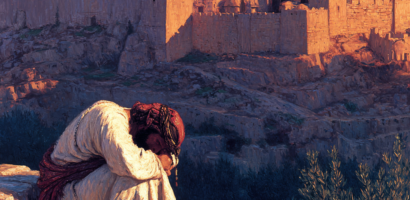
Jesus’ Tears
Yet before this triumphant entry unfolds in full, something deeply moving takes place—something that belongs just as much to His Passion as the events that follow.
In Luke 19, as Jesus approaches Jerusalem, we read:
“He saw the city and wept over it…”
(Luke 19:41)
How many times does Jesus weep in the Gospels?
Only twice.
Once here—over Jerusalem.
And once at the tomb of Lazarus: “Jesus wept” (John 11:35).
This parallel is often overlooked. And yet, it is essential if we want to understand His heart.
There are no coincidences in Scripture.
These two moments are meant to be seen together.
At Lazarus’ tomb, Jesus weeps in the face of death: revealing His humanity before revealing His power.
Over Jerusalem, He weeps in the face of coming destruction: once again, revealing His humanity before revealing His power. largely be rejected.
In both cases, His tears are not weakness. They are revelation. Revelation of God’s plan. Revelation of His heart.
As He approaches the city, He knows what lies ahead—not only for Himself, but for His people. He knows the suffering that will come upon Jerusalem. He knows the judgment that history will bring. And perhaps most painfully, He knows that much of this suffering will unfold in His own name.
And He weeps – not quietly, not inwardly. Openly and publicly.
Even as the crowds are preparing to celebrate Him, He is grieving for them.
This is the paradox of Palm Sunday: joy on the surface, grief underneath.
A Man with a Jar
As Jesus and His disciples draw near to Jerusalem, the city is already overflowing with pilgrims who have come to celebrate Passover. It is one of the three pilgrimage festivals. Every available space is filled. Every guest room is taken.
And yet, Jesus appears completely unconcerned.
He gives His disciples an unusual instruction:
“As you enter the city, a man carrying a jar of water will meet you. Follow him…”
(Luke 22:10)
At first glance, this may seem like a simple logistical detail. But when we look closer, it becomes clear that something deeper is taking place.
How could He know this?
And why identify the man in this particular way?
In that cultural context, carrying water was typically women’s work. A man carrying a water jar would immediately stand out.
It would be a sign.
There was, however, one group in Jewish society where men did carry water jars: the Essenes.
Many of the Essenes lived celibate lives, which meant that their men performed tasks usually done by women. They were known for their distinct practices, their communal life, and their strict observance of purity laws.
They also had a presence not only in Qumran, but in Jerusalem itself. The Jewish historian Josephus even mentions a “Gate of the Essenes” in the city.
Jesus was likely directing His disciples toward this area.
But why would they still have empty rooms?
There is another important detail that helps us understand the story: the Essenes followed a different calendar.
This means that while the rest of Jerusalem was already crowded to capacity for Passover, the Essene quarters may still have had available space.
Once again, we see that nothing in this story is accidental.
Every detail is intentional.
Every step is prepared.
What Did the Crowd Cry?
As Jesus enters Jerusalem, the scene shifts dramatically.
The crowds gather. The excitement builds. And they begin to cry out:
“Hosanna to the Son of David!
Blessed is He who comes in the name of the Lord!
Hosanna in the highest!”
(Matthew 21:9)
These are familiar words.
We sing them. We read them. We celebrate them.
But what did they actually mean in Hebrew?
The word Hosanna comes from the Hebrew phrase הושיעה נא (Hoshia Na), which literally means: “Save, please!” or “Save now!”
These words are drawn directly from Psalm 118:
“O Lord, save now, we pray…”
(Psalm 118:25)
Psalm 118 is part of the Hallel (Psalms 113–118), a collection of praise psalms recited during the great festivals, including Passover.
The Hallel celebrates God’s deliverance. It proclaims His faithfulness. It calls upon Him as the true source of salvation.
It means the people are not just welcoming a king.
They are proclaiming—without fully understanding it—the source of salvation. “Hoshia Na.” Save us now.
But there is something even more striking.
According to Jewish tradition, Psalm 118 was recited during the Passover sacrifice—at the very moment when the lambs were being slaughtered in the Temple.
This means that the very words the crowd is shouting as Jesus enters Jerusalem are the same words spoken during the offering of the Passover lamb.
When we step back and look at the whole picture, the pattern becomes unmistakable.
- On the 10th of Nisan, the lamb is set apart.
- On the 10th of Nisan, Jesus enters Jerusalem and is set apart.
- Before the sacrifice, the lamb is examined.
- Before the sacrifice, Jesus is questioned.
- On the 14th of Nisan, the lamb is sacrificed.
- On the 14th of Nisan, Jesus dies on the cross.
The story of the Exodus was never only about the past. It was always pointing forward.
And in those final days in Jerusalem, what was once hidden becomes visible.
The pattern is fulfilled. The Lamb is revealed.
And the cry of the people—“Hoshia Na”—echoes through the ages, carrying a truth far greater than they could have imagined.
The Gospels make it clear that He did not enter Jerusalem only as a king.
The Gospels make it clear: He entered Jerusalem as the Passover Lamb— and as the true source of salvation.
If you like the insights on this blog, you might enjoy my books, you can find them here: books. As always, I would be happy to provide more information (also, a teacher’s discount for new students) regarding our wonderful courses (juliab@eteachergroup.com)