


A lot of people want to go deeper into Scripture but aren’t sure where to start. Bible schools seem like the obvious answer, but the moment you look into them, things get confusing. How much do they cost? Do they actually teach you to read Hebrew and Greek? And are online courses a real alternative or a watered-down version?
In this post, we’ll break down what Bible schools are, what they teach, how much programs cost, and how traditional schools compare to online learning. Whether it’s personal growth or a career in ministry, this guide will help you figure out the right path.
TLDR:
Bible schools are institutions dedicated to studying Scripture, theology, and ministry, offering programs that range from short certificates to full degrees.
Traditional campus programs provide an immersive learning community, with costs and academic focus varying by institution.
Online courses offer a flexible alternative, connecting students with experienced instructors from around the world.
For those looking to explore the Bible in its original languages, many online programs provide direct access to biblical languages and historical context without the need to relocate.
What Is A Bible School?
A Bible school is an educational institution focused on studying the Bible and theology, preparing students for ministry, leadership roles, or personal spiritual growth. They generally fall into three categories:
- Bible colleges: Offer accredited degree programs (like associate or bachelor’s degrees) combining biblical studies with general education.
- Bible institutes: Provide shorter, non-degree or certificate programs centered directly on Scripture for personal enrichment or practical training.
For official recognition, some partner with universities. For instance, the Israel Institute of Biblical Studies offers courses accredited by the Hebrew University of Jerusalem, allowing students to earn transferable academic credits.
- Discipleship schools: Focus on immersive, community-focused environments emphasizing personal spiritual formation and daily application.
What Do Bible Schools Teach?
Traditional Bible schools focus heavily on Scripture, theology, and practical ministry skills. Students learn to analyze the Old and New Testaments, studying historical contexts and interpretive methods.
However, many believers realize that translation can sometimes veil the vibrant reality of the text. When you study the Bible in its original language, words you thought you knew take on a whole new dimension of “wholeness.”
Take the word Shalom (שָׁלוֹם). We usually translate it as “peace,” meaning the absence of conflict. But in Hebrew, the root of Shalom (ש-ל-ם) means “to be whole” or “complete.” When the Bible speaks of peace, it isn’t just a quiet moment; but a prayer for total well-being, where nothing is missing and nothing is broken.
Connecting The Ancient Word To Modern Life
For centuries, ancient scripts were treated like artifacts locked behind academic glass. But language is meant to live. One of the greatest miracles of our time is the historic resurrection of Hebrew, breathing life into an ancient tongue so that it serves as a living bridge between the world of the patriarchs and modern Israel. This language came back to life, and it belongs to those who love the Word.
When you study Scripture through this lens, the text opens up in unexpected ways:
In Genesis, we meet the first man, Adam (אָדָם). If you read the Hebrew, you see he isn’t just given a random name. He is named after the very ground he was formed from, the Adamah (אֲדָמָה). This linguistic bond reminds us that we are inextricably linked to the earth and our Creator’s handiwork.
Despite these rich horizons, Bible schools vary in their academic focus and available resources. For instance, non-accredited schools often face limitations with transferable credits and institutional resources. Accredited Bible colleges typically combine biblical studies with theology, ministry, and pastoral training, which may have less room for an intensive focus on the Bible’s original languages. Discipleship programs also vary in curriculum and academic depth, depending on the institution.

Bible School Programs And What They Cost
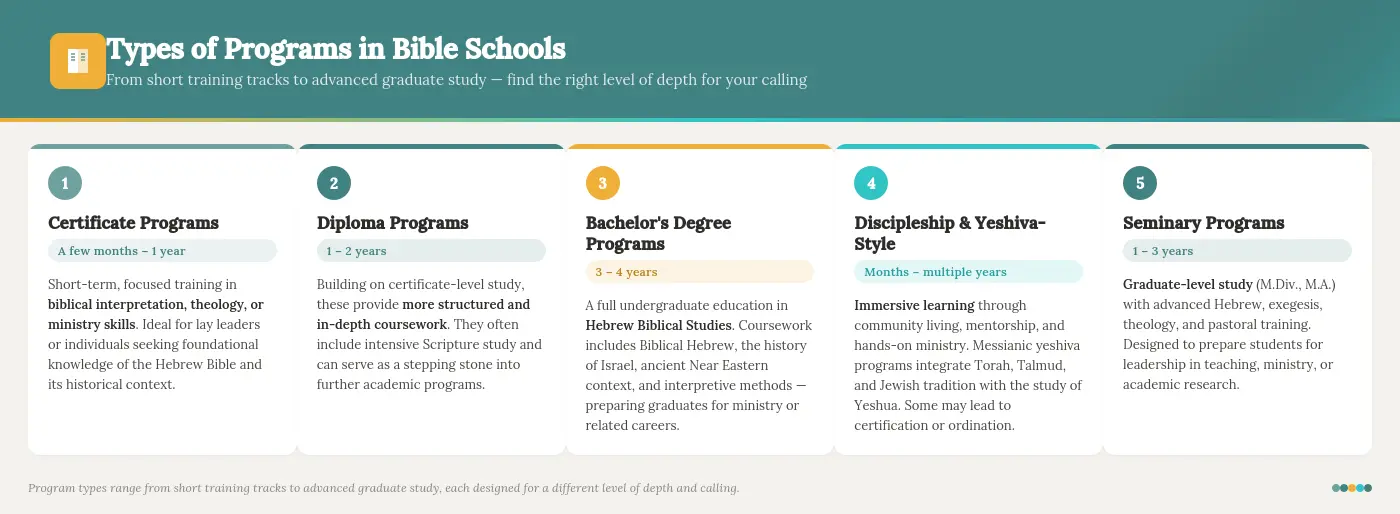
Bible schools offer programs for different stages of life and levels of commitment.
Certificate programs (1 to 12 months):
These provide a practical introduction to Scripture, theology, and ministry. They’re ideal for people who want to strengthen their Bible study without committing to a degree program.
Diploma programs (1 to 2 years):
Diploma programs offer a more structured learning experience and allow students to explore biblical studies in greater depth. They often include intensive Scripture study and can function as a stepping stone for those who want more than an introductory overview.
Bachelor’s degree programs (3 to 4 years):
These programs combine biblical studies with broader academic subjects. Students may study theology, church history, biblical interpretation, and even original languages like Hebrew and Greek. They prepare graduates for ministry, education, counseling, or further academic study.
Discipleship and yeshiva-style programs (Varies):
These immersive programs place a strong emphasis on spiritual formation, mentorship, and community life. Learning goes beyond the classroom and becomes part of daily living. They also encourage students to engage with Jewish tradition and Scripture through a rich cultural and historical lens.
Seminary programs (1 to 3 years):
Seminary programs provide graduate-level education for students pursuing leadership, teaching, pastoral ministry, or advanced biblical studies. Degrees like the Master of Divinity or Master of Arts often include theology, exegesis, and deeper engagement with Scripture in its original languages.
Counting The Cost
Financial investment depends on the format and location you choose:
- Online individual courses: Industry averages often range from $200 to $500 per course. Some institutions offer monthly installment plans, and specialized programs may cost significantly more.
- Certificate programs: Generally cost between $600 and $3,000.
- Formal degree programs: Tuition at physical universities or seminaries ranges from $5,000 to over $15,000 per year.
- Total on-campus expenses: When housing, books, and living expenses are factored in, the total annual cost can range from around $20,000 to more than $30,000, depending on the institution.
Traditional Bible Schools vs Online Courses
Choosing the right path comes down to understanding how the learning environment impacts your daily life and your relationship with the Word. In a digital classroom, “listening” takes on a deeper meaning.
In many Bible programs, you will study the Shema (שְׁמַע), the famous call to “Hear, O Israel.” In English, “hearing” is just a sound hitting your ears. In Hebrew, Shema means to hear, to take heed, and to respond with action. In Biblical Hebrew, the verb shama (“to hear”) often includes the idea of hearing that results in obedient action.
The Modern Online Learning Experience
Online courses emphasize flexibility through asynchronous learning, removing geographic barriers entirely. Busy professionals can access high-quality lectures from international scholars often at their own pace.
Financially, online programs eliminate housing and transportation fees, making deep scriptural study highly accessible. While online learning requires more self-direction, it transforms your study into a personal sanctuary of discovery, right where you are.
A New Way To Experience Scripture
If you are looking for an educational experience that goes beyond dry, grammar-heavy instruction, the Israel Institute of Biblical Studies (IIBS) offers a unique path. Instead of looking at the Bible as a cold text to analyze, IIBS invites you into a guided discovery led by experienced instructors.
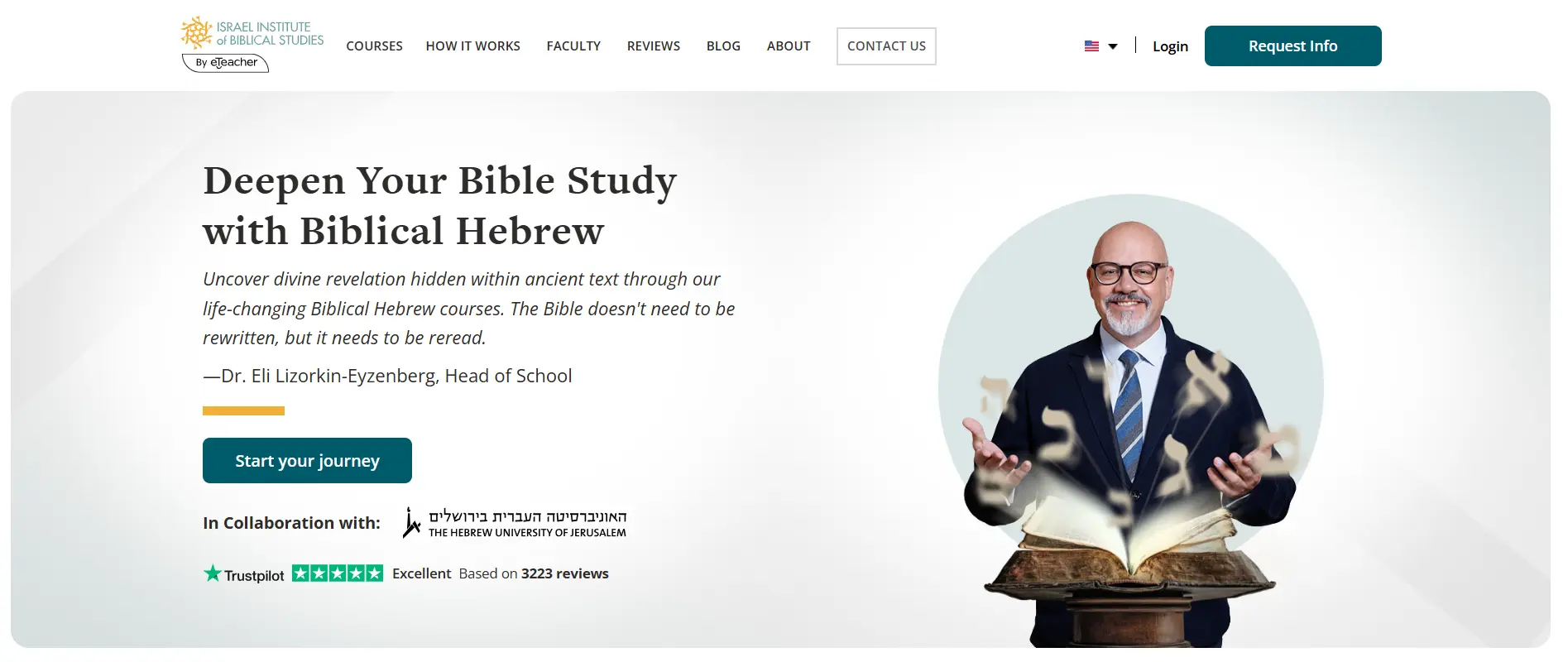
As the renowned scholar Dr. Eliyahu Lizorkin points out:
“The Bible does not need to be rewritten — it needs to be re-read.”
Through live, interactive online classes, you don’t just memorize terms; you explore the text from a cultural and historical perspective.
Take, for example, the word for “spirit” or “wind,” Ruach (רוּחַ). Pronouncing it requires a physical exhale, linking us directly to Genesis where God breathed life into humanity. It shows that the Spirit isn’t an abstract concept, but something as close as the breath in your lungs.
The programs are beautifully structured to build your confidence step by step:
- Biblical Hebrew: This course gently guides you from the very first letters of the alphabet straight into reading your favorite verses in their original form. It’s a rewarding 5-level journey that moves at your pace, one comfortable hour a week.
- Biblical Greek: A beautiful pathway through the New Testament that uncovers the deep, hidden connections between the Greek text and its ancient Hebrew roots.
- Biblical Aramaic: A focused journey dedicated to unlocking the vibrant, original context behind the prophetic pages of Daniel and Ezra.
- Modern Hebrew: A warm, conversational track that connects your heart directly to the living voice of Israel today, building your confidence to speak and read the language of the resurrection.
Are You Ready To Start Reading Scripture In Its Original Language?
Start with an online Biblical Hebrew course. The Israel Institute of Biblical Studies offers live, accredited classes taught by experienced biblical language instructors.
Conclusion
Bible schools offer a meaningful path for anyone wanting to move beyond surface-level reading. From full degree programs to focused certificates and discipleship experiences, each meets learners where they are. The key is knowing what you want and choosing accordingly.
Traditional programs bring structure and community but come with higher costs and rigid schedules. Online courses have made quality biblical education more accessible than ever, with accredited programs, original language instruction, and flexible schedules. Whatever format fits your life, the best time to start is now.
FAQ
Is Bible school the same as seminary?
No. Bible school is a broad term that includes Bible colleges, institutes, and discipleship programs. Seminary refers specifically to graduate-level study, such as a Master of Divinity or Master of Arts degree.
Do I need to attend Bible school to work in ministry?
Not always. Many ministry roles don’t require formal education. However, studying Scripture and biblical languages can strengthen your understanding and teaching.
Can I study Biblical Hebrew online?
Yes. Many institutions offer online courses. The Israel Institute of Biblical Studies provides live classes accredited by the Hebrew University of Jerusalem and designed for students at every level.
How long does it take to learn Biblical Hebrew?
That depends on the amount of time you invest and the program you choose. Most students can begin reading simple biblical passages within their first year of structured study.
Are online Bible courses as good as in-person programs?
High-quality online programs can provide an experience comparable to traditional classrooms. They offer flexibility, live interaction, and access to scholars from around the world.
What’s the difference between a Bible college and a Bible institute?
Bible colleges usually offer degree programs that combine biblical studies with broader academics. Bible institutes focus on shorter, non-degree programs centered on Scripture and ministry training.
How much does Bible school cost?
Costs vary widely. Online courses often cost $200 to $500 per course, while degree programs typically range from $5,000 to over $15,000 per year. For on-campus students, housing and other expenses can bring total annual costs to $20,000 to more than $30,000.