


Imagine reading the Psalms and encountering the cadence, poetry, and literary artistry of their original Hebrew. Learning Biblical Hebrew isn’t an exclusive club for elite academics; it’s an accessible invitation for every Bible enthusiast and curious soul to deepen their understanding of Scripture.
While Biblical Hebrew is an ancient literary language instead of the living spoken tongue of modern Israel, its patterns, words, and poetry remain dynamic and deeply moving for anyone willing to study them. Learning the original language reduces your dependence on translations and allows you to engage with the text directly.
This blog post will explore the hidden limits of translation, why self-study attempts often stall, and the essential pillars to look for when choosing the right online program to guide your spiritual journey.
TLDR:
Reading Scripture entirely through English translations can flatten vibrant cultural and linguistic nuances trapped beneath the ancient surface.
“Going it alone” with apps or isolated videos feels manageable for a few weeks until complex roots, verbs, and unanswered questions wear you down.
Before you enroll, look at four things: live interactive sessions, recorded lesson flexibility, scholar-led teaching, and whether university accreditation aligns with your personal goals.
Setting a clear reading milestone like reading Genesis 1 in the original Hebrew is much closer than you think.
The Hidden Barrier Between You And Your Bible
Most Christian readers rely entirely on English translations due to accessibility, yet this reliance creates an unintended barrier to the vibrant cultural nuances trapped beneath the surface. Everyday readers remain largely unaware of how much nuance gets lost when multi-layered ancient terms are translated into single English words.
Take the Hebrew word Hesed (חֶסֶד) as a prime example. Standard translations might render it as “steadfast love,” “loving-kindness,” or “mercy”. However, no single English word can truly capture its profound biblical meaning: an active, loyal, and unconditional love rooted deeply in a committed covenant relationship.
Because Classical Hebrew belongs to an entirely different language family than English, traditional instructional materials can appear intimidating. Bible enthusiasts frequently pull back from learning because standard textbooks appear dry, grammar-heavy, and overwhelmingly complex, leaving them unsure of where to begin.
Why “Going It Alone” Usually Ends In Frustration
Trying to learn Biblical Hebrew independently can seem manageable and even achievable at first. Learning the alphabet and memorizing basic vocabulary might feel deceptively straightforward during the first week or two.
As learners progress, however, the real structural challenges begin to surface. Self-studying stalls when tackling the language’s unique root system, complex verb conjugations, and weak verb forms.
Piecing together random YouTube videos or free vocabulary apps provides a temporary burst of momentum, but the absence of a cohesive course structure eventually leaves learners confused. Watching pre-recorded lectures uploaded online offers no way to get personal questions answered or receive corrections on pronunciation, turning the educational experience into a lonely endeavor.
For older adult learners, busy professionals, and dedicated Bible enthusiasts, this isolation breeds immense frustration. Wasting limited time on trial-and-error routines or staring at vocabulary flashcards fails to deliver the ultimate reward: actually reading and experiencing the biblical text.
What To Look For Before You Enroll
Stepping into biblical languages should be an inspiring journey, not a chore. Look for courses designed to deepen your spirituality, enlighten your understanding, and reveal the hidden depths of the text.
To find a program that balances academic depth with an encouraging environment, ensure it satisfies the following core criteria.
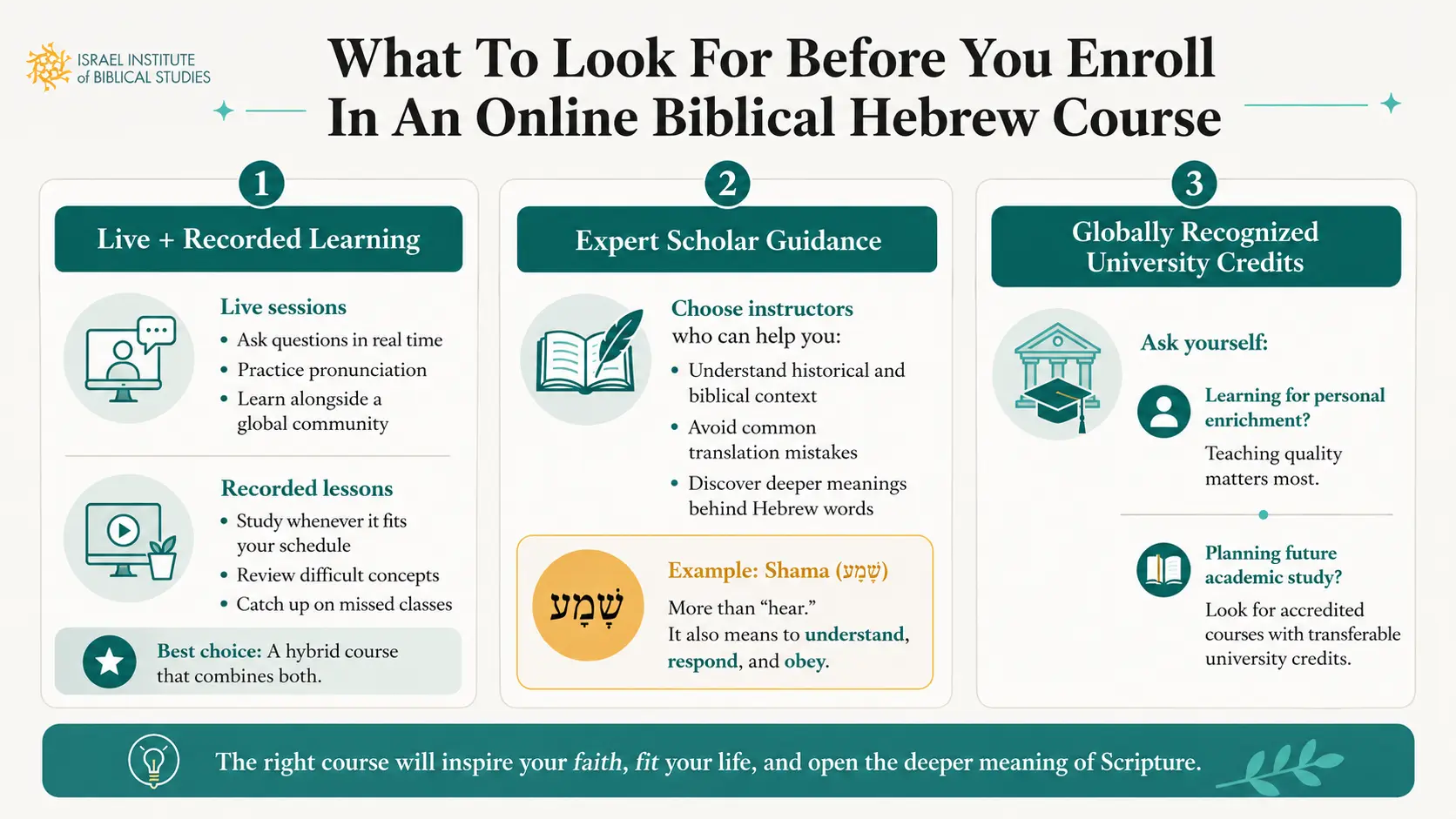
Live Interaction vs. Recorded Learning
Real-time live sessions provide immediate guidance, instant answers to questions, and vital pronunciation practice alongside a global community of learners, preventing bad reading habits early on.
On the other hand, on-demand recorded lessons grant the flexibility to review complex grammar rules, study on your own schedule, catch up on missed sessions, and revisit challenging material as often as needed.
Blending these two formats into a hybrid course structure hits the absolute sweet spot for adult education. It perfectly balances human accountability with personal scheduling flexibility.
Expert Scholar Guidance
Relying solely on software or basic grammar books can’t replace the value of learning from educators who understand both the academic nuances and the historical background of the text. Seeking scholarly guidance is highly recommended because Biblical Hebrew is an ancient, complex language; attempting to learn it completely alone often leads to deep confusion and poor translation habits.
Expert instructors provide personalized guidance, explain the vital historical context, and reveal breathtaking linguistic connections. For instance, a scholar can unpack the profound word Shama (שָׁמַע), which standard versions often translate simply as “hear” or “listen”. However, in biblical thought, Shama signifies far more than passive auditory reception. It carries the integrated meaning of hearing with understanding, attention, and responding through obedience.
Clear Accreditation Standards
University accreditation may not be the main driver for every student, especially lifelong learners studying for personal growth, home Bible study, or spiritual enrichment. If you are not actively pursuing a degree, transferable credits hold little practical value, and teaching quality, curriculum, and community matter far more.
The situation changes if you plan to pursue a formal academic degree. In that case, accreditation becomes highly important. Students needing recognized academic credits for future programs or ministry requirements should look for courses affiliated with accredited institutions, such as programs offering optional academic credit in collaboration with recognized universities.
A Guided Path Tailored For You
The Israel Institute of Biblical Studies (IIBS) serves as an excellent example of a program that meets every standard on the preparation checklist. Instead of using a cold, technical seminary tone, IIBS implements an “edutainment” model. This means lessons are deeply educational but highly inspiring, focusing on the real geography, history, and context of the Holy Land.
Here are a few examples of how this approach is put into practice:
- Step-by-step pathways designed to have you reading phrases almost immediately.
- Weekly live interactive classes led by experienced instructors, forming a vibrant global community.
- Multi-level courses (Levels 1-5) designed to support steady, confidence-building progress.
- Optional transferable university credits in collaboration with the Hebrew University of Jerusalem.
The program is beautifully structured to build confidence step-by-step, allowing beginners to bypass the dry, academic hazing of traditional environments and start reading simple biblical phrases surprisingly quickly.
Choosing Your Milestone
Developing reading comprehension in an ancient language takes time and consistent practice. Setting realistic expectations means recognizing that fluency isn’t built overnight, but meaningful progress is entirely possible within a few months of dedicated study.
A high-quality course keeps you motivated by guiding you toward concrete reading milestones. For example, after establishing your foundation in basic grammar and vocabulary, you can approach a text like Genesis 1:20 in its original form:
וַיֹּאמֶר אֱלֹהִים יִשְׁרְצְוּ הַמַּיִם שֶׁרֶץ נֶפֶשׁ חַיֶה וְעוֹף יְעוֹפֵף עַל־הָאָרֶץ עַל־פְּנֵי רְקִיעַ הַשָּׁמָיִם
And God said, “Let the water teem with living creatures, and let birds fly above the earth across the vault of the sky.”
In this verse, encountering the word Nefesh (נֶפֶש) provides a fascinating study window. While frequently rendered in older English versions as “soul,” Nefesh fundamentally refers to a “living creature” or “living being.”
In Genesis 1:20, it applies equally to all creatures that breathe and possess conscious physical life, linking animals and humans together as breathing expressions of God’s design. Focusing on these tangible, text-based milestones transforms your study from a grammatical puzzle into a deeply rewarding journey.
Are You Ready To Read Your First Verse In Hebrew?
Start a Biblical Hebrew online course with a clear reading milestone and open your Bible to Genesis 1 in the language it was written in. Our teachers will walk with you the whole way.
Conclusion
Every translation of the Bible is, by necessity, an interpretation that simplifies multi-layered ancient terms like hesed, shama, and nefesh. Moving past these surface-level filters requires an educational path that brings the language to life instead of burying it under dry grammar drills.
The ideal learning experience successfully marries human accountability with structural flexibility. By prioritizing live interaction, expert scholarly guidance, and inspiring milestone-driven goals, you can protect yourself from the burnout and isolation of self-study. Unlocking the Hebrew alphabet is not an obstacle; it’s the doorway to encountering familiar scriptures with fresh eyes.
The Bible doesn’t need to be rewritten; it simply needs to be re-read. Finding a supportive community led by caring instructors ensures that you are guided every step of the way, turning an ancient script into a deeply personal sanctuary of discovery.
FAQ:
How long before I can read the Hebrew Bible?
Recognizing letters and simple words takes a few weeks. Reading a short verse like Genesis 1:20 with understanding usually takes a few months of steady study. Deeper fluency builds over years, and every stage brings its own rewards.
Do I need any background in languages?
No, our beginner course, Biblical Hebrew A, starts with the alphabet and vowel markings and assumes you’re beginning from zero.
What if I miss a live class?
Every session is recorded and available in your student portal, so you can catch up whenever your schedule allows.
Is accreditation worth paying attention to?
Only if you plan to apply the coursework toward a degree or ministry requirement. For personal enrichment, teaching quality, curriculum, and community matter far more.