


There is a moment every Hebrew student remembers. You open the text, your eyes land on a line, and the words simply speak. No decoding, no flipping to the glossary. The verse just arrives.
Most learners assume the moment comes after thousands of memorized words. In our experience, it doesn’t. It arrives when you stop collecting words and start seeing how Hebrew actually builds them.
Below, we’ll look at why the flashcard treadmill leaves so many students exhausted, how the Hebrew root system turns memorization into recognition, why dictionary definitions quietly flatten Scripture, and which words deserve your attention first.
TLDR:
Memorizing endless vocabulary lists often leads learners to hit a “vocabulary wall.” Overcoming this barrier becomes much easier when you leverage the underlying design of the Hebrew language. Many Biblical Hebrew verbs and nouns are organized around consonantal roots (most commonly three consonants).
Learning a core root can make related words far easier to recognize in context. By prioritizing high-frequency words within their original scriptural setting, readers gain the tools to engage with the Bible deeply and naturally.
The Frustration Of The Flashcard Treadmill
Standard language-learning techniques frequently push students straight toward endless flashcard decks. Memorizing thousands of isolated words as standalone blocks quickly creates an overwhelming mental barrier. Learners hit a “vocabulary wall,” feeling as though real reading fluency remains forever out of reach.
Unlocking the language requires stepping off that exhausting treadmill and leaning into the structure of Biblical Hebrew: the Hebrew Root System (Shoresh). Biblical Hebrew operates like a majestic tree branching out from simple seeds. Many Biblical Hebrew verbs and nouns are organized around consonantal roots, most commonly consisting of three consonants.
Learning a root can make related words far easier to recognize in context:
- The root: ש-פ-ט (Sh-F-T)
- Shofet (שׁוֹפֵט): A deliverer or judge, like Gideon.
- Mishpat (מִשְׁפָּט): Restorative justice and treating people righteously.
- Shefet (שֶׁפֶט): Acts of divine deliverance.
While root recognition isn’t a substitute for full vocabulary study, since students must also understand grammatical patterns, prefixes, suffixes, and contextual usage, it transforms confusion into logical, encouraging progress.
Why Isolated Definitions Leave You Empty-Handed
Relying only on dictionaries or isolated flashcards falls short because standard definitions rarely reveal the underlying root patterns and word relationships.
Looking up a word in a standard dictionary usually provides a single English equivalent. While helpful as a starting point, it rarely conveys the historical, cultural, and theological richness carried by the original Hebrew. A literal translation captures the basic meaning but often misses the fuller picture.
Take the Hebrew word Chesed (חֶסֶד), for example. English Bibles often translate Chesed as “mercy,” “kindness,” or “steadfast love.” While these translations are accurate, none fully captures the depth of the original. Depending on the context, Chesed conveys God’s faithful covenant love, steadfast loyalty, and enduring commitment to His people. Encountering Chesed in Scripture reveals not merely an emotion, but a relationship grounded in God’s unwavering faithfulness.
Unlike static English definitions, Biblical Hebrew vocabulary is deeply connected to physical imagery, root patterns, and cultural context. Exploring these underlying connections uncovers rich themes that echo throughout Scripture:
| Hebrew Concept | Root/ Etymology Connection | Revealed Depth |
| Shalom (שָׁלוֹם) | Root ש-ל-ם (Sh-L-M, “to be complete/whole”) | Not merely quietness, but total well-being and wholeness where nothing is broken. |
| Ruach (רוּחַ) | Onomatopoeic connection to physical breathing | Represents spirit, wind, and breath, as close as the air in human lungs. |
| Rachamim (רַחֲמִים) | Shares the root with rechem (רֶחֶם, “womb”) | Ties divine compassion directly to a mother’s tender care. |
Learn The Right Words, Not More Words
Efficiency in Biblical Hebrew comes down to strategy, not sheer volume. Because core words repeat constantly throughout Scripture, the law of diminishing returns heavily impacts vocabulary study. Once a student learns the most common words, the remaining majority of the text consists of rare terms appearing only a few times.
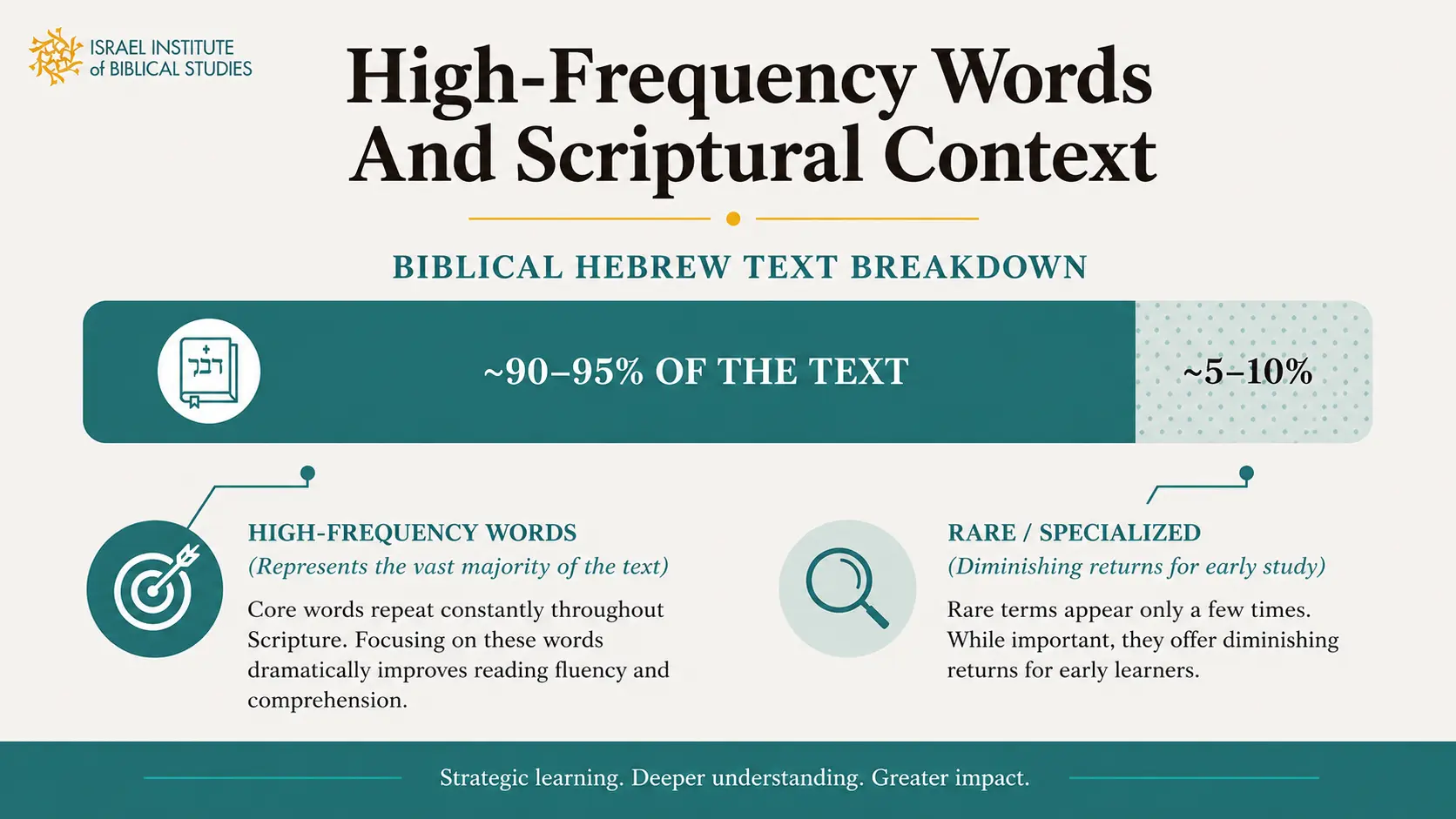
Focusing on a highly targeted list of high-frequency words dramatically improves reading fluency without causing academic burnout. Consider the word Davar (דָּבָר). Occurring over 1,400 times in the Hebrew Bible, Davar translates as “word,” “speech,” or “thing.” Derived from the root ד-ב-ר (D-B-R, “to speak”), it highlights how in the Hebrew mind, a spoken word is closely bound to action, concrete reality, and fulfillment of intent.
Prioritizing these core, high-frequency words inside their actual scriptural context unlocks immediate comprehension across huge portions of the Bible.
Bringing The Language To Life
Moving beyond self-study apps, flashcards, and dictionaries into an interactive, beginner-friendly learning environment helps bridge the gap between frustration and confident reading. Through structured instruction, students naturally learn to recognize recurring root patterns (shorashim) while reading passages aloud, making Biblical Hebrew progressively easier to understand.
The Israel Institute of Biblical Studies (IIBS) provides learning pathways tailored for spiritually curious readers. Instead of bogging students down with cold academic jargon, IIBS courses ground every lesson in the geography, history, and faith of Israel, providing premium Biblical Hebrew vocabulary resources that inspire genuine discovery.
For instance, our foundational course, Biblical Hebrew A, is designed as true first steps. You begin with the alphabet and move toward reading real passages, learning words inside the stories that gave them weight. Live weekly classes, small groups, and recorded lessons keep the journey personal for students.
As Dr. Eliyahu (Eli) Lizorkin often reminds our students: “The Bible doesn’t need to be rewritten. It needs to be re-read.”
Vocabulary is where re-reading begins. Word families become visible, and verses you’ve known your whole life start showing you their original texture.
Are You Ready To Meet These Words Where They Live?
Vocabulary sticks best inside a structured reading plan. Join our live, guided courses today to experience rapid reading progress and uncover deeper scriptural truths.
Conclusion
Learning Biblical Hebrew vocabulary doesn’t require memorizing thick dictionaries or learning complex academic jargon. Focusing on high-frequency vocabulary and consonantal root patterns allows learners to recognize word families through logical, interconnected patterns. This natural approach transforms intimidating ancient script into an approachable, deeply rewarding discovery.
Direct engagement with high-frequency words in their original context reveals rich layers of meaning that translation simply flattens. Words like Chesed, Shalom, and Davar stop being flat English equivalents and begin breathing with covenantal loyalty, wholeness, and active power. The text ceases to be a cold object of analysis and becomes a living bridge to the ancient world.
Taking guided, structured steps alongside supportive instructors opens up the full beauty of the original language. Every learned root brings the reader one step closer to encountering Scripture in its rich, original ancient context.
FAQ:
How many words do I need to know to start reading Biblical Hebrew?
Learning a targeted list of roughly 300 to 500 high-frequency words allows readers to recognize a massive percentage of the Hebrew Bible, as Biblical Hebrew relies heavily on repeating core terms and roots.
What is a Shoresh and why is it important?
A Shoresh is a consonantal root, most commonly three consonants, from which many Hebrew nouns, verbs, and adjectives are formed. Understanding root patterns enables learners to deduce potential meanings and recognize related words far more easily.
Why are flashcards often ineffective for learning Biblical Hebrew?
Flashcards typically provide static, one-to-one English translations that miss the cultural, historical, and physical nuances embedded in the original Hebrew. Studying vocabulary inside actual scriptural context yields vastly superior retention and depth.
Do I need to know Modern Hebrew before learning Biblical Hebrew?
No prior knowledge of Modern Hebrew is necessary. Beginner-friendly courses start from the foundational alphabet and vowel markings, guiding students directly into reading ancient biblical narratives.