

There are passages in Scripture that we know so well that sometimes we no longer notice how astonishing they really are. For me, Abraham’s conversation with God before the destruction of Sodom is certainly one of them.
We remember the famous numbers—fifty, forty-five, forty, thirty, twenty, ten—and we remember Abraham’s question, “Shall not the Judge of all the earth do right?” Yet perhaps we have become so accustomed to this conversation that we no longer hear how daring Abraham’s words actually are.
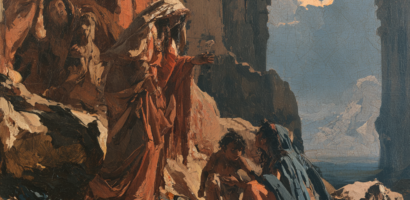
The story begins when the mysterious visitors who have just announced the impossible birth of Isaac rise from Abraham’s table and turn toward Sodom. The atmosphere of Genesis 18 changes completely. Sarah’s hidden laughter and the promise of new life give way to the announcement of judgment, and Abraham suddenly finds himself standing before the Lord and pleading for a city whose wickedness he certainly does not deny.
Then Abraham says:
“Far be it from You to do such a thing, to slay the righteous with the wicked, so that the righteous should be as the wicked; far be it from You! Shall not the Judge of all the earth do right?”
—Genesis 18:25
There is something breathtaking about these words. Abraham is not questioning whether God is righteous; on the contrary, he believes so deeply in God’s righteousness that he dares to make that very righteousness the foundation of his argument.
The Hebrew expression that Abraham uses twice in this verse is חָלִילָה לְּךָ — chalilah lecha, usually translated as “far be it from You.” Yet the emotional force of the Hebrew is much stronger and sounds almost like, “God forbid! This cannot be!”
Abraham is saying, in effect: This would be completely out of character for You.
He is not arguing against God’s righteousness, but from God’s righteousness. He takes what he has learned about God and brings it back before Him in prayer: You are the Judge of all the earth, and precisely because You are the Judge of all the earth, I know that You must act justly.
I find this very significant. Sometimes we imagine faith as the opposite of questioning, as though trusting God means that we should simply accept everything silently. Yet Abraham’s faith produces exactly the opposite response. Because he trusts God’s character, he dares to question what seems inconsistent with that character.
And God allows him to do it.
Then begins the famous descent in numbers. What if there are fifty righteous people in the city? Will God spare it for their sake? Yes. But what if five are missing from the fifty? What about forty? Thirty? Twenty?
Finally Abraham reaches ten.
There is something almost uncomfortable about reading this dialogue. Again and again Abraham asks for more, and every time God answers him patiently. Abraham himself seems aware of how audacious he is becoming: “Let not the Lord be angry, and I will speak.” Yet he continues.
What is especially striking is the nature of Abraham’s request. He is not merely asking God to remove the righteous people from Sodom before destroying everyone else. His request is much bolder: he is asking whether God will spare the entire city for the sake of the righteous people who live there.
In other words, the presence of a righteous minority becomes a reason for mercy toward the whole community.
The dialogue finally stops at ten. The number ten would later acquire great importance in Jewish communal life, most obviously in the minyan, the quorum required for public prayer. But within Abraham’s conversation itself, the movement toward ten already makes a powerful point: Abraham keeps searching for the smallest possible community of righteous people whose presence might preserve the many.
And perhaps the most extraordinary detail in Abraham’s prayer is the one we can easily overlook.
Lot is in Sodom.
Abraham knows this, of course. Lot had travelled with him from the beginning. Their lives had been intertwined for years, and when Lot was taken captive in Genesis 14, Abraham had gathered his men and gone to war to rescue him.
Abraham clearly loves Lot.
Yet now, when Abraham learns that Sodom is facing destruction, he never says, “Please save Lot.”
This is remarkable.
It would have been completely natural for Abraham to ask for a private exemption for the person he loves: Whatever happens to the city, Lord, please protect my nephew. But he does not do this.
He asks for the city.
His concern becomes larger than his own family. The man who once risked his life to rescue Lot now pleads not only for Lot, but for people whose names he does not know and whose lives he certainly cannot defend.
Perhaps this is one of the first great biblical pictures of intercession. Abraham stands before God not merely asking for something he himself needs, and not even merely asking for someone he loves. He places himself between judgment and an entire city.
This is also one of the striking differences between Abraham and Noah.
Noah is told that judgment is coming upon his generation, and he builds the ark through which his household will be saved. Abraham hears that judgment is coming upon Sodom, and his immediate response is to plead for others.
Jewish interpretation has often noticed this contrast. Noah is described as righteous, but Abraham becomes the one who argues for his generation. He cannot prevent the judgment by his own righteousness, and he certainly does not pretend that Sodom is innocent. Yet once God allows him to know what is about to happen, Abraham cannot simply turn away.
He has to speak.
And this makes Abraham’s next words even more extraordinary:
“Indeed now, I who am but dust and ashes have taken it upon myself to speak to the Lord.”
—Genesis 18:27
The Hebrew expression is עָפָר וָאֵפֶר — afar va’efer — “dust and ashes.”
The word afar, “dust,” takes us immediately back to the creation of Adam, when God formed the human being from עָפָר מִן־הָאֲדָמָה — afar min ha’adamah, “the dust of the ground.”
Abraham knows exactly who he is.
He is dust standing before the Creator.
He is a mortal human being speaking to the Judge of all the earth. There is no arrogance in his argument and no illusion that he and God are equals in this conversation. In fact, the more boldly Abraham speaks, the more aware he seems to become of the enormous distance between himself and the One to whom he is speaking.
And yet this awareness does not silence him.
This, for me, is one of the deepest lessons of the entire passage: humility before God does not necessarily mean silence.
We sometimes confuse humility with passivity. We think dustthat a humble believer should never question, never protest, never say, “But Lord, how can this be?” Yet Abraham shows us a very different kind of humility. He knows that he is dust and ashes, but he still speaks. He knows that God is the Judge of all the earth, but he still asks.
In fact, these two things seem to belong together.
Abraham can speak so boldly precisely because he knows who God is, and he can remain humble precisely because he knows who he is.
There is no contradiction between the two.
“Dust and ashes” can say, chalilah lecha -Far be it from You.
A human being can stand before the Creator and say, in effect: I know You. I know what You are like. And therefore I cannot understand how this can be consistent with who You are.
And perhaps the most remarkable part is that God does not rebuke him. God stays in the conversation.
Fifty.
Forty-five.
Forty.
Thirty.
Twenty.
Ten.
At every stage Abraham pushes the question further, and at every stage God answers him. The conversation ends not because God silences Abraham, but because Abraham stops asking.
Of course, we know what happens next. Sodom will not be spared. Abraham’s intercession will not produce the answer he seems to be seeking, because even ten righteous people will not be found there.
But that does not mean his prayer was meaningless.
And this is precisely where the story becomes even more mysterious.
Abraham does not ask specifically for Lot. He asks for Sodom. Sodom will be destroyed—and yet Lot will be rescued.
Genesis 19 will tell us something Abraham himself cannot yet know: “God remembered Abraham, and sent Lot out of the midst of the overthrow.”
So Abraham’s prayer will not be answered in the form in which he asks it, and yet neither will it be forgotten.
But that belongs to the next part of the story.
For now, Genesis 18 leaves us with Abraham standing before God: bold and humble at the same time, pleading for people who have no idea that someone is pleading for them.
Perhaps that is the image I want to keep from this chapter.
A man who knows that he is dust and ashes, yet refuses to let his smallness become an excuse for silence.
A man who believes so deeply in God’s righteousness that he dares to question God about righteousness.
A man whose faith does not eliminate difficult questions, but gives him the courage to bring those questions directly into the presence of God.
And a God who lets him speak.
Perhaps true humility is not saying, I am dust and ashes, therefore my questions do not matter.
Perhaps it is saying:
I am dust and ashes—and still, I will stand before You and ask.