


Choosing your first Biblical Hebrew book can feel overwhelming. Some promise a complete introduction, while others focus on grammar, vocabulary, or biblical interpretation.
The best choice isn’t always the most popular one. It’s the one that matches your personal goal, whether that’s reading Scripture in its original language, building a strong foundation, or uncovering deeper biblical insights.
TLDR:
Popular books aren’t always the right fit; the right book matches your learning goal. Some books introduce the alphabet, others build grammar, and others unlock Scripture’s historical and cultural world.
Well-chosen resources plus guided instruction create the strongest path to reading the Hebrew Bible with confidence.
Start With Your Learning Goal
Every Biblical Hebrew textbook serves a different purpose. Some help beginners recognize letters, read simple words, and connect directly with Scripture. Others prepare students for deep grammatical analysis.
Before choosing, ask yourself: “What do I want Biblical Hebrew to help me do?”
For instance, readers who want to experience Scripture more deeply need different resources than those preparing for advanced language study. Finding the right match makes learning feel rewarding from the very beginning.
One of the first rewards is recognizing words and phrases in the biblical text that once seemed completely unfamiliar.
Imagine opening your Bible and recognizing the opening words of Genesis 1:1 in Hebrew:
“In the beginning God created the heaven and the earth.”
בְּרֵאשִׁית בָּרָא אֱלֹהִים אֵת הַשָּׁמַיִם וְאֵת הָאָרֶץ

Even a few familiar words can make Scripture feel more personal, and moments like these often inspire learners to keep going.
Choose A Book Based On Your Learning Goal
Choosing a book aligned with your personal goal ensures steady progress without unnecessary stress.
Learn The Hebrew Alphabet And Start Reading
If your goal is a friendly, stress-free introduction, these two beginner-friendly books can help you take that first step.
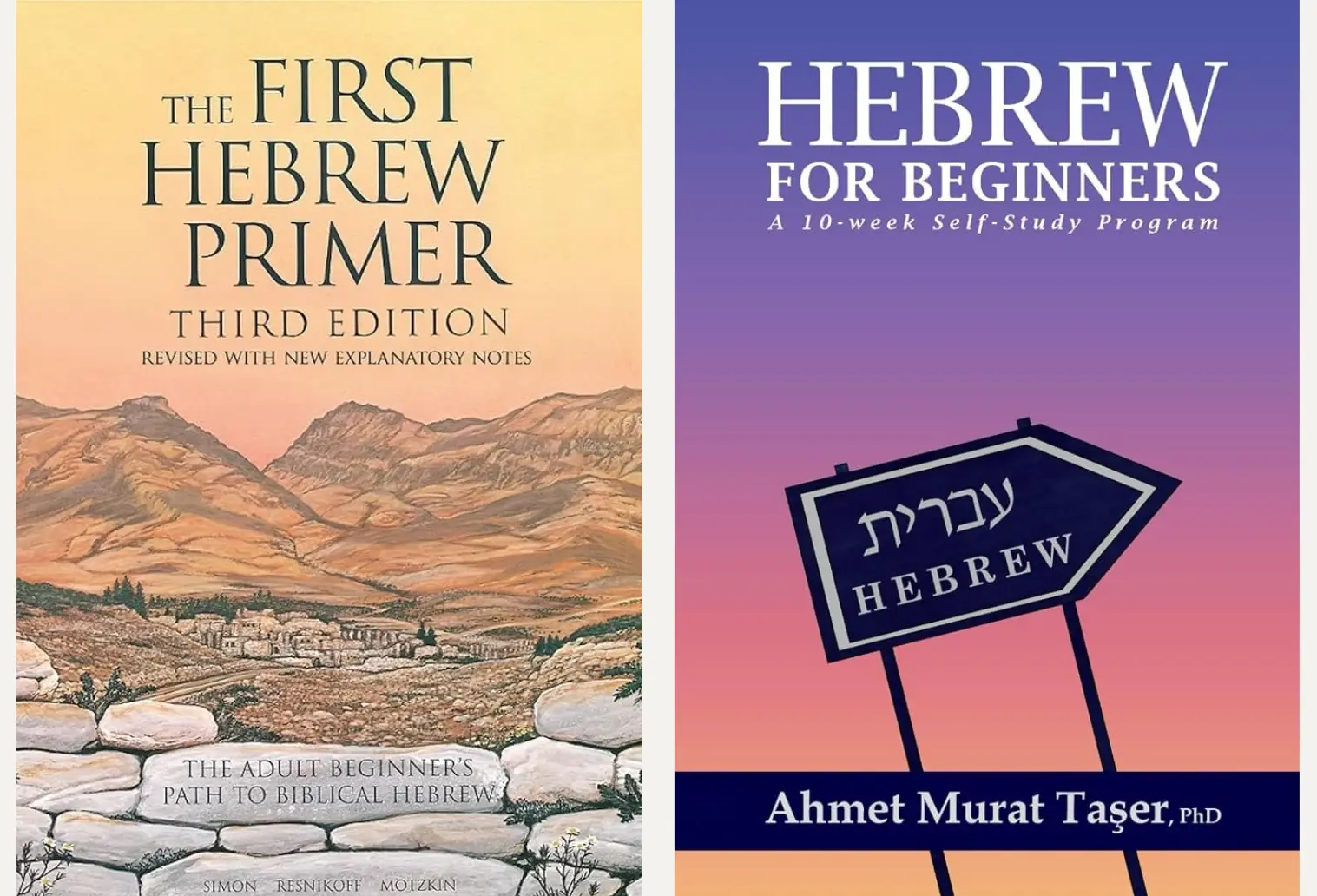
The First Hebrew Primer: The Adult Beginner’s Path to Biblical Hebrew by Ethelyn Simon, Linda Motzkin, and Irene Resnikoff walks you through thirty gentle lessons.
You’ll learn the alphabet, pick up basic grammar, and gradually work up to real passages from Scripture, including selections from the Book of Ruth. It focuses on recognition and understanding instead of long memorization lists, so it feels approachable even if you’re starting completely from scratch.
Hebrew for Beginners: A 10-Week Self-Study Program by Ahmet Murat Taşer takes a different route. It introduces Modern Hebrew through weekly lessons, everyday dialogues, and practical vocabulary, so you’ll also pick up basic reading and speaking skills in contemporary Hebrew.
Build A Strong Foundation In Biblical Hebrew
Once you can recognize the alphabet, the next goal is reading Scripture with growing confidence. Some books take a traditional grammar-first approach. Others teach through stories, illustrations, or extended reading.
Basics of Biblical Hebrew Grammar by Gary D. Pratico and Miles V. Van Pelt is one of the most widely used textbooks in seminaries and university classrooms. If you love clear explanations and want the same foundation serious students receive, you’ll feel right at home here.
Beginning Biblical Hebrew: A Grammar and Illustrated Reader by John A. Cook and Robert D. Holmstedt teaches the same foundations in a more visual way. Short grammar lessons, illustrations, and story-based readings let you see the language come alive, which makes new concepts easier to hold onto.
Learning Biblical Hebrew: Reading for Comprehension by Karl V. Kutz and Rebekah L. Josberger encourages you to move beyond single words and read whole biblical passages. You’ll start to feel the rhythm and flow of Hebrew, which is where the real joy of reading Scripture begins.
Discover Richer Biblical Meaning Through Hebrew
Reading Biblical Hebrew opens the door to Scripture in its original language. Supplementary books can take that journey further by exploring the historical, cultural, and Jewish background behind familiar passages.
Hebrew Insights from Revelation by Dr. Eliyahu (Eli) Lizorkin-Eyzenberg and Pinchas Shir opens the first chapters of Revelation through Hebrew literary patterns and the Jewish world of the first century. Passages you thought you knew begin to feel richer and more layered.
Hebrew Visions of Revelation continues through chapters 6 to 14. When the Lamb opens the Seven Seals, the vision points to God’s authority even in times of conquest, war, famine, and death. Once you see how those images echo Zechariah 1 and 6, whole new themes open up that most readers miss in translation.

The Jewish Book of 1 Enoch with Illustrations, edited by Dr. Eliyahu (Eli) Lizorkin-Eyzenberg, introduces an ancient Jewish text that shaped how many people around the time of the New Testament thought about God, angels, and judgment.
Abraham Had Two Sons: What Did Go Wrong? by Prof. Julia Blum revisits the stories of Isaac and Ishmael through Jewish interpretive traditions, giving you a deeper appreciation for the family tensions and theological threads that run throughout the Bible.
These titles aren’t designed to teach the alphabet or how to read the Hebrew Bible on your own. They shine as companion resources once you’ve learned the fundamentals.
Build A Study Stack Instead Of Relying On One Book
No single resource covers every dimension of Biblical Hebrew. Combining books gives you both practical language skills and deep contextual insights. Three stacks that work well together:
- The Gentle Explorer Stack: The First Hebrew Primer (for fundamental reading skills) + Hebrew Insights from Revelation (for inspirational, contextual insights).
- The Visual Comprehension Stack: Beginning Biblical Hebrew + Learning Biblical Hebrew: Reading for Comprehension (for visual, story-based immersion).
- The Deep Exegesis Stack: Basics of Biblical Hebrew Grammar + Hebrew Insights from Revelation (for detailed grammar work paired with literary analysis).
No matter which study stack you choose, each combines a resource that develops your Hebrew reading skills with one that deepens your understanding of Scripture.
As your confidence grows, you’ll not only recognize more Hebrew words and patterns, but you’ll also begin to notice literary connections and biblical themes that enrich your reading of God’s Word.
Books Teach Well, But Teachers Help You Grow Further
Books are an excellent way to begin learning Biblical Hebrew, but they are only part of the journey. Reading on your own builds knowledge, yet books can’t answer questions, correct pronunciation, or provide personalized feedback.
Guided instruction bridges that gap, giving you the support and encouragement to build lasting confidence as you learn.
The Israel Institute of Biblical Studies (IIBS), in affiliation with the Hebrew University of Jerusalem, combines structured lessons with expert guidance. You learn through live instruction supported by custom-designed manuals and workbooks.
One example is the Biblical Hebrew Level A Workbook, designed for complete beginners. It gradually introduces the alphabet, vowel points, foundational grammar, and about 450 of the Bible’s most common words.
You’ll practice writing letters such as Lamed (ל), Mem (מ, ם), Nun (נ, ן), Resh (ר), Heh (ה), and Het (ח), building the skills to read simple words like lechem (לֶחֶם), meaning “bread.” Guided exercises reinforce each lesson, so every step feels like real progress.
Take Your Next Step
Imagine opening your Bible one day and reading the words as they were first written. That moment is closer than you think. Learn alongside experienced teachers who guide you step by step toward reading Scripture in its original language with confidence.
Conclusion
Choosing the best book to learn Biblical Hebrew is about finding what matches your goals and where you are in your journey. Some books help you recognize the alphabet. Others strengthen grammar. Others reveal the rich background behind Scripture. Together, they help the Bible come alive in new ways.
Learning Biblical Hebrew doesn’t require becoming a linguist. Curiosity, consistent practice, and the right guidance can take you much farther than you might imagine.
FAQ:
What’s the best book for learning Biblical Hebrew as a beginner?
If you’re starting from scratch, The First Hebrew Primer is one of the friendliest choices. It walks you gently through the alphabet, reading skills, and foundational Biblical Hebrew, so you never feel lost.
Can one book teach me everything I need to know?
No single resource covers every aspect of Biblical Hebrew. Many learners benefit from combining books that develop reading skills with resources that explore the historical and cultural background of Scripture.
Do books help me understand the deeper meaning of Scripture?
Some do. Books like Hebrew Insights from Revelation and Hebrew Visions of Revelation open up the Bible’s Jewish context and literary patterns in beautiful ways. They shine brightest once you’ve built a basic reading foundation.
Why should I consider a guided course instead of only studying with books?
Books explain concepts, but teachers provide feedback, answer questions, correct pronunciation, and help you stay on track. Guided learning makes steady progress easier and helps build lasting confidence.