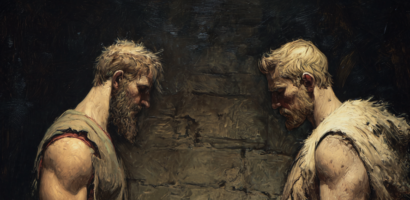



Image and Shadow
We all know that “God created man in his own image, in the image of God created he him.” But what does this mean? These words have produced endless commentaries over the centuries. Clearly, we are not created in the physical image of God, because Judaism steadfastly maintains that God has no physical appearance. And yet, after the Flood, when God made an unconditional covenant with Noah and his descendants, the sacredness of human life, established here for the first time, was clearly based on this statement: to shed another man’s blood would be a crime not only against man, but also against God – “for in His image did God make man”.[1] So, what does it mean, that man is created in the image of God? Does the Hebrew text help us here?
The Hebrew word for “image”,צֶלֶם (tzelem), is a beautiful example of how Hebrew, being a root language, functions. This wordצֶלֶם is related, and may even be derived from another Hebrew wordצֵל (tzel), which means “shadow”. A shadow is an imperfect image resembling the real thing which casts it. Tzel (shadow) is a biblical word, and the expression “in the shadow of God” occurs several times in the Scriptures. For instance, in the famous Psalm 91 we read: “He who dwells in the secret place of the Most High shall abide under the shadow of the Almighty” (בצל שדי). Also, in Exodus 31 we read about Bezalel whom God filled with His Spirit, giving him wisdom, understanding and knowledge. The name “Bezalel” בצלאל) ) means “in the shadow of God.”
This tzel /tzelem dynamic helps us better understand what it means to be created “in the image of God”. A shadow is not an exact replica, it is an imperfect copy of the perfect real image. Even though man’s nature is different from God’s, man is capable of resembling God’s actions: His love, His mercy, His justice. Moreover, man becomes truly human as he endeavors to resemble God.
A New Reading of the Old Story
Whom did God create in Genesis 1? Everyone knows the story of Genesis 2: first, God fashions Adam from dust and places him in the Garden of Eden, and only at the end of this chapter is Eve created from one of Adam’s ribs. This is the traditional understanding: Creation of the Man occurs first, whereas creation of the woman occurs some time later, after the animals are created. However, some Jewish commentators read this story in a very different way. Let us look closely at the Scriptures – and let me remind you, we are still in the first chapter!
Genesis 1:26 first refers to adam in the singular, but then says that “they shall rule”. Who are “they?” We find an answer in verse 27 where the nature of this creation is clarified: “male and female He created them”[2]. The truth is that “let us make man”[3] of English translation is a very unfortunate rendering of the Hebrew word “adam”: this word simply means “human” and doesn’t necessarily denote a male only. We see it very clearly in Genesis 5: “He created them male and female, and blessed them and called them adam.[4]”
So, was it one being or two? A number of rabbinic passages maintain that the first human was actually comprised of both genders. Thus, Midrash Bereshit Rabba says: “man and woman were originally undivided, i.e. adam was at first created … hermaphrodite”. In Midrash Leviticus Rabbah we read: “At the time that the Holy One, Blessed Be He created Man, He created him as an Androgynous”. According to this concept, God creates a human who is both male and female.
In the next chapter, we will see God looking at this two-gendered creature and for the first time in all His creative work saying: lo tov – “not good”[5]. This was clearly not the ideal way of creating a male/female couple, so God divided them into two separate people. That’s why, when a man and woman marry, they become “one”: they return to God’s original design before the man and the woman were separated – but we will definitely talk more about this when we get to Genesis 2.
Where do you meet Adam?
I suppose, at this point you are already convinced that we miss many important details when our understanding of Scripture is based upon translation and not upon the original Hebrew text. Mistranslations surrounding the word “adam” abound in these first chapters—while it is precisely in these chapters that the true understanding of God’s message and God’s design is so crucial! For example, when is the first time we meet Adam in the Bible?
I wrote about that recently in my post on the Bereshit Torah Portion; however, the difference between the English and Hebrew texts is so striking here that I think I should repeat it. When we read our English Bible, there is no Adam in Genesis 1 – we first encounter Adam in Genesis 2. (Most translations introduce him in Genesis 2:20, although some do speak about Adam in verse 19). However, you will remember that in Hebrew we saw Adam in Genesis 1:26, in the very verse we just discussed. Why?
The explanation, as always, comes from the Hebrew language. While in English, Adam is always a personal name, in Hebrew, as we just learned, it also means “human” and can be used both in collective sense and in an individual sense. In Genesis 1, “adam” is used in the collective sense: not only the individual Adam, but all humans are created on the sixth day. In Genesis 2 and 3, the generic and personal usages are mixed. This interplay between the individual “Adam” and collective “humankind”, and the ambiguity throughout the narrative, certainly adds a new dimension and brings additional depth to the crucial events of Genesis 3 – something that is completely missed in translations (again, we will talk about it more when we get there).
We are almost done with Chapter 1, but before we move to Chapter 2, I would like to give you a home assignment. We would all know that the sixth day of Creation differs from all the other days; however, only when read in Hebrew, can we really understand how special this day is. In Hebrew, there is an obvious difference between Genesis 1:31 and all the other days. Most translations don’t render this difference, although some do. So – this assignment is for those who know some Hebrew: can you try to find the difference between the sixth day and all the previous days in Genesis 1? You have a week – I will start my next post with the answer!
[1] Gen. 9:6
[2] Gen. 1:27
[3] Gen. 1:26, adam here is usually translated as Man.
[4] Gen. 5:2, adam here is usually translated as Mankind.
[5] Gen. 2:18
If these articles whet your appetite for discovering the hidden treasures of the Hebrew Bible, or studying in depth Parashat Shavua, along with New Testament insights, I would be happy to provide more information (and also a teacher’s discount for new students) regarding eTeacher courses (juliab@eteachergroup.com) .
If you like the articles on this blog, you might enjoy also my books, you can get them from my page: https://israelbiblicalstudies.com/julia-blum/ . Also, Also, my last book “Unlocking the Scriptures”, with the Hebrew insights into the Torah and Jewish Background insights into NT, is available on Amazon: https://www.amazon.com/s?k=unlocking+the+scriptures+by+julia+blum&crid=2IHYED6W7ZVYI&sprefix=julia+blum+%2Caps%2C689&ref=nb_sb_ss_i_4_11