


Most of us read the New Testament in English and assume we are getting the full picture. However, the Bible does not need to be rewritten, it needs to be re-read.
When we step into the original languages, we aren’t just looking at grammar; we are going on a journey into the culture and heartbeat of the biblical world.
Biblical Greek and Biblical Hebrew work together to remove the filters of translation, allowing you to stop depending on someone else’s interpretation and start engaging with the text directly.
TLDR:
Reading the New Testament in translation is like hearing a beautiful melody through a thick wall; you catch the tune, but the lyrics are muffled. English often flattens the vibrant, precise world of Koinē Greek into generic terms, hiding the emotional and theological depth intended by the authors.
By exploring the original language, you step into the world of the apostles and see how the fulfillment of the New Testament perfectly interlocks with its Hebrew foundation. It’s not about mastering complex grammar; it’s about a spiritual journey that reveals the Bible’s hidden treasures.
Why Learning Biblical Greek?
A lot of people think modern translations are “good enough,” but missing out on the original language strips away a level of precision you deserve to experience. Translating the Bible into English often flattens distinct, highly targeted terms into single, generic words for the sake of readability, leaving significant theological clarity behind.
Consider what happens when we look past the translation filter:
Love / Agapē (ἀγάπη): In English, “love” can mean anything from a warm feeling to a favorite food. In the Greek text, agapē represents something far deeper: a sacrificial, choice-driven, and covenant-shaped love.
Word / Logos (λόγος): We often read that Jesus is the “Word.” In Greek, logos carries immense historical weight, representing the ultimate design, reason, and divine logic that holds the universe together.
Sincerity / Haplotēs (ἁπλότης): A single English word can easily miss the flavor of this term, which shifts depending on the context to mean simplicity, pure sincerity, or single-minded generosity.
Learning Biblical Greek makes these hidden layers visible again. It allows you to trace key themes and spot wordplay that rarely survives the jump to English. You begin to see the specific brushstrokes the authors used to describe God’s grace, revealing a theological precision that is simply breathtaking.
What Is Biblical (Koine) Greek
There is a common misconception that Biblical Greek is a high-brow language reserved for elite scholars. In reality, it was the opposite. Koinē literally means “common.” It was the everyday language of the marketplace and the family dinner table.
In that sense, Koinē Greek served as a living bridge across the ancient world, much as the revival of Hebrew has made it a living bridge for Israel today.

Understanding this helps us hear Scripture more as its first readers did. For example, in Ephesians 5:16, English translations often say “redeem the time.” The Greek verb ἐξαγοράζω (exagorazō) means “to buy up” or “make the most of,” carrying commercial overtones familiar in the ancient marketplace. Combined with καιρός (kairos), an opportune or strategic moment, Paul’s instruction is to seize every God-given opportunity before it passes by.
How Biblical Greek Complements Biblical Hebrew
If Biblical Hebrew is the root of a tree, Biblical Greek is the fruit. You can’t fully understand the depth of the New Testament without seeing how it interlocks with its Hebrew foundation.
This connection was forged long before the New Testament was written, as ancient scholars used the Greek Septuagint to translate Hebrew idioms and theology. This historic bridge shaped the vocabulary of the Apostles, allowing them to use the precise structure of Greek to explain the beautiful promises established in Hebrew.
Because the writers were steeped in the Hebrew Scriptures, their Greek words often carry deeper Hebrew echoes. For example, the Greek word for faith, pisteuo (πιστεύω), reaches back to the Hebrew emunah (אֱמוּנָה), which means firmness and faithful steadiness. Faith in the biblical sense is not merely agreeing with an idea, it’s a way of standing and living with enduring trust.
Where Hebrew paints with vivid imagery, Greek, especially in the New Testament epistles, organizes those truths into clear and structured explanations, allowing the symbols and promises of earlier Scripture to be expressed with greater precision.
Comparison: The Foundation Of Biblical Hebrew vs Biblical Greek
| Feature | Biblical Hebrew | Biblical Greek |
|---|---|---|
| Primary focus | The Old Testament and the Torah; covenant, law, and prophecy. | The New Testament; the Gospels, Epistles, and fulfillment of prophecy. |
| Style | Rich imagery and narrative | Structured explanations and teachings |
| Cultural setting | Ancient Israel and the world of the patriarchs and prophets | The Mediterranean world of the first Christians |
| Key themes | Creation, covenant, law, worship, and hope | Grace, salvation, discipleship, and proclamation |
| Famous books | Genesis, Psalms, Isaiah, and the Torah | The Gospels, Acts, Romans, and Revelation |
| Connection between them | Lays the foundation and introduces God’s promises | Builds on those promises and reveals their fulfillment |
| Shared purpose | Invites readers into God’s story through the language of Israel | Carries that same story to believers across nations and generations |
Getting Started With Biblical Greek Without Feeling Overwhelm
If you have ever felt intimidated by the unfamiliar letters of the Greek alphabet, please take a deep breath. You don’t need a PhD or hours of dry academic drills to start reading Scripture directly.
The best way to begin is to take it one step at a time with a clear and structured plan. You can start by simply focusing on the Greek alphabet, perfecting the pronunciation, and learning a few basic words first. Short, daily practice keeps your progress steady and prevents you from feeling any overload. Building a simple routine with manageable goals helps you avoid confusion and keeps the journey enjoyable.
Learning this way becomes an encouraging spiritual experience instead of a chore. By joining a guided course, you gain the accountability and support that self-study apps often lack. You are simply lifting a veil to hear the message exactly as it was spoken on the streets and in the marketplaces of the ancient world.
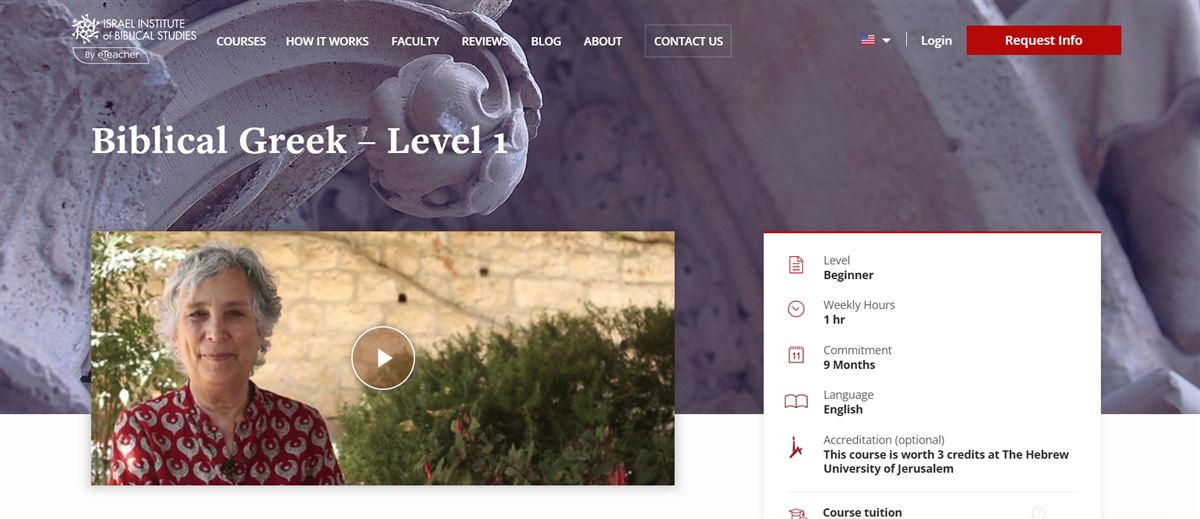
At the Israel Institute of Biblical Studies, our caring teachers, including scholars like Dr. Eliyahu (Eli) Lizorkin, are ready to walk with you every single step of the way. We don’t focus on cold grammar; we focus on guided discovery that fills you with wonder. Take your Bible study to a whole new level and join our community of learners for our upcoming course.
Are You Ready To Learn Biblical Greek?
The best way to learn Biblical Greek is with structure and consistency. The Israel Institute of Biblical Studies offers live online courses taught by university-level scholars, accredited by the Hebrew University of Jerusalem.
Start with the alphabet, build from there, and begin reading Scripture the way it was written.
Conclusion
The New Testament wasn’t just written in Greek; it was written in the language of the streets, the marketplace, and the home. The authors chose Koinē Greek because they wanted to reach everyone, and they chose every single word with a heartbeat behind it. While a good translation is like a sturdy bridge, there’s something deeply personal about walking the path yourself.
When you start learning Biblical Greek, it’s like a veil begins to lift. You’re no longer just reading words on a page. Instead, you’re catching the subtle nuances that often get lost in translation. And when you connect those insights back to their Hebrew roots, you’re not just seeing a story. You’re seeing a tapestry being woven together across time.
This kind of connection isn’t something you can just read about in a commentary; it’s something you feel when you engage with the text yourself. So, don’t be intimidated by the new characters or the different sounds. Take it one letter at a time, find your rhythm, and enjoy the process. The text has been waiting for centuries to speak to you exactly as it was written.
FAQ
Is Biblical Greek hard to learn?
It takes effort, but it’s manageable. Most students learn the alphabet in just a few weeks. Because this is a reading-based study, you focus on the beauty of the Scripture instead of conversational fluency.
Should I learn Biblical Hebrew or Biblical Greek first?
There is no wrong answer. If you want to understand the roots of the faith, start with Hebrew. If you want to read the life of Jesus directly, start with Greek. They complement each other perfectly.
How long does it take to read the New Testament in Greek?
Many students begin reading simple passages within their first year. Fluency develops gradually through consistent practice and guided study.
Can I learn Biblical Greek online?
Yes. We provide live weekly classes where you can interact with scholars in real-time. This provides the encouragement and accountability that self-study apps often lack.
Why not just use an Interlinear Bible?
An interlinear Bible is a helpful tool, but it’s like using a map without knowing how to read the landscape. Learning the language lets you see why the authors made certain choices, giving you a personal connection to the text.