


Learning Biblical Hebrew is a deeply inspiring goal that many Bible enthusiasts dream about. We want to open the pages of Scripture and see the words exactly as they were written thousands of years ago. Yet, a lot of learners start strong and hit an unexpected wall within weeks because the unfamiliar alphabet and unique structure make most online resources feel either too shallow or like dry, intimidating textbooks.
The truth is, you don’t need to be a rigid academic to understand the language of the Bible; you just need a supportive path. Guided online classes offer a warm community and personal mentorship from passionate scholars, transforming a daunting task into an inspiring adventure of spiritual discovery.
In this blog, we will explore exactly how to choose a program that nurtures your curiosity without burying you in complex linguistic jargon.
TLDR:
Learning Biblical Hebrew opens a beautiful doorway into deeper Scripture study, but going at it alone can feel overwhelming.
Independent study lacks the personal feedback and community support needed to master a new script and language structure. Guided online classes solve this by providing a clear path, encouraging peer connection, and offering direct access to caring scholars.
When choosing a program, look for live interaction, a progressive journey from beginner levels, and teachers based in Israel who connect the language to its rich historical and cultural roots.
Why Most People Struggle To Learn Biblical Hebrew
Many people feel an unexpected wave of disconnect when they first see a Hebrew text. That’s completely normal. Most Western languages share common roots and familiar vocabulary. Hebrew, however, is a Semitic language, which means it belongs to an entirely different family.
Think of learning Hebrew less like memorizing a technical code and more like adjusting your vision to see an ancient landscape. It takes a shift in how you process meaning, but it’s a shift anyone can make with the right encouragement.
So what does that shift look like? Instead of thousands of isolated words, Hebrew uses an elegant system where three-letter roots branch out into dozens of related meanings.
For example, consider the root ש-ל-ם (S-L-M). Its most famous derivative is Shalom (שָׁלוֹם), which we translate as “peace.” But the root fundamentally means wholeness or completeness. From it we also get Le-shalem (לְשַׁלֵּם), “to make things right,” and Shalem (שָׁלֵם), “complete.” Understanding the root reveals that biblical peace is the presence of divine wholeness.

This web of meaning makes Hebrew so rewarding, but it’s also where solo learners get stuck. Tackling the structure alone, progress often stalls, with no natural roadmap to keep you from getting bogged down in grammar or overwhelmed too early.
Language is also meant to be heard. Without a caring teacher to listen to your reading or clarify a subtle meaning, minor pronunciation errors can harden into frustrating habits, and momentum quickly drains away.
Why A Guided Online Community Changes Everything
The Bible doesn’t need to be rewritten, it needs to be re-read. An online class brings the text to life in a way textbooks can’t, blending the convenience of learning from home with genuine human connection.
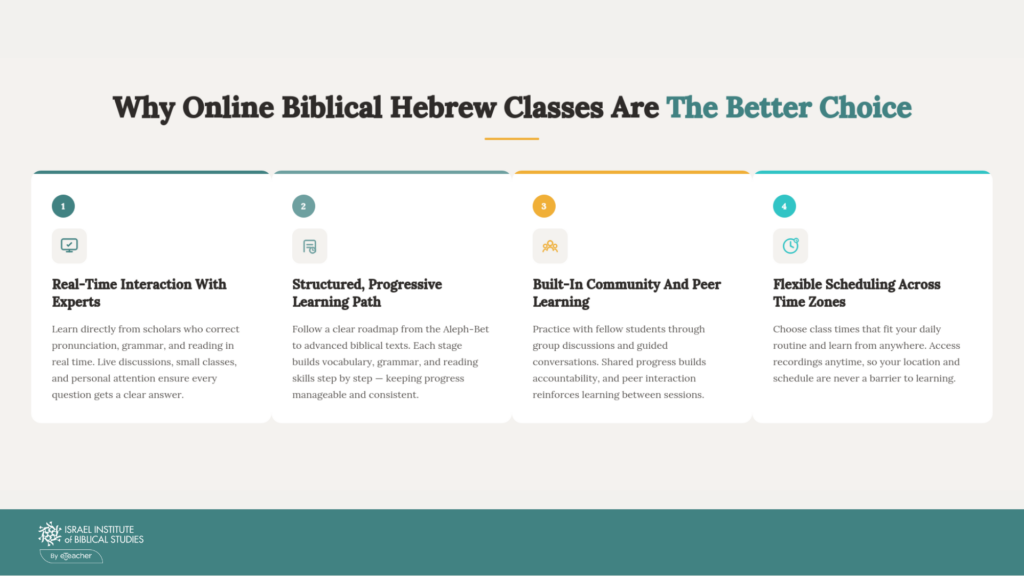
Real-Time Interaction With Passionate Scholars
An authentic online classroom gives you direct access to scholars who guide each step with care. Instead of analyzing a dead language on a page, you join live discussions, ask questions on the spot, and get immediate, encouraging feedback on your pronunciation and reading. Caring teachers make sure you understand how the language works within the biblical narratives.
To see how much this matters, look at Genesis 12:1, where God tells Abraham, Lech Lecha (לֶךְ-לְךָ). In English translations, this is often rendered simply as “Go” or “Leave your country.” But the literal Hebrew reads, “Go for yourself” or “Go to yourself.” It wasn’t just a geographic move; it was an internal, spiritual journey of self-discovery and destiny. An app misses this layer, but a live setting illuminates it instantly.
At the Israel Institute of Biblical Studies, we bring these moments to life. Students learn from experienced Israeli scholars through live video sessions and collaborative practices. If life gets busy, recorded classes are always available, alongside a vast academic library to feed your curiosity outside of class times.
A Gentle, Progressive Roadmap
A great online course replaces confusion with a clear, step-by-step path. You begin exactly where you need to: mastering the beautiful shapes of the Aleph-Bet and learning the vowel marks (niqqud) that help you read smoothly.
Instead of overwhelming you with a wall of grammar terms, the focus stays on revealing hidden meaning within the text. Our core beginner-friendly entry point, “Biblical Hebrew A” is designed to make you feel capable and confident from day one. Over 8 to 9 months, you’ll progress naturally from the alphabet into biblical narratives, prophetic writings, and the profound poetry of Isaiah and Jeremiah.
Because quality matters, our programs are accredited by the Hebrew University of Jerusalem, offering a globally recognized standard of excellence.
The Power Of Shared Journeys
We learn best when we share the experience with others. A live online class connects you with a vibrant community of like-minded Bible enthusiasts worldwide who share your passion. Seeing peers ask questions and hit milestones keeps your own dedication strong. Open classrooms and 24/7 discussion forums give everyone a warm space to connect, share discoveries, and support one another.
Flexible Scheduling Across Time Zones
Alongside community, consistency requires a schedule that fits your life. Live online classes let you learn from anywhere, making them ideal for working professionals, university students, and international learners.
The Israel Institute of Biblical Studies supports this with weekly one-hour live classes and multiple scheduling options. Pick the date and time that suits you best, and if you ever miss a session, you can review the material later through class recordings.
What To Look For When Choosing An Online Biblical Hebrew Class
As you look for the perfect environment to begin, keep this checklist in mind:
Choose programs led by qualified educators based in Israel. Teachers living in the land of the Bible add irreplaceable cultural and historical context.
Look for weekly live webinars or group sessions that offer immediate feedback.
Decide whether you prefer live, fixed-time classes or pre-recorded lessons. Some institutes, like ours offer both, plus recorded sessions for review.
Avoid courses that treat Hebrew as a technical puzzle. Prioritize programs where every lesson points back to reading actual Scripture.
Look for accredited programs with recognized certificates of completion, backed by respected academic institutions.
Online Classes vs Self-Paced Courses
Online classes and self-paced courses both teach Biblical Hebrew, but in different ways. The right choice depends on how you learn, how much structure you need, and how much feedback matters. Here’s a side-by-side comparison.
| Key Factors | Live Online Classes | Self-Paced Courses |
|---|---|---|
| Interaction | Real-time interaction with scholars and classmates via live video | Limited or no interaction; learning happens solo through pre-recorded content |
| Feedback | Immediate support and corrections | Little to no personalized feedback |
| Learning path | Clear, weekly progression | Flexible but unstructured; self-directed |
| Accountability | Built into the schedule | Depends on self-discipline |
| Flexibility | Set class times across days and time zones; recordings available | Full flexibility to study anytime |
| Depth of meaning | Rich cultural insights and lively Q&A sessions | Surface-level focus on memorization |
The Miracle Of A Living Language
When you study Biblical Hebrew, you are interacting with a language that holds a unique place in human history. Under the leadership of visionary scholars like Dr. Eliyahu (Eli) Lizorkin, our institute loves to highlight the beautiful reality of its historic cultural revival.
For nearly two millennia, Hebrew was preserved primarily as a sacred tongue for scripture and prayer, not as a language spoken in the streets. Its modern revival as a vibrant daily language is a miraculous resurrection.
This connection becomes beautifully clear with a word like Chai (חַי), meaning “alive” or “living.” In Genesis, this root forms the name of Eve, Chava (חַוָּה), because she is the mother of all the living. Today, when people in Israel toast to life, they say L’Chaim (לְחַיִּים).
To learn Biblical Hebrew, then, is to learn the foundational roots of a living bridge that connects ancient history to modern Israel. The very words you read in Genesis are alive today.
Take Your Bible Study To A Whole New Level
Explore our online Biblical Hebrew classes and find the right level for you. Our caring teachers are ready to walk with you every step of the way to discover meanings hidden in the original text.
Conclusion
Learning Biblical Hebrew is one of the most rewarding ways to understand the Bible on a deeper, more personal level. But the environment you choose matters just as much as the dedication you bring. Scattered resources and lonely study plans leave too many well-intentioned learners stuck in the same place for months.
Guided online classes reshape that experience entirely. They give you what independent study can’t: immediate correction from an expert, a clear path forward, and a warm community to keep you inspired. The right course will do far more than teach you vocabulary lists. It will help you read the Hebrew Bible exactly the way it was written, revealing the timeless depth behind every single word.
FAQ
Do I need to know any Hebrew before starting?
Not at all. Most programs, including those at the Israel Institute of Biblical Studies, are designed for complete beginners and start with the Aleph-Bet.
How long does it take to learn Biblical Hebrew?
Progress varies from person to person, but each level at the Israel Institute of Biblical Studies typically lasts eight to nine months with around one hour of study per week.
Is Biblical Hebrew the same as Modern Hebrew?
No. They share many similarities, but Biblical Hebrew is the language of Scripture, while Modern Hebrew is spoken in everyday life in Israel today.
Can I participate if I live in a different time zone?
Yes. We connect learners worldwide with scholars in Israel by offering multiple scheduling options for different days and hours. If you miss a live session, full recordings are available in your student portal.
Are online Biblical Hebrew classes accredited?
Some are, some aren’t, so verify before enrolling. The Israel Institute of Biblical Studies is accredited by the Hebrew University of Jerusalem, and some courses offer internationally recognized university credits.
Will I really be able to read the Hebrew Bible?
Yes. A structured program gradually helps students move from learning the alphabet to reading and understanding biblical passages in their original language.