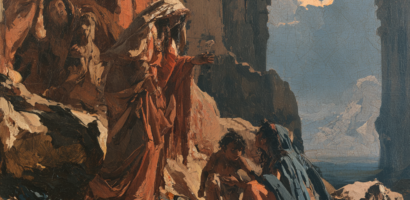


Genesis chapters 13 and 14 are so clearly marked by the name of Lot that we cannot simply pass them by without saying a word about him. Before we continue following Abraham’s journey, I think we need to pause for a moment and try to understand his relationship with his young nephew. It is one of those relationships that Scripture never explains directly, yet quietly reveals through a series of simple details that, once put together, tell a remarkably moving story.
The very first time we encounter Lot’s name, at the end of Genesis 11, we read that Haran begot Lot, and then, in the very next verse, we learn that Haran died before his father Terah. In other words, Haran died an untimely death, leaving his son without a father.
Was Lot still a sweet little boy when his father died? Was he already a rebellious teenager? Or perhaps he was a grown young man with a family of his own? Scripture doesn’t tell us. Yet I cannot help wondering whether it was precisely at that time of mourning and loss that Lot formed this special relationship with his uncle Abraham. Had Abraham gradually become almost a father to his fatherless nephew? Had Lot become almost a son to his childless uncle?
We do not know exactly when it happened, or how. Yet the fact that it did happen seems almost beyond question; otherwise, how do we explain those simple words from Genesis 12?
“So Abram departed as the Lord had spoken to him, and Lot went with him… Then Abram took Sarai his wife and Lot his brother’s son…” (Genesis 12:4–5)
When Abraham departed for Canaan in full obedience to God’s call, he was prepared to leave behind everything and everybody. He took only those who belonged to his own household, those who were, in a sense, “his own.” The moment we discover that his nephew belonged to this small circle, we realize that there must have been a very special bond between them. And the relationship had to be mutual. Not only was Abraham willing to take Lot with him into the unknown, but Lot himself was willing to leave everything behind and follow his uncle into a land he had never seen.
Scripture tells us nothing about Lot’s time in Egypt. Yet when uncle and nephew return from Egypt, their paths begin to diverge.
Genesis 13 explains that the land could no longer support them because their possessions had become so great. That is certainly true. Yet somehow, as I read the story, I cannot escape the feeling that there was more to this separation than simply the practical problem of sharing pastureland.
As complicated as an ordinary father-son relationship can become, an “almost father–almost son” relationship may be even more complicated. The moment inevitably comes when the younger person wants to make his own choices, and the older one realizes that love no longer gives him authority.
Perhaps every parent, or every person who has loved someone as their own child, knows the pain hidden behind words that Scripture never records but life often does:
“You aren’t my father. You can’t tell me what to do.”
Whether Lot ever spoke such words, we do not know. But suddenly Abraham’s appeal begins to sound different:
“Please let there be no strife between you and me, and between my herdsmen and your herdsmen; for we are brethren…”
Notice that we are still in the realm of Peshat—the plain, straightforward meaning of the text. The conflict is first described as being between you and me. Only afterward does Abraham mention the shepherds. Somehow, it feels as though the quarrel over grazing land was merely the visible expression of a much deeper conflict.
Then Abraham adds, “for we are brethren.”
To me, these words sound almost like a lost argument, a sorrowful reminder that despite everything that has happened between them, they are still family.
And finally come the heartbreaking words:
“Please separate from me…”
Blessed are the parents who have never had to say those words to a child—or to someone who has become like a child to them.
Like any loving father would do, Abraham allows Lot to choose first. Lot chooses what appears, from every natural point of view, to be the better option. The Jordan plain is well watered everywhere. Why struggle in the hill country when such fertile land lies before him?
Yet there is something significant about Lot’s choice. He chooses the place where, at least outwardly, he will have to depend less on God. He has spent years walking beside Abraham. He knows Abraham’s God. The apostle Peter even calls him “righteous.” Yet alongside God’s ways, Lot seems to prefer relying on his own judgment and his own strength.
Very soon, of course, he finds himself in trouble.
In the very next chapter, the neighboring kings wage war against the king of Sodom and his allies, and Lot is taken captive together with all his possessions.
Again, blessed are those parents who have never experienced the anguish of watching someone they love choose a different path—and then seeing that choice lead to suffering.
Chapter 14 tells us nothing about Abraham’s emotions. In fact, Genesis rarely tells us how Abraham felt. It simply tells us what he did.
When he heard that Lot had been taken captive, he armed the three hundred and eighteen trained servants born in his own household. He pursued the invading kings as far as Dan—nearly three hundred kilometers from where he was living—and continued chasing them north of Damascus until he rescued Lot, recovered all the possessions, and brought everyone safely home.
This is, remarkably, the only military campaign we ever see Abraham undertake.
As far as we know, Abraham was a peaceful man. He was nothing like David. He did not seek battles, nor did he hope to enrich himself through war. In fact, after the victory he refused to take anything for himself.
This was not even his war.
He could easily have stayed at home.
Instead, he got up and ran nearly three hundred kilometers to rescue Lot.
Why?
Not because he liked wars—he clearly didn’t.
Not because he hoped to become rich through this campaign—in fact, he refused to take anything for himself.
Not because he and Lot were still enjoying the close relationship they had once shared—they weren’t. Their relationship had been strained, they had separated, and Lot had consciously chosen a different path.
Yet Abraham went to this war.
He ran three hundred kilometers because someone who had hurt him, disappointed him, and chosen another path was still, in his heart, his son.
Of course, Lot was not Abraham’s son. Yet if Abraham had indeed become almost a father to his fatherless nephew, everything suddenly begins to make sense. The pain of chapter 13 becomes more understandable. Abraham’s generosity in allowing Lot to choose first becomes more natural. And his extraordinary determination in chapter 14 becomes almost inevitable.
Abraham had the heart of a father long before he actually became a father.
Long before Ishmael was born, long before Isaac was born, long before God’s promise was fulfilled, Abraham’s fatherly heart had already found someone to love.
Perhaps that is one of the hidden treasures of these two chapters.
Sometimes God begins shaping our hearts long before He fulfills His promises.
This week’s insight is adapted from my book Abraham Had Two Sons. The book follows Abraham’s entire journey—from his first call to his final years—and explores many of these themes in much greater depth. You can explore my books and resources here: books
As always, I would be happy to provide more information (also, a teacher’s discount for new students) regarding our wonderful courses (juliab@eteachergroup.com)