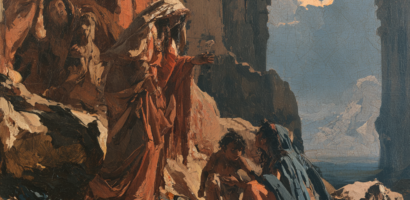


When we think of Genesis 15, our minds almost instinctively travel to the stars. We picture Abraham standing beneath the magnificent Canaanite sky while God tells him to look toward heaven and count the stars, if he is able, before making one of the most breathtaking promises in the entire Bible: “So shall your descendants be.” It is a scene that has inspired painters, poets, and preachers for centuries, and rightly so. The black velvet of the eastern night, illuminated by countless stars, has become one of the great images of biblical faith.
Yet the more I return to this chapter, the more I find myself wondering whether we have been missing something here.
The stars are magnificent, but perhaps they are not the true center of the story.
Perhaps the greatest miracle of that unforgettable night had already taken place before Abraham ever stepped outside his tent.
It happened quietly, in a private conversation between God and one old man who had finally reached the point where he could no longer pretend that everything was all right.
******************
By the time we reach Genesis 15, Abraham has already become one of the great heroes of Scripture. He has left his homeland in obedience to God’s call. He has wandered through Canaan as a stranger while believing promises that seemed almost impossible. He has generously allowed Lot to choose the better land. He has risked his life to rescue his nephew from powerful kings. He has refused the wealth of Sodom because he would rather owe everything to God than anything to man.
Again and again, we are impressed by his faith. Again and again, we admire his obedience. Again and again, we watch a man who appears remarkably composed, remarkably courageous, and remarkably steadfast.
Yet throughout all these chapters there is one thing we have never seen. We have never seen Abraham break. We have never heard him complain. We have never heard him ask aloud the question that must have been growing heavier with every passing year: How can I become the father of a great nation if I have no son?
This question did not suddenly appear in Genesis 15. It had been silently accompanying Abraham for a long time.
Already in Genesis 12, God had promised to make him into a great nation. Later, after Lot separated from him, the promise became even more astonishing:
“I will make your descendants as the dust of the earth; so that if a man could number the dust of the earth, then your descendants also could be numbered.”
Abraham believed those promises. Scripture never suggests otherwise. But believing God’s promises does not automatically remove every painful question. Sometimes the opposite is true. Sometimes God’s promises make the unanswered questions even more difficult to ignore.
Every new promise concerning descendants must have brought Abraham back to the same painful reality: he still had none.
The years continued to pass. Sarah remained barren. The promise grew larger. The silence grew longer. And at some point the unspoken question must have become impossible to suppress. God kept speaking about descendants. Abraham kept looking at an empty tent.
******************
Then Genesis 15 begins.
The Lord appears to Abraham with words that are full of reassurance:
“Do not be afraid, Abram. I am your shield, your exceedingly great reward.”
One almost expects Abraham to respond with worship. Instead, something astonishing happens.
For the first time in the biblical narrative, Abraham answers God’s promise not with another act of obedience, but with a pain he has carried silently for years. “Lord GOD, what will You give me, seeing I go childless?”
I often wonder what it cost Abraham to utter those words. This is not the language of rebellion. Neither is it the language of unbelief. It is the language of a man who has trusted God for years and who finally discovers that trust does not require silence.
The English translations convey Abraham’s complaint faithfully enough, but the Hebrew allows us to hear something even deeper. Abraham says: Anochi holech ariri.
“I go childless.”
The word ariri means “childless,” “bereft,” “without an heir.” Yet to a Hebrew ear it also echoes another word that sounds strikingly similar—a word associated with being cursed. Whether the resemblance is intentional or simply one of those remarkable echoes that languages sometimes contain is almost beside the point. The emotional force is unmistakable.
Abraham’s words are heavy with loneliness. They sound almost as though he is saying, “I am empty.” “I am abandoned.” “How can You speak to me about reward when my deepest longing has remained unanswered?”
What makes the scene even more moving is that Abraham does not say it only once. In the very next verse, he repeats the complaint.
“Look, You have given me no offspring; indeed one born in my house is my heir.”
He repeats himself because this is not merely information.
It is pain. Pain often repeats itself.
Anyone who has ever carried a deep disappointment knows that one sentence is rarely enough. We say it again, not because the other person failed to hear us, but because the wound itself has become part of our language.
For years Abraham had demonstrated extraordinary obedience.
Yet perhaps this moment required even greater faith.
Obedience can remain silent.
Relationship cannot.
A relationship becomes deeper when one person discovers that they do not have to hide the part of themselves that hurts.There comes a moment in every genuine relationship when we discover whether we are loved only when we are strong, or whether we are also loved when we are broken.
Genesis 15 is that moment for Abraham.
***********************
What happens next is, perhaps, one of the most beautiful moments in the entire Abraham story.
We have become so accustomed to God’s answer that we almost fail to notice how astonishing it really is. Abraham has just interrupted God’s magnificent declaration with what sounds almost like a complaint. Instead of responding to the promise of an “exceedingly great reward” with gratitude, he has answered with the deepest disappointment of his life. If ever there were a moment when we might expect a gentle rebuke—or at least a reminder of God’s faithfulness throughout the years—surely this would be it.
Yet none comes.
God does not tell Abraham that he ought to trust more and complain less.
He does not remind him of the victories He has already given him.
He does not point to the altars Abraham has built or to the promises already fulfilled.
Instead, He goes straight to the wound itself and answers the question Abraham has finally found the courage to ask.
“This one shall not be your heir, but one who will come from your own body shall be your heir.”
It is difficult for us to hear these words with Abraham’s ears because we already know the rest of the story. We know about Isaac. We know about the covenant. We know that this promise will eventually shape the history of Israel and, through Israel’s Messiah, the history of the entire world.
Abraham knows none of this.
What he hears that night is something much simpler, and at the same time infinitely more overwhelming.
Until now, every promise had pointed toward a distant future filled with descendants too numerous to count.
Now, for the first time, the promise becomes intensely personal.
Before there can ever be a multitude of descendants, there will be one child.
Before there can be a nation, there will be a son.
Before there can be history, there will be a tiny baby whom Abraham himself will hold in his arms.
I cannot read those verses without imagining tears.
The Bible never tells us that Abraham cried.
Perhaps it doesn’t need to.
Sometimes joy is simply too deep to require description.
Only after speaking directly to Abraham’s deepest wound does God bring him outside.
Only then does He point toward the heavens.
“Look now toward heaven, and count the stars if you are able to number them… So shall your descendants be.”
Suddenly the stars are no longer merely a symbol of an unimaginable future.
They have become intensely personal.
For the first time, Abraham can look at that impossible sky knowing that somewhere among all those countless descendants there will first be one little child who will call him father.
The stars have not changed.
Abraham has.
********************
Perhaps this is why, the more I meditate on Genesis 15, the less I think that the stars are the greatest miracle of that unforgettable night.
They are magnificent, of course. They deserve every painting they have inspired and every sermon that has been preached about them.
Yet by the time Abraham looks upward, something even more extraordinary has already taken place inside the tent.
The greatest miracle has happened where no one else could see it.
A man who had carried his deepest disappointment in silence for years finally dared to place it before God.
And instead of finding rejection, he found compassion.
Instead of reproach, he received a promise addressed precisely to the place where his heart had been aching all those years.
I sometimes wonder whether this is one of the most important lessons Abraham ever learned.
Until that night he knew that his obedience mattered to God.
He knew that his faith mattered.
Now he discovered something entirely new.
There is one more detail in this story that I cannot leave unnoticed.
Most of us know what God says next: “Look toward heaven, and count the stars, if you are able to number them.” We picture the stars. We admire the promise. We move on.
But Hebrew invites us to linger for one more moment.
God does not simply say, “Look toward heaven.”
He says, Hebet-na hashamaymah.
That tiny word na is almost impossible to translate. It is the Hebrew particle of entreaty. It softens a command into something deeply personal. It is the difference between saying, “Look,” and saying, “Please… look.”
Usually, it is human beings who say na to God.
“Please, hear me.”
“Please, save us.”
But here something astonishing happens.
God Himself says “na” to Abraham.
The God who has just listened to Abraham’s painful question now answers him—not with rebuke, not with wounded dignity, not with a lecture about faith, but with extraordinary gentleness.
“Please… look toward heaven.”
The little Hebrew word that disappears completely in translation allows us to hear something we might otherwise miss.
It is not only the stars that reveal God’s heart.
It is His voice.
His pain mattered too.
We often imagine that faith means carrying our disappointments quietly, carefully hiding them behind words of confidence lest they somehow betray a lack of trust. Abraham’s story suggests something profoundly different. The father of faith does not become less faithful when he finally tells God that his heart is breaking. On the contrary, his relationship with God enters an entirely new depth precisely because he no longer hides behind silence.
There is no real friendship without honesty.
There is no genuine walk with God until we discover that we may bring Him not only our worship and our gratitude, but also the questions we have carried for years without daring to speak them aloud.
The God who would one day ask Abraham to trust Him with Isaac first showed him that He was willing to listen to the sorrow of an old man who longed for a child.
Perhaps that is why I find Genesis 15 so deeply moving.
Not simply because it contains one of the Bible’s greatest promises.
But because it contains one of the Bible’s most tender conversations.
Before Abraham became the father of nations, he became a man who discovered that God’s heart was spacious enough to hold his own.
And I cannot help wondering whether that quiet discovery, made in the privacy of a tent long before the stars filled his vision, was itself one of the greatest gifts God ever gave him.
For the night Abraham finally told God that it hurt…
…was also the night he discovered that God had been listening all along