

Ask anyone how many letters are in the Hebrew alphabet and you’ll hear the same answer: 22. That’s technically correct, but incomplete. The alphabet most people picture is missing key pieces that shape how Hebrew is actually read: final letter forms, a separate vowel system, and centuries of evolution that gave each letter its current shape and spiritual meaning.
To treat this sacred language as nothing more than 22 consonants is to overlook the very foundation that brings Biblical Hebrew to life. The alphabet is not a rigid code waiting to be cracked. It’s a beautifully layered system crafted to safeguard meaning, history, and spiritual richness. Look more closely, and you’ll find that the letters themselves carry keys to understanding the Bible in ways no translation could ever capture.
This post pulls back the curtain on what the 22 letters represent, why five have a second form, how the vowel system works, and how to take your first steps into reading Scripture in its original language.
TLDR:
The 22-letter answer is correct, but it leaves out half the system. Five letters take a different shape at the end of a word to help readers spot where words end.
Hebrew also uses a vowel system called Niqqud, made of small dots and dashes added by the Masoretes centuries later to preserve traditional pronunciation. Behind it all sits a beautiful history.
Once you understand this full system, reading Scripture in its original language stops feeling out of reach and begins to feel like a living, breathing experience.
What You See Beyond The Number 22
When you first glance at the Hebrew alphabet, it’s easy to treat it like a checklist. You count 22 characters, check the box, and think you are ready to go. But treating this sacred language like a simple collection of consonants means missing the very foundation that makes Biblical Hebrew come alive on the page.
The alphabet is not a puzzle to be solved and set aside. It’s a beautifully layered system built over centuries, designed to protect meaning, history, and spiritual depth. When you look closer, you discover that the letters themselves hold keys to understanding the Bible in ways that slip away the moment the text is translated.
For example, the Hebrew word for “letter” is ot (אוֹת). In the text of the Bible, this exact same word is used to mean “sign” or “miracle.” This is where it gets interesting. To the ancient biblical mind, a letter was never just an ink mark on parchment used to build a dry grammatical sentence. Every single letter is a signpost, a small miracle carrying a spark of divine communication
Translations often flatten the text, hiding the wordplay the original authors built in. When you read the Bible in translation, you are looking at a beautiful painting through a frosted window. You see the general shapes and colors, but you miss the texture of the brushstrokes. Learning to see beyond the 22 letters cleans that window.
When you learn the alphabet as a living system rather than a dry list, you are not just memorizing sounds. You are uncovering the structural signs that the biblical authors used to paint their inspired visions of the world. You begin to see that every word is an invitation to dig deeper.
The True Structure Of The Hebrew Alphabet
To truly appreciate how Hebrew works, we need to look at the three distinct layers that make up the written language: the core consonants, the final forms, and the hidden vowels. Together, they create a beautifully efficient system that has remained unchanged for thousands of years.
The 22 Core Letters
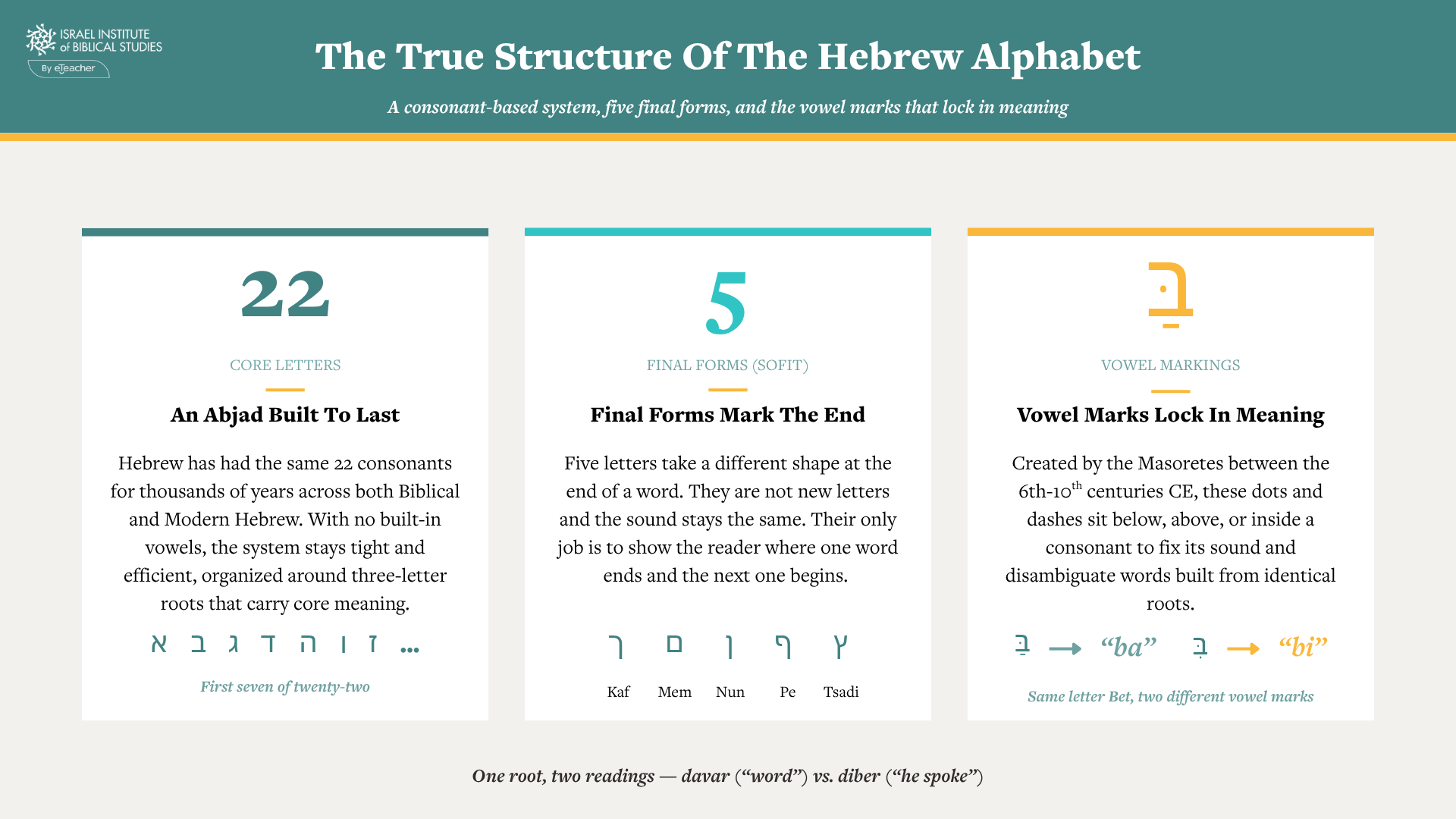
The Hebrew alphabet has maintained its 22 core letters since ancient times. This incredible consistency across both Biblical and Modern Hebrew is a rarity in human history.
Linguists classify Hebrew as an abjad, which is a writing system where every letter represents a consonant. There are no built-in vowel letters like A, E, I, O, or U in the core alphabet. Instead, the language is beautifully tight and efficient, relying on a system of three-letter roots to carry core meanings.
The 5 Final Letters (Sofit)
As you begin reading, you will notice something fascinating. Five specific letters change their appearance completely when they land at the very end of a word. These are known as sofit (final) forms:
Kaf changes from כ to ך
Mem changes from מ to ם
Nun changes from נ to ן
Pe changes from פ to ף
Tsadi changes from צ to ץ
These are not extra letters to add to your 22-letter count. Think of them as elegant visual punctuation marks.
In ancient scrolls, words were often crowded closely together. The final forms stretch down or close up, acting like a visual stop sign to tell your eyes exactly where one word ends and the next begins. The sound stays exactly the same, but the shape guides your reading rhythm.
Hebrew Vowels
Because ancient Hebrew was written with only consonants, the original readers relied entirely on oral tradition and context to know how to pronounce the words. Imagine reading an English sentence written as “th bnk”. Depending on the context, it could mean “the bank” or “the bunk.”
As the centuries passed and Jewish communities scattered across the globe, scholars worried that the authentic pronunciation of the biblical text might be lost to time.
To rescue this sacred melody, a dedicated group of scribes called the Masoretes stepped forward between the 7th and 10th centuries CE. They developed Niqqud, a brilliant system of tiny dots and dashes placed delicately above, below, or inside the consonants.
This brings us to a profound realization about how Hebrew operates. The consonants provide the physical body of the word, but the vowels provide its breath and spirit.
In Hebrew, the word for “breath” is ruach (רוּחַ), which is the very same word used for “Spirit.” Without the vowels, the text rests quietly on the page. But when you add the Niqqud, the breath enters the text, and the language springs to life.
Let’s look at a powerful example of how this works. Take the three core consonants ד-ב-ר (Dalet, Bet, Resh). Without vowels, the meaning waits in silence.
Add one set of vowel points, and you get davar (דָּבָר), which means “word” or “thing.”
Add a slightly different set of dots, and it becomes diber (דִּבֶּר), which means “he spoke.”
Notice how the concrete noun and the active verb are bound together by the exact same physical letters. In the biblical worldview, a spoken word is not an abstract thought. A word is a real, powerful thing that creates reality.
Quick Reference Chart
Here is an easy, skimmable guide to help you visualize the 22 letters, their final forms, and their general sounds.
| Letter Name | Hebrew Letter | Final Form | Sound (Approx.) | Notes |
|---|---|---|---|---|
| Alef | א | — | Silent / Glottal | Often carries a vowel |
| Bet | ב | — | B / V | Dot changes sound |
| Gimel | ג | — | G | Hard “g” |
| Dalet | ד | — | D | — |
| He | ה | — | H | Often at word endings |
| Vav | ו | — | V / O / U | Can act like a vowel |
| Zayin | ז | — | Z | — |
| Het | ח | — | Kh (guttural) | Throat sound |
| Tet | ט | — | T | Emphatic T |
| Yod | י | — | Y / I | Small but important |
| Kaf | כ | ך | K / Kh | Has final form |
| Lamed | ל | — | L | Tallest letter |
| Mem | מ | ם | M | Closed final form |
| Nun | נ | ן | N | Final drops below line |
| Samekh | ס | — | S | — |
| Ayin | ע | — | Silent / deep | Often hard for beginners |
| Pe | פ | ף | P / F | Has dot variation |
| Tsadi | צ | ץ | Ts | Final form exists |
| Qof | ק | — | K (deep) | Back-of-throat sound |
| Resh | ר | — | R | Slightly rolled |
| Shin | ש | — | Sh / S | Dot changes sound |
| Tav | ת | — | T | — |
The Miracle Of The Living Script
The story of these 22 letters is not confined to dusty archives or archaeological digs. It’s a living miracle.
For nearly two millennia, Biblical Hebrew survived as a language of prayer, sacred study, and scripture, kept safe by generations of readers who treasured every brushstroke. Then, through what can only be called a historic cultural resurrection, it came back to life as a spoken home language.
Today, the very same square letters used by Moses, David, and Isaiah appear on street signs in Jerusalem, and the alphabet that recorded the depth of the Psalms is spoken by children playing in Israel. The revival forms a beautiful bridge across time, connecting you directly to the ancient world through a language that refused to stay silent.
Want to Learn The 22 Letters Of The Hebrew Alphabet?
If your heart stirs at the thought of reading these words exactly as they were written, learning the alphabet is your natural next step. You don’t have to navigate this path alone or get lost in intimidating textbook rules. The most rewarding way to learn is within a warm, guided community.
At the Israel Institute of Biblical Studies, we invite you to take your first steps through our foundational course, Biblical Hebrew A. Designed specifically for beginners, this course embraces edutainment, making your learning experience both deeply educational and incredibly inspiring.
Under the gentle guidance of caring Israeli teachers and scholars, you’ll discover that the alphabet is completely approachable. From your very first lessons, you won’t just memorize shapes. You’ll begin interacting with real biblical narratives, unlocking the beautiful, hidden depths of Scripture right where they live.
Ready to Start Reading Hebrew?
Once you can recognize all 22 letters and their final forms, you’re ready to begin simple Bible reading practice. Start with the alphabet by joining an online Biblical Hebrew course, then build from there.
Conclusion
The 22-letter answer gets repeated everywhere because it’s technically true, but it leaves out the layered mechanics that make the language work. From the five final letter shapes that mark word boundaries to the protective system of Niqqud vowels, every single element was explicitly designed to preserve the accurate pronunciation and deep meaning of Scripture across centuries.
Learning Hebrew is far more than memorizing a character checklist. It’s about understanding the framework underneath the sacred text itself. Once the alphabet starts making sense as an interconnected system, ancient passages stop looking like coded symbols and finally start reading like a living language.
FAQ
How many letters are in the Hebrew alphabet?
The Hebrew alphabet has 22 core consonants. Five of those letters also have a final form used at the end of words, but they are variations of the same letters instead of separate additions to the alphabet.
Are the final letters considered separate letters?
No. The five final forms are alternate shapes of letters already in the alphabet. They share the exact same pronunciation and meaning, acting purely as visual markers to show where a word ends.
Does Hebrew have vowels?
Yes, but they are not separate letters in the alphabet. Instead, vowels are indicated through a system of dots and dashes called Niqqud, which are placed around and inside the consonants.
Why was Nikkud added?
The Masoretes, a group of Jewish scribes, developed Nikkud between the 6th and 10th centuries CE to preserve the traditional pronunciation of the Hebrew Bible as the language declined in daily use.
Is the Hebrew alphabet the same in Biblical and Modern Hebrew?
The 22 core letters and 5 final forms are identical in both. The main difference is that Modern Hebrew typically omits Niqqud in everyday writing, while Biblical Hebrew texts include them.
Can I learn the Hebrew alphabet on my own?
Yes. You can recognize the letters within a few days to a few weeks of consistent practice. But a structured course speeds up the process and ensures you don’t develop pronunciation errors early on.