


THE LORD’S ANSWER
We continue watching Rebecca on these pages. You have probably noticed that of all the four matriarchs (Sarah, Rebecca, Leah and Rachel), Rebecca’s personality is the most fully defined and described in Scripture – and I think this fact by itself bears witness to her outstanding character. We saw Rebecca as a young girl; we saw her as a pregnant woman; and in this post, we will see her entering motherhood—the ultimate test of faith for every mother.
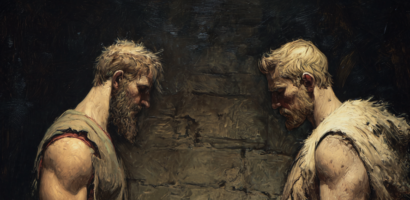
We remember that Rebekah conceived and that it was God’s response to the emotional and faithful intercession of her husband. We also remember that as her pregnancy progressed, Rebecca felt vigorous movements within her womb: But the children struggled together within her… The wordּ “struggled” here renders the Hebrew words וַיִּתְרֹצְצו, but it does not really express the gravity of Rebecca’s situation: the root רצץ communicates the idea of “breaking”, “crushing” and “oppressing”—the movements she felt were extremely strong and extremely unusual.
Rebecca was truly concerned, probably first of all because of possible miscarriage—remember she had been barren for twenty years. A modern woman would have an ultrasound; of course Rebecca did not have this option, and as we already know, she went to inquire of the LORD.
23 And the Lord said to her:
“Two nations are in your womb,
Two peoples shall be separated from your body;
One people shall be stronger than the other,
And the older shall serve the younger.”[1]
While we see the long-term consequences of this famous verse, of course Rebecca was first of all preoccupied with knowledge that was relevant to her pregnancy. She realized, for the first time, that there were two babies in her womb. The Rabbinic commentaries say that she was very relieved and comforted by this news: she thought something was wrong with her baby and her pregnancy so was comforted to learn that it was “just” a struggle between two babies. I believe she was also quite astonished: Jacob and Esau were the first twins mentioned in the Bible, and at that point Rebecca may not have even known about this possibility. In this sense, it’s only when she gave birth to the twins that it became clear that she was not imagining things and that the answer did indeed come from the Lord.
TWO NATIONS IN YOUR WOMB
The second, long-term layer of God’s response was even more significant: The babies’ movements in Rebecca’s womb were but a sign foretelling the relationship they would have as siblings and symbolizing the struggle between two nations. “Two nations are in your womb”: not only does each baby pull in his own direction even now, and that’s why you feel these strong movements in your womb, but they will split up and go completely different ways once they are issued from your body.
However, there is something more that we should know about this verse. While traditional translations always render the last sentence as “the older will serve the younger”, in Hebrew this last portion of the verse is much less clear and presents considerable ambiguity: וְרַ֖ב יַעֲבֹ֥ד צָעִֽיר. Since the Hebrew words here don’t have the definite article, the word את (et) – direct definite object marker – is missing. However, withoutאת (et), it is not clear which word is the object and which is the subject. Without the marker, the text can work both ways, and therefore there is no way to determine who will serve whom.
Finally, we have to know that שְׁנֵי גֹיִים בְּבִטְנֵךְ – Two nations are in your womb – has been a very important phrase in Jewish history. Many times, it has been used to define the relationship of the people of Israel to the nations around them. For instance, just as Jacob was seen as representing his descendants, the Jewish people, so Esau was said to represent Rome—the power that destroyed the Temple and scattered the remnants of Israel. The phrase has also been used by Jewish commentators in their perceptions of Jews and Christians in Late Antiquity.
THE TWINS
Finally the twins were born. I wonder what was going through Rebecca’s mind as she watched her little sons. She knew that her boys would go different ways – did she see it from the very beginning? Just a few days ago I was listening to my friend telling me how badly her children fight and quarrel and how desperate she feels because of that. Did Rebecca feel desperate? Did she try to reconcile them when they were fighting, or did she just think: they are destined to be this way anyway, so why to bother? Indeed, motherhood becomes an ultimate test of faith for almost every mother – and I have no doubt that it was like this for Rebecca: her whole situation, prophesized and defined by God, was extremely complicated and challenging.
We all know the story about the blessing ‘stolen’ by Jacob thanks to Rebecca’s plot. However, before this story, there had been years and years (next time, we will calculate together how many years exactly) of difficult, painful and torn motherhood. Did she share this prophecy with her family? With her husband? With her sons? How did this terrible split between the brothers begin? Did they not get along from the very beginning, even when they were small children? Was this split inevitable because of God’s prophecy, or was it just an imperfect human understanding of this prophecy that caused the enmity between the brothers?
Is it important for us to understand that? I believe it is, because it seems to be very important for God. We see in the Scripture that the whole life of Jacob/Israel, in a sense, has been shaped and determined by his conflict with his brother: it is because of this conflict that he went into exile, where he stayed at Laban’s service for 20 years, married and fathered 11 sons (Benjamin was born later); and it is because of and before his meeting with Esau (the night before this meeting), that he had his amazing and unique encounter with God at Penuel that changed his name and changed his heart—and also definitely changed the course of the upcoming meeting of the brothers. And if the story of Jacob and Esau is important in God’s eyes (not to mention their mother who is our primary object here), it should also be important in ours. So, how did this conflict begin? Maybe, the terrible split that will tear the brothers apart has its origin in the parents’ story?
(to be continued)
Many of the things that you’ve read here, I tell my students during DHB (Discovering Hebrew Bible) classes . I just want to let you know that a new semester at eTeacher is starting next week. If these articles whet your appetite for discovering the hidden treasures of the Hebrew Bible, I would be happy to provide more information (and also a teacher’s discount) regarding eTeacher courses.
[1] Gen.25:23