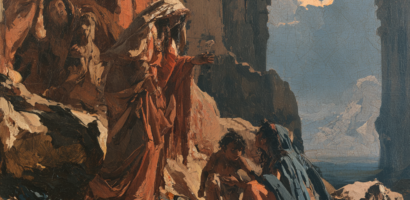



Do you remember Joseph’s tears in the inner room – tears that the brothers do not see, but we the readers do: and he went into his chamber and wept there? Do you remember also what Joseph did upon leaving this chamber: he washed his face so that his tears would not be seen – so there would be no trace of that love – and came out; and he restrained himself… (ויתאפק).[1] We need to remember this word “restrained” – these tears of love that Joseph had to hold back – when we read through the rest of the story. We need to know that the moment will inevitably come when the tears of love that are held back and hidden in Chapter 43, will be revealed to their full extent, because Joseph will be not able to restrain himself… ( וְלֹֽא־יָכֹ֙ל יוֹסֵ֜ף לְהִתְאַפֵּ֗ק ) any longer; he will allow himself to weep aloud and finally reveal himself to the brothers.
What does it mean, to “restrain” himself ( לְהִתְאַפֵּ֗ק)? The prophet Isaiah used the same word while speaking to God about Israel. ‘Where are Your zeal and Your strength, the yearning of Your heart and Your mercies toward me? Are they restrained?” For me, the testimony of this word is priceless: the dramatic and startling apparent inconsistency between what we see with our eyes and what is going on in the true, invisible reality of the heart, is condensed in this word. Joseph (revealing the character of God’s love in this more than in anything else!) cannot reveal himself to the brothers until his plan is complete – until God’s work in the hearts of the story’s participants is finalized. In the same way, for the sake of His plan, God restrains and withholds His love and mercy, therefore the reality we see with our natural eyes scarcely corresponds to the reality of His heart. It is an “as though” reality – if you recall our Key Number Three – and this “as though” reality is often used by God to test hearts.
Joseph needed the set-up with Benjamin in order for the brothers to repent and be transformed – but the testing of the brothers was possible only because Joseph’s love for Benjamin was hidden from them. Without exception, each brother had to be kept in the dark regarding the infinite love this powerful governor held for their younger brother. Only in so doing, could their true attitude towards him could be ascertained. In the same way, all who have received salvation, thanks to Israel being “enemies for (their) sake”, are being tested by Israel today. The attitude of the nations toward Israel can be gauged because, on the level of visible circumstances, nothing is coercing them to believe that God loves His people. It goes without saying that those who know God loves Israel can find enough visible confirmations of this love. However, the innumerable tragic facts of our history are also at the service of those who claim that God has rejected His people. As always, God gives everyone a free choice: in this case, it is the liberty to choose one’s attitude to Benjamin/Israel.
Paradoxically, it is by this attitude that He will judge whether the nations’ attitudes towards Him are genuine, and whether they are sincere in their worship of Him. Do you remember the first conversation Joseph had with his brothers? The ten brothers stand before Joseph, bowing down to the ground before him, and he tells them: “No, I will not speak with you until you bring your younger brother.” Moreover, precisely by your bringing him with you will I discover whether there is any truth in you – whether you have come to me in sincerity. In this manner, you shall be tested: …bring your brother… that your words may be tested to see whether there is any truth in you. Maybe, peoples standing before His throne will hear: “Bring your brother – and I will see whether there is any truth in you?”
And now, back to the most crucial question: What was it that brought this “as though” time to its conclusion; why could Joseph no longer restrain himself? Last time, we spoke about the remarkable division of Torah portions here: Parashat Shavua Miketz suddenly ends in the middle of the chapter 44, to give way to a new Parasha, VeYigash. Thus, the flow of this chapter, completely uninterrupted in translations, breaks in the middle of the chapter for a Hebrew reader. There is a break, a pause, something significant is about to happen – and then we read the first sentence of the next Portion, VeYigash: Then Judah came near unto him .…[2] It is here, in VeYigash, after Judah’s move and Judah’s speech, that Joseph reveals himself to his brothers.
Let us say a few words about Judah: after all, he has been a key player throughout all of this story. His voice is decisive every time something is about to happen: it is according to his suggestion that Joseph is sold to Egypt; it is after his words that Jacob/Israel releases Benjamin go to Egypt; and it is after his speech that Joseph can no longer restrain himself, and reveals his identity. Among all the brothers, Judah seems to have a pre-eminent role and an amazing authority. Whom does he represent, then?
We all know that both King David and Jesus were descendants of Judah. You may also know that Judah’s Hebrew name, Yehudah (יהודה), can be translated literally as “thanksgiving” or “praise”: the verb lehodot (להודות) means “to thank” or “to praise”, and the Hebrew name Yehudah is the noun form of this root Y-D-H (ידה). However, few are aware that the verb lehodot has yet another meaning: to admit, to confess. For example, Vidui, the Hebrew name of a special prayer of confession read before and during Yom Kippur (Day of Atonement), comes from the same root. There is no doubt that this ‘confession’ aspect of Judah provides an important additional insight into our story.
Having said all this, I will leave it for you to decide who is represented by Judah in the end-time scenario. As in the story of Joseph, the recognizing of the unrecognized will become possible only after the test is completed. All the nations will be tested with what is nearest and dearest to God’s heart – as in our story, all the brothers have to be ready to return with Benjamin and to again walk out the entire path. However, in order for Joseph to release his ‘restrained’ tears, there must be Judah who will be ready to step in and approach Joseph: Veyigash. When Judah, and those who are represented by him, are finally prepared to lay down their lives for this brother, only then does Joseph allow his restrained tears to flow – and only then does Messiah son of Joseph reveal himself to his brothers, falling on the neck of “Benjamin” and weeping[3].
[1] Gen. 43:31
[2] Gen 44:18
[3] All these parallels between the story of Joseph and Benjamin and God’s plan with Israel, are explored in my book “If you are Son of God…” You can get this book (and my other books) from my website readjuliablum.com