

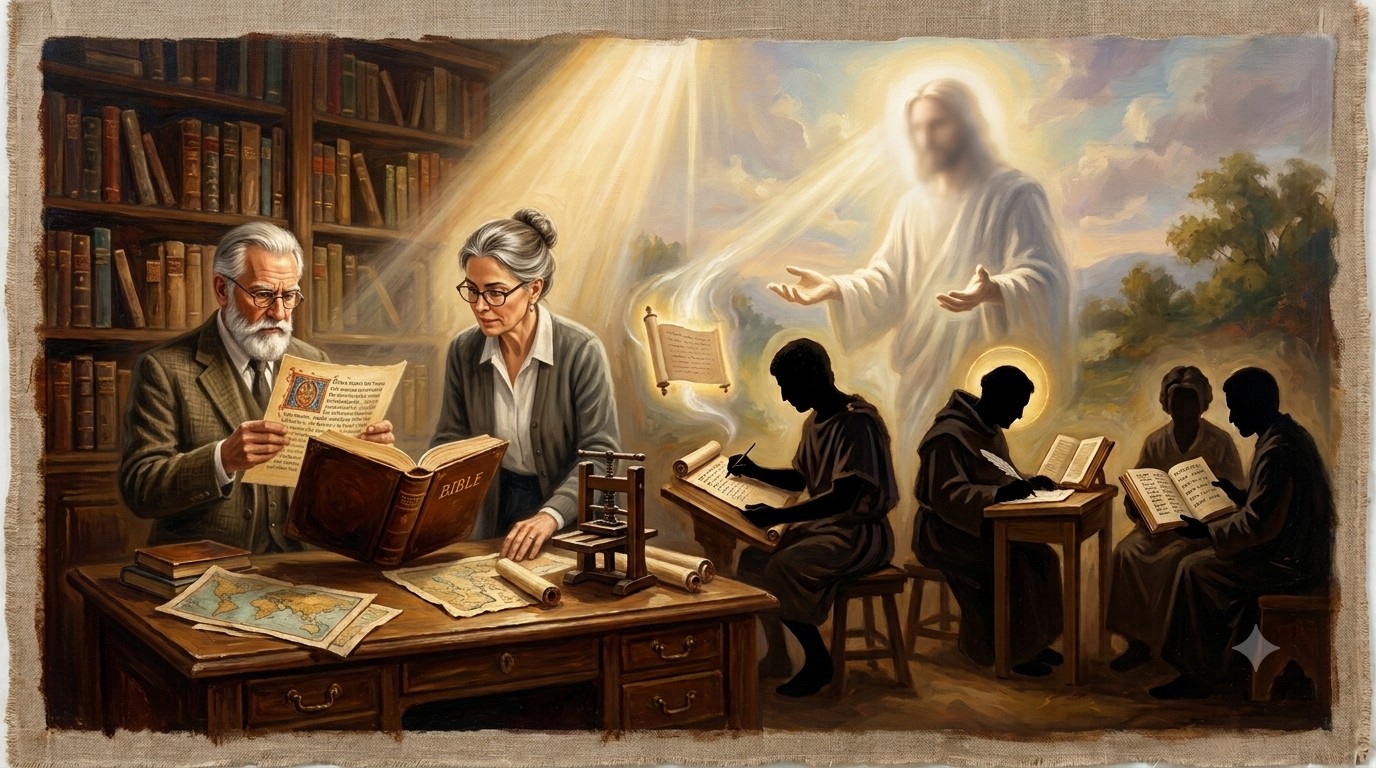
Imagine holding a text recorded over a millennium ago, feeling the immense weight of centuries preserved within its pages. The Hebrew Bible stands as an extraordinary living legacy, faithfully handed down across generations through ancient scrolls and dedicated scribes.
Understanding its remarkable journey from fragile manuscripts to modern translations does more than satisfy historical curiosity. It opens a door into the world of the original writers, deepening personal connections to Scripture and revealing the living voice behind every word.
TLDR:
The journey of the Hebrew Bible from ancient parchment scrolls to modern translations reflects a remarkable story of historic preservation. Centuries of careful copying by dedicated scribes kept God’s Word intact across generations.
Relying only on English translations can sometimes hide rich cultural nuances. Exploring the history and original language of Scripture brings ancient passages to life, offering fresh clarity and a deeper connection to God’s Word.
Feeling Distant From The Ancient World Of Scripture
Reading the Bible in English is a wonderful gift, but relying only on translation can sometimes create distance from the world in which Scripture was first written. As faith deepens, many Christians naturally become curious about how the Bible was preserved, transmitted, and translated through the centuries. Exploring those questions is not a sign of doubt. It’s a meaningful step toward a deeper understanding of God’s Word.
One of the clearest examples is the Hebrew word Torah (תּוֹרָה). Although it’s often translated as “Law,” its meaning reaches beyond a single English word. Depending on the context, Torah also carries the sense of teaching, instruction, or loving guidance. Returning to the original Hebrew reveals layers of meaning that are difficult to capture in just one English translation, helping readers experience Scripture with greater depth and richness.
Origins And Early Manuscripts: How Scripture Began
Before the Bible was gathered into the book we know today, God’s Word was preserved through rich oral traditions and carefully copied written manuscripts on parchment and papyrus scrolls. Early biblical texts likely drew on longstanding oral traditions, while other texts were composed in writing from the start.
Paleo-Hebrew served as the earliest known script for writing the Hebrew language, developing from the Phoenician alphabet around the 10th century BCE. During and after the Babylonian exile in the 6th century BCE, Jewish scribes gradually adopted the Aramaic square script. Over time, this square script became the standard for copying the Hebrew Scriptures.
The letter Aleph (א) provides a memorable example of that visual evolution. Originally drawn like the head of an ox to represent strength and leadership, the picture transformed into the square letter seen on biblical scrolls today. Experiencing these roots builds a direct connection to the evolution of the text.
Timeline: The History Of The Hebrew Bible
The story of the Hebrew Bible stretches across centuries of history, shaped by changing cultures, languages, and remarkable acts of preservation. Every stage in its journey helped safeguard God’s Word, allowing its message to reach generation after generation.
Looking back at that journey offers a deeper appreciation for the remarkable history behind the Scriptures we read today.
| Time Period | Historical Milestone | Why It Matters For Readers Today |
| c.1200-500 BCE | Early Manuscript Composition | The Torah, Prophets, and Writings were recorded in Hebrew on parchment and papyrus scrolls, establishing the sacred foundation of Scripture |
| c. 250 BCE | The Septuagint (LXX) | Jewish scholars translated the Hebrew Scriptures into Greek, making God’s Word accessible to ancient Greek-speaking communities |
| c. 150 BCE-70 CE | The Dead Sea Scrolls | Manuscripts preserved the earliest surviving copies of Hebrew biblical texts |
| c. 500-1000 CE | The Masoretic Text | Masoretic scribes added vowel markings (niqqud) to protect traditional pronunciation, creating the standard text used today |
The Masoretes And The Dead Sea Scrolls: A Story Of Preservation
The Hebrew Scriptures were preserved with extraordinary care by generations of devoted scribes. Among the most influential were the Masoretes, who meticulously copied every letter and word to protect the text from errors. Their careful work reflected a deep reverence for God’s Word and a commitment to passing it on faithfully to future generations.
Centuries later, the discovery of the Dead Sea Scrolls offered remarkable confirmation of that tradition. Among them was the Great Isaiah Scroll, which scholars compared with the later Masoretic version of Isaiah. Although the two texts were separated by more than a thousand years, they showed an astonishing degree of agreement, providing powerful evidence for the faithful preservation and transmission of Scripture.
Why Learning The Original Language Deepens Faith
Exploring the historical and cultural context brings familiar passages to life in fresh and meaningful ways. Many details that seem ordinary in English become more vivid when viewed through the world of the original authors. Hebrew wordplay, rich imagery, and carefully crafted poetic structures often preserve subtle meanings that can be difficult to communicate in English.
A beautiful example is the Hebrew word Shalom (שָׁלוֹם). Although it’s commonly translated as “peace,” it speaks of more than just the absence of conflict. Shalom also expresses wholeness, completeness, well-being, and flourishing. Exploring words like Shalom in their original language opens the door to a richer understanding of Scripture and helps readers experience the depth and beauty woven throughout God’s Word.
Read Scripture In Its Original Context
Learning about the Bible’s remarkable history naturally leads to an exciting next step: exploring the original Hebrew for yourself. With the guidance of the scholars at the Israel Institute of Biblical Studies, you can approach the biblical text with confidence in a supportive, beginner-friendly environment that emphasizes spiritual growth.
Biblical Hebrew A provides a welcoming introduction to the language, with additional levels that allow learners to continue building their skills at a comfortable pace.

The Institute also offers programs in other ancient languages, including Biblical Aramaic and Biblical Greek, along with Biblical and Holy Land Studies, where you explore topics such as biblical archaeology, the geography of the Bible, and individual books of Scripture.
Every course is designed to deepen your understanding of God’s Word while helping you connect more closely with the world in which it was first written.
Begin Your Journey Into Biblical Hebrew
Engage the biblical text directly and experience hidden layers of meaning with guided support from Israeli scholars. Explore our beginner courses now.
Conclusion
The history of the Hebrew Bible tells an incredible story of divine preservation. From ancient parchment scrolls stored in desert caves to the meticulous work of scribal traditions, God’s Word has been handed down with extraordinary care across thousands of years.
Stepping into the original language lifts the translation filter, transforming familiar verses into vibrant, picture-rich encounters. Small breakthroughs in Hebrew reveal rich word connections, poetic depth, and historical context that strengthen personal faith.
Starting this journey requires no prior academic background. Guided study opens the beauty of Scripture one letter at a time, allowing ancient words to speak clearly today.
FAQ:
Is Biblical Hebrew difficult for beginners to learn?
Learning a new script takes practice, but Biblical Hebrew follows an elegant, logical structure based on three-letter roots. Step-by-step guidance keeps the learning experience encouraging and achievable.
How do the Dead Sea Scrolls prove the accuracy of the Bible?
Comparing manuscripts from the Dead Sea Scrolls with the Masoretic Text written a thousand years later shows remarkable word-for-word consistency, proving that scribes copied the text with extreme care.
What is the main difference between Paleo-Hebrew and square Hebrew script?
Paleo-Hebrew was an ancient pictographic script used in early Israelite history. The square script was adopted around the time of the Babylonian exile and forms the alphabet used in Hebrew Bibles and modern Israel today.
Why should someone study Biblical Hebrew instead of relying only on English?
English translations simplify complex terms for readability. Studying the original language uncovers hidden root connections, cultural nuances, and poetic structures that translations can’t fully capture.