


Most people assume they need years of study before they can confidently read a single verse of the Bible in its original language. That assumption often keeps them relying exclusively on translations, even though it’s possible to begin reading Biblical Hebrew much sooner by building a solid foundation one concept at a time.
The truth is much more encouraging than many people realize. You don’t need to master every grammar concept before you begin reading. Instead, you need the right building blocks, introduced in a logical order, that help you recognize how the language works.
Biblical Hebrew has its own unique structure and way of expressing ideas. As you begin learning its foundational grammar, you’ll discover that the language is remarkably consistent, revealing not only how the text is written but also the rich culture and worldview behind it.
Let’s explore why Biblical Hebrew feels so different from English, the foundational grammar concepts every beginner should know, and how they can open the door to reading Scripture in its original language.
TLDR:
Biblical Hebrew has a reputation for being difficult, but much of its grammar follows consistent patterns that become easier to recognize with guided practice. Instead of memorizing thousands of unrelated words, you’ll learn how three-letter roots, recurring patterns, and a handful of foundational grammar concepts work together to form the language.
By learning the alphabet, understanding how words connect, and recognizing how Hebrew verbs express completed or ongoing action, you can begin reading authentic biblical passages while continuing to deepen your understanding. If you’re looking for a clear path forward, structured instruction can make the learning process much more approachable.
Why The Original Text Feels Different (And Why It Matters)
If you try to read Hebrew through the lens of English grammar, it feels like trying to fit a square peg into a round hole. English is a Germanic language built on strict word order and precise timelines. Hebrew is a Semitic language built on relationships, pictures, and multi-layered meanings.
When we read standard translations, we are often looking at a smoothed-out, flattened version of a deeply poetic masterpiece. Translators are forced to choose English words that best fit the context, but many Hebrew expressions carry a wider range of meaning than any single English word can fully capture.
Consider how the text uses rhythm and sound to paint pictures. In the creation account in Genesis, the earth is described as tohu vavohu (תֹּהוּ וָבֹהוּ), which is often translated as “without form and void.”
In Hebrew, the two words rhyme and echo each other, creating an auditory sensation of swirling, untamed chaos. While translations communicate the meaning accurately, some of the poetic rhythm and literary beauty naturally remain in the original language.
This is why learning the foundational structure of the language matters. It helps you appreciate not only what the text says, but also how it communicates its message.
The 6 Essential Building Blocks For Reading
You don’t need to be a linguist to read the Bible in Hebrew. By focusing on these six foundational grammar concepts first, you’ll develop the confidence to begin exploring authentic biblical passages while continuing to build your knowledge over time.
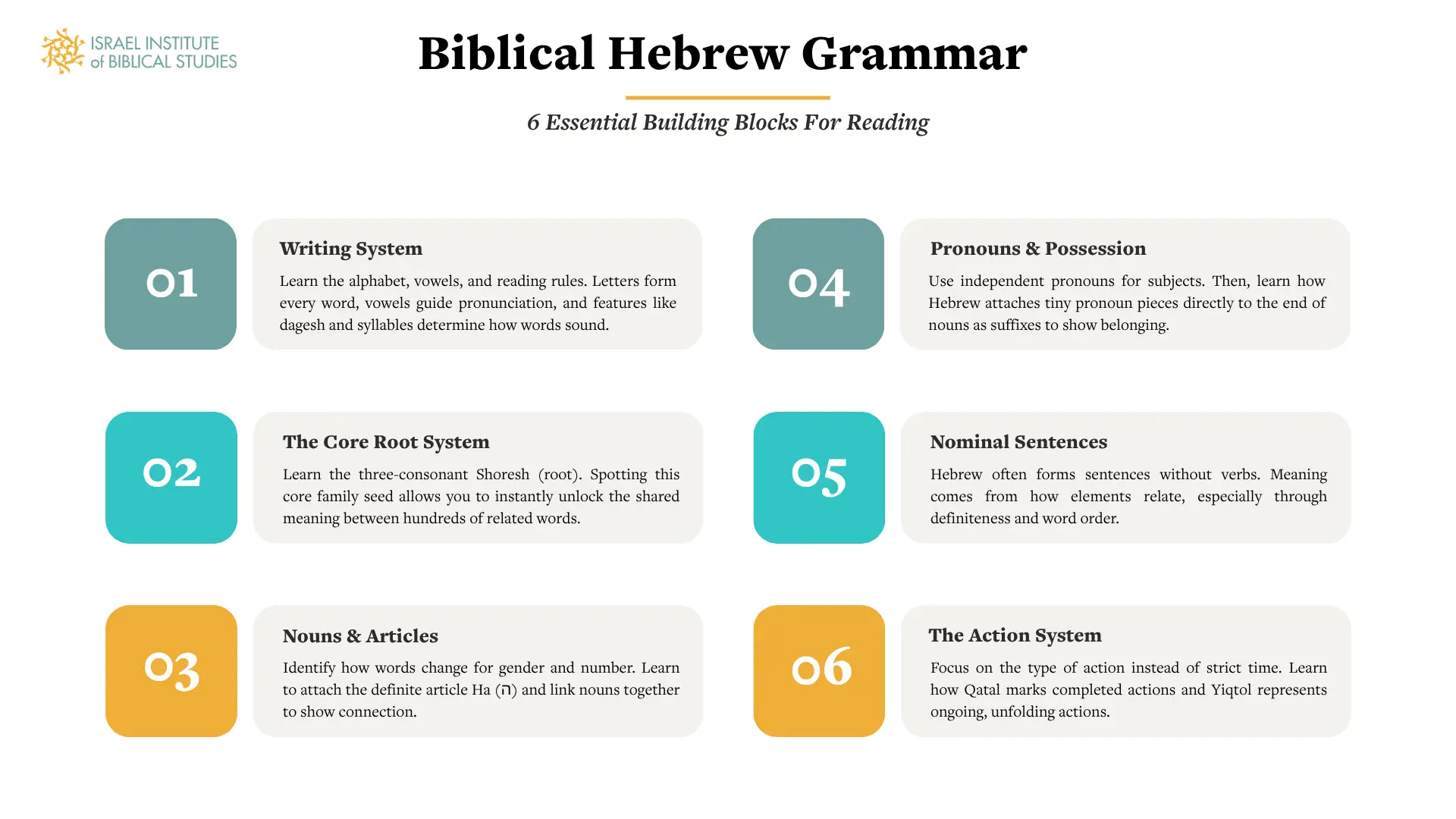
1. The Alphabet And The Sounds Of Scripture
Your journey begins with the Hebrew alphabet: 22 consonants written from right to left, from א (Aleph) to ת (Tav). It’s a visual language, and as you learn the letters, you will notice a few look slightly different when they come at the very end of a word.
The script holds another feature worth knowing. Because the original text was written using only consonants, a system of dots and dashes called Niqqud (vowels) was later added around the letters to preserve the pronunciation.
Once you can read those vowel points, the connections between words become easier to recognize. Take the word for “bread,” lechem (לֶחֶם). The very same three consonants, pointed differently, give you milchamah (מִלְחָמָה), meaning “war.”
To the ancient Hebrew mind, these ideas were intimately connected because war was often fought over resources such as food. Seeing these relationships within the language offers insights that are difficult to capture through translation alone.
2. The Core Root System
In Hebrew, words are rarely random. Most nouns, verbs, and adjectives are built from a three-consonant skeleton called a Shoresh (root). Think of the root as a family seed. When you place that seed into different structural frames, it grows into different related words.
For example, the root כ-ת-ב (K-T-V) expresses the idea of writing. By adding different vowels, it becomes katav (כָּתַב), “he wrote,” or kotev (כּוֹתֵב), “writing.” By adding a prefix, it becomes michtav (מִכְתָּב), “a letter.
Once you learn to spot the three-letter root, your vocabulary expands exponentially because you can see how hundreds of words are conceptually linked.
Roots do more than build vocabulary, though. They also preserve the connections the ancient mind saw between ideas. The word for “womb,” rechem (רחם), shares its root with rachamim (רחמים), “mercy” or “compassion.” In the biblical worldview, compassion is closely associated with the nurturing, protective love of a mother, a connection beautifully preserved within the language itself.
3. Nouns And How They Connect
Hebrew nouns identify people, places, and things, while also expressing gender and number. Masculine plurals usually end in —im (ים), while feminine plurals usually end in —ot (ות). Another simple feature you’ll encounter early on is the definite article. Instead of using a separate word for “the,” Hebrew adds the letter Ha (ה) directly to the beginning of the noun.
Hebrew also links nouns together in a distinctive structure called the construct chain. Instead of saying “the house of the king” or “the laws of the Lord” with separate connecting words, Hebrew places the two nouns side by side, creating a close grammatical relationship between them.
4. Pronouns And Belonging
Pronouns like “I,” “you,” “he,” and “she” stand as independent words when they are the subject of a sentence. However, to show possession or ownership, Hebrew often attaches small pronoun endings directly to nouns and prepositions, creating compact expressions that become familiar as you continue learning.
Instead of writing two separate words for “my king,” Hebrew takes the word for “king,” melech (מֶלֶךְ), and adds a tiny sound to the end to make malki (מַלְכִּי), which means “my king.”
This feature gives the language a remarkable sense of closeness. When the psalmist cries out Eli (אֵלִי), “my God,” the relationship between the speaker and God is woven directly into a single word, making the expression both personal and powerful.
5. Sentences Without Verbs
One of the most liberating things for a beginner to learn is that Hebrew sentences frequently don’t use verbs at all. In English, we naturally say, “The man is wise.” Hebrew simply places the noun and adjective together, leaving the connection implied.
For example, Ha’ish chacham (הָאִישׁ חָכָם) literally reads, “The man wise.” As you become familiar with this pattern, you’ll find that many biblical sentences become surprisingly straightforward to understand.
Learning this structure early provides a solid foundation before you move on to the broader range of Hebrew verb forms and sentence patterns you’ll encounter later in your studies.
6. The Action System: Completed And Ongoing
When you begin studying Hebrew verbs, you’ll notice that they don’t always emphasize time in the same way English verbs do. Instead of focusing exclusively on the past, present, or future, Biblical Hebrew often highlights the nature of an action.
The Qatal form generally presents an action as complete or whole, while the Yiqtol form often describes an action that is ongoing, unfolding, or incomplete. Understanding this distinction helps readers appreciate nuances that sometimes become less visible in translation.
We see this clearly in the priestly blessing of Numbers 6:24, Yevarechecha Adonai veyishmerecha (יְבָרֶכְךָ יְהוָה וְיִשְׁמְרֶךָ), “The Lord bless you and protect you.”
The verb yevarechecha takes the ongoing Yiqtol form. Because this form represents an unfolding action, it implies that God’s blessing and protection are not a one-time past event, but a continuous stream of grace that never stops flowing into your life.
Encountering The Miracle Of The Language
As you study these foundational grammar concepts, you’re doing more than learning vocabulary or sentence structure. You’re engaging with one of history’s most remarkable linguistic traditions.
For centuries, Biblical Hebrew was preserved primarily in sacred scrolls and prayer. Then, in an extraordinary chapter of history, it became the only ancient language to return to everyday spoken life on a national scale.
Today, the same alphabet, roots, and many of the same grammatical patterns found in the Hebrew Bible continue to be used in modern Israel. Learning Biblical Hebrew allows you to explore a language that connects the ancient world with the present in a uniquely tangible way.
Your Path To Guided Discovery
Studying on your own with books, videos, or flashcards is an excellent way to begin building your foundation. At the same time, many learners find that questions naturally arise as they begin reading biblical passages and encountering new grammar patterns.
Learning alongside experienced instructors and a supportive community can make that process much more rewarding. At the Israel Institute of Biblical Studies (IIBS), our programs combine structured grammar instruction with the historical, cultural, and spiritual context that brings the biblical text to life.

Through our foundational Biblical Hebrew A course, you’ll build your understanding step by step, beginning with the alphabet and core grammar before progressing toward reading authentic passages from Scripture. Weekly live online classes, accredited by the Hebrew University of Jerusalem, provide both academic rigor and a supportive environment that encourages steady, confident progress.
CTA: Take Your First Steps Into Biblical Hebrew
If grammar is where you get stuck, a structured course accelerates progress. The Israel Institute of Biblical Studies offers structured courses with expert teachers that walk with you every step of the way.
Conclusion
Biblical Hebrew grammar may seem unfamiliar at first, but it follows a remarkably consistent system built on roots, patterns, and recurring structures. As you learn the alphabet, recognize word families, and understand how nouns, pronouns, and verbs work together, you’ll begin reading biblical passages with growing confidence.
The key isn’t mastering every grammar topic before you begin. It’s building a solid foundation and expanding it gradually through consistent practice. The six concepts we’ve explored provide an excellent starting point, helping you see connections, literary beauty, and layers of meaning that are often difficult to capture in translation.
Each new concept builds on the last, opening the door to a richer appreciation of Scripture in its original language. Every step forward brings you closer to experiencing the text as its earliest readers encountered it.
FAQ:
Do I need to learn Biblical Hebrew grammar to understand the Bible?
Translations work well for the core message, but they inevitably flatten the text. Learning the basic structure gives you direct access to the multi-layered wordplay, poetic echoes, and cultural nuances that translations can’t fully capture.
How long does it take to learn the basics?
Most students comfortably learn the alphabet, the vowel system, and foundational grammar concepts within a few months of consistent study. Our framework is designed to make you feel comfortable identifying words and reading real biblical sentences in a manageable, weekly format.
What is Shoresh in Biblical Hebrew?
A Shoresh is a three-consonant root that forms the conceptual heart of Hebrew words. Instead of memorizing thousands of unrelated vocabulary words, recognizing roots allows you to instantly see the spiritual and thematic connections between families of words.
Why do translations miss so much of the original meaning?
Because English and Hebrew belong to completely different language families. Hebrew uses aspect-based verbs, gendered concepts, and rhythmic sound patterns. Translators must pick a single English word to fit the sentence, leaving behind the poetic depth present in the original Hebrew text.