

 The Jewish Revolts against Rome (sometimes called the Jewish Wars) were a series of small and large-scale armed conflicts between the Jews and the Romans that spanned almost two centuries. These wars provide the overall historical background for the understanding of New Testament texts.
(This text is an excerpt from an entry in Online Lexham Bible Dictionary by Logos Press).
The kingdom of Israel was situated along a major trade route to Egypt and Africa and throughout its history was dominated by a number of larger nations. The Roman Empire controlled Israel’s territories from 63 BC into the fourth century AD. Apart from the Greco-Roman dominance, this period of Israel’s history was characterized by substantial internal divisions: Pharisees, Sadducees, Essenes, Qumranites, Hellenists, Herodians, Samaritans, Proselytes, Galilean and Diaspora Jews (Josephus, Antiquities XVIII 1.2-6; Eusebius, Ecclesiastical History IV 22.7; Justin Martyr, Dialogue with Trypho 80; Mark 3:6; Acts 6:1, 2:11, 9:29; Luke 10: 25-37, 17:11-19, John 4:1-40). Roman rule precipitated the emergence of newly-organized nationalistic revolutionary groups. According to Josephus, a radical Jewish movement of Zealots (ζηλωταὶ/קַנָאִים) believed that political and religious freedom for Israel should be achieved by any means necessary (Josephus, Antiquities XVIII. 1.6). Zealots, and among them the Sicarii (σικάριοι), were known for violent opposition to Rome (Acts 21:28). Unmoved even by death they were responsible for much of the unrest. (To make comment and to visit the original post, click HERE.)
The First Revolt
In the first century the tensions associated with Roman rule erupted into multiple violent conflicts in Israel and in the centers of Jewish Diaspora. A tax census of Quirinius triggered an uprising by Judas the Galilean in 6 AD (Josephus, Antiquities XVIII. 1.1; Acts 5:37; Eccl. Rabbah 1:11). The local population of Egyptian Alexandria rioted against the Jews in 38 AD for not properly honoring Emperor Caligula (Josephus, Antiquities XVIII 8.1). After an incident involving the construction of a pagan altar in front of the synagogue in the Judean town of Jamnia, Caligula ordered a statue of himself erected in the Jerusalem Temple, escalating the tensions (Philo of Alexandria, The Embassy to Gaius XXX 200-203; Josephus, Jewish War II 184-203, Antiquities XVIII 289-309). A messianic contender named Theudas attempted an uprising around 46 AD, but was quickly apprehended and beheaded by the Romans (Acts 5:36; Josephus, Antiquities XX 5.1). In 46 AD Simon and Jacob, the sons of Judah the Galilean, led an uprising in Galilee and were defeated by 48 AD (Josephus, Antiquities XX 5.2).
The First Jewish Revolt against Rome (66-70 AD) followed these smaller uprisings. It ignited with riots under procurator Florus and its exact causes remain uncertain. Most of the details that are known about this war come from Joseph ben Matityahu better known as Flavius Josephus. Josephus personally witnessed the revolt, having fought against Romans in Galilee. He defected and served Vespasian and Titus, later documenting the events he witnessed. According to Josephus the revolt was instigated by a minor disturbance between Jews and Gentiles in the coastal town of Caesarea. Florus’ brutality across Israel and appropriation of temple funds for Rome provoked the populace and made war unavoidable (Josephus, Wars of the Jews II 14-16).
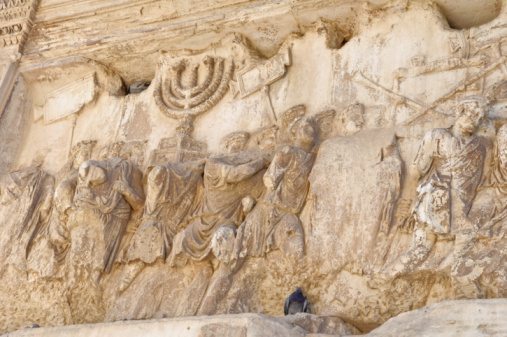
The revolutionaries first attacked Jews loyal to Rome and then overpowered a Roman garrison stationed in Jerusalem, temporarily eliminating Roman control of the region. The governor of Syria, Cestius Gallus, was dispatched to restore order with thirty thousand troops. After a series of attempts he was defeated and was not able to retake Jerusalem. Emperor Nero appointed Vespasian to put down the Judean rebellion with greater force. By 68 AD Vespasian’s sixty thousand man army crushed the resistance in Galilee and along the Mediterranean. In December of 69 AD Vespasian became the next emperor and returned to Rome while his son Titus took over the military action (Eusebius, Ecclesiastical History III. 4). Titus besieged Jerusalem in the springtime of 70 AD and by summer’s end the city fell and the Temple was destroyed (Josephus, Wars of the Jews IV 4). The Romans commemorated their victory by erecting the Titus Arch, which still stands in Rome. The nationalistic freedom-seeking spirit among many Jews was shaken but not fully crushed. Three years after the fall of Jerusalem some Zealots, their families and few Roman hostages (960 people), remained besieged inside the Masada fortress. When their defeat was immanent, refusing to be captured alive, the Zealot leaders reached a decision to end each other’s lives. (Josephus, Wars of the Jews VIII-IX).
The Second Revolt
The Second Jewish Revolt, also known as the Bar Kochba Rebellion (132-135 AD), was predated by a series of widespread hostilities known as the Kitos War (115-117 AD) during the rule of Emperor Trajan (Seder Olam Rabba 30; Mishna, Sotah 9:14). In the beginning of the second century Rome was at war with Parthia and some Jews started an insurgency campaign against occupying Roman forces. It is believed that Kitos War was named after Quietus, a general who led the campaign against the Jewish rebels in Mesopotamia. A Roman source reports that the fighting was widespread. The Diaspora Jews of Cyrene massacred two hundred twenty thousand Greeks. Egypt had an uprising as well and two hundred forty thousand Greeks were killed in Cyprus (Cassius Dio, Roman History 68:32). Some fighting may have taken place in Judea as well (Babylonian Talmud, Taanit 18b). Even after these widespread conflicts were settled significant nationalist aspirations lingered among many Jews, laying the foundation for future conflicts.
The historical sources for the Second Jewish Revolt are more fragmentary. They propose several possible reasons for the Bar Kochba Revolt: The Roman desire to rebuild the Temple and their sudden reversal (Gen. Rabbah 64:10), Hadrian’s design to turn Jerusalem into a Roman city with a temple of Jupiter (Cassius Dio, Roman History 69:12, 1-2) and Roman ban on circumcision (Augustan History, Vita Hadriani 14:2). Eusebius speaks of Hadrian building the Roman Aelia Capitolina on the ruins of Jerusalem as a consequence of the war (Eusebius, Ecclesiastical History 4.6). However, Aelia Capitolina coins were found in the el-Jai cave together with Bar Kochba coins which had to be minted prior to 135 AD. The presence of such coins prior to 135 AD suggests that Hadrian had these plans for Jerusalem even before the Bar Kochba Revolt began. The war may have been a preemptive action against Emperor’s plans. Though the exact reasons that triggered the Second Revolt remain uncertain, it is safe to assume that as before the hopes of national independence fueled the revolution. Bar Kochba’s Revolt began in the town of Modi’in. Centuries earlier the Maccabean Revolt against the Greeks (167-160 BC) which culminated with Israel’s victory and the rededication of the Jerusalem Temple began in this very town. The revolution was well planed, strategically executed and may not have needed specific triggers, but only an opportunity.
The Aftermath of Jewish Wars with Rome
The Revolts against Rome proved to be catastrophic for Israel and their significance cannot be understated. Since the days of Julius Caesar the Israelites and their unique way of life were officially recognized by the Romans. With an established center in Judea and influential Diaspora communities, the Jews were a recognizable cultural force in the Hellenistic world of the Mediterranean. (Josephus, Antiquities XIV 10. 2). Despite being conquered by Rome, Israel retained the rights to maintain their own worship system and was afforded a measure of self-governance. But the nationalistic struggle for greater independence from their conquerors drastically altered these circumstances. The wars devastated the Jewish population as countless lives were lost in battles, subsequent famine and sickness. Untold numbers of Jews were enslaved and hundreds of towns and villages were destroyed (Josephus, Jewish Wars VI. 9.3; Cassius Dio, Roman History LXIX, 14:1). The constant unrest was problematic for Rome as well. The expenditure of resources and Roman casualties were significant, complicating their internal power struggles and politics (Cassius Dio, Roman History LXIX, 14:3).
The full Roman administration of the region ended the Herodian dynasty and marginalized the Jewish elites. The Revolts decentralized Jewish worship and the absence of the Temple ended many internal sectarian disputes. A new class of Jewish leadership emerged, the sages whose prominence was based not on heredity, but on Torah expertise. This non-political leadership of Jamnia scholars laid a new direction for observant Jewish life without the Temple and priesthood. The destruction of the Temple in 70 AD and the leveling of Jerusalem in 135 AD was followed by a fierce official persecution and compulsory expulsion of all Jews from vicinity of Jerusalem (Eusebius, Ecclesiastical History IV. 6). The course of Jewish life changed dramatically in Judea, the nationalistic aspirations of an independent state were crushed and remaining Jews were forced to relocate to Galilee or to major Diaspora centers. The Jewish followers of Jesus were also subject to Hadrian’s expulsion and the Jerusalem Assembly was dramatically transformed during the administration of its first non-Jewish leader Marcus (Eusebius, Ecclesiastical History IV. 6). The establishment of the Roman Aelia Capitolina on the ruins of Herodian Jerusalem began a long chapter in the history of the region without meaningful Jewish prominence. As nascent Christianity began to gain prominence in Rome the city of Jerusalem slowly lost its influence as the historical and spiritual center of Jesus movement.
Many Jews of that era have pondered the deeper reasons behind these tragic events. The prior devastations announced by Israel’s prophets provided a precedent for Israel being chastised by the means of foreign conquerors (Neh. 9:30; Jer. 25:1-14; Is.10:5-6; 39:5-8). In the gospels Jesus lamented His rejection and persecution by quoting Psa. 69:4, “They hated me without a cause” (John 15:18-25) and even predicted Jerusalem’s ruin because her inhabitants did not recognize Him (Luke 19:4). In retrospect, the rabbis of the Talmudic era saw the destruction of the Temple as a sign of divine punishment, attributing it to inter-Jewish “hatred without a cause” (Babylonian Talmud, Yoma 9b). The third book of the Sibylline Oracles and the first fourteen chapters of Second Baruch written by Jews in the second century AD also saw divine punishment as the underlying cause of these tragic events.