

25 Now a discussion arose between some of John’s disciples and a Jew over purification. 26 And they came to John and said to him, “Rabbi, he who was with you across the Jordan, to whom you bore witness – look, he is baptizing, and all are going to him.” 27 John answered, “A person cannot receive even one thing unless it is given him from heaven. 28 You yourselves bear me witness that I said, ‘I am not the Christ, but I have been sent before him.’ 29 The one who has the bride is the bridegroom. The friend of the bridegroom, who stands and hears him, rejoices greatly at the bridegroom’s voice. Therefore this joy of mine is now complete. 30 He must increase, but I must decrease.” 31 He who comes from above is above all. He who is of the earth belongs to the earth and speaks in an earthly way. He who comes from heaven is above all. 32 He bears witness to what he has seen and heard, yet no one receives his testimony. 33 Whoever receives his testimony sets his seal to this, that God is true. 34 For he whom God has sent utters the words of God, for he gives the Spirit without measure. 35 The Father loves the Son and has given all things into his hand. 36 Whoever believes in the Son has eternal life; whoever does not obey the Son shall not see life, but the wrath of God remains on him.
Between the Nicodemus’ story and the story of Samaritan Woman, John very briefly draws our attention back to John the Baptist. He brings us back only to move us forward in his narrative presentation of Jesus’ life as he continues to make his case for Jesus’ supremacy.
The crucial time has come. The ministry of Jesus is to supersede the well-established, prophetic, anointed ministry of John the Baptist. If we are to see this story in connection with the thesis that the Gospel may have been written with Samaritan Israelites in mind, its literary setting will be even more significant than it may seem at first.
You see, the Gospel of John is not pro-Samaritan; rather it is a Judean Gospel that is Samaritan-oriented in its mission. There is a big difference. The Israelite Samaritans were persuaded that they had always followed a more faithful way than had the Judean Israelites. (Remember they believed that those Israelites who had Zion and Jerusalem as their center of worship were in error and had gone down a wrong path).
We are not told what the debate was over (vs.25), but we are told that following this apparently heated discussion with one Iudai (a Jew in most translation) the followers of John the Baptist came to him to question him about the rising popularity of Jesus’ ministry among the people. (Jn. 3.25-26)
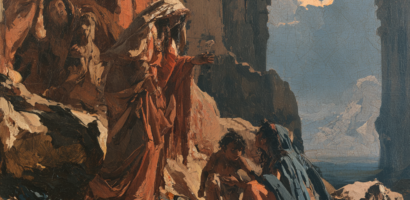
The Baptist then confirmed to his disciples that Jesus is the one who has supremacy, reminding them that he had previously told them so. (Jn. 3.27-28) John compared himself to the best friend at the bridegroom’s wedding, who rejoices with the bridegroom, but is not the center of the celebration. John the Baptist’s disciples needed to follow John and allow Jesus to take the lead. “He,” said John, “must increase, but I should decrease” (vs.30). In fact this statement by John foreshadows Jesus’ statement to the Samaritan woman “… believe me, the hour is coming when neither on this mountain nor in Jerusalem will you worship the Father.” (Jn. 4.21)
Here, like earlier in the chapter (Jn.3.16-21), we must remember that John the Baptist is continuing to speak. The Gospel’s author places the words recorded in vs. 31-36 in John the Baptists’ mouth.
John the Baptist makes a statement strikingly similar to Jesus’ statement to Nicodemus. You will recall that Jesus said to Nicodemus: “For God did not send his Son into the world to condemn the world, but to save the world through him. Whoever believes in him is not condemned, but whoever does not believe stands condemned already because they have not believed in the name of God’s one and only Son.” (Jn. 3.16-17) John the Baptist says to his followers: “The Father loves the Son and has given all things into his hand. Whoever believes in the Son has eternal life; whoever does not obey the Son shall not see life, but the wrath of God remains on him.” (Jn. 3.34-36)
It’s essential to note that both John the Baptist and Jesus (as well as John the Zebedee who likely authored the Gospel) expected the Jewish Nicodemus and the Jewish disciples of John the Baptist to understand and relate to the language of the supremacy of the Son of God. In other words, to be used so openly and freely, it must not have been a new or foreign concept to them as we normally think. After all the Sonship of God concept was the very argument that both Jesus and John the Baptist employed to prove their point.
The Samaritan Israelites just like John’s disciples struggled to accept supremacy of Jesus. However, they needed to do so, because Jesus was the Chosen King with legitimate authority from above. He was the Son of God – His royal appointee.
To listen to Jesus meant to listen to God himself. To disobey Jesus meant to disobey God himself. Jesus was not optional for John’s disciples, for Israelite Samaritans, or for anyone else who might stumble over these words in years to come – His capable rule of God’s people was unavoidable necessity.
To receive more information about learning Biblical Languages with Hebrew University of Jerusalem/eTeacher Biblical program online at affordable cost, please, click here.