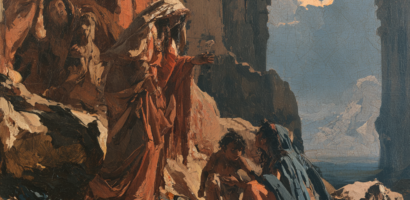



What Did Joseph Wear?
Last time, we stopped on verse 3 of Genesis 37: Israel loved Joseph more than all his sons, and he made him very special clothes. In Hebrew, this coat, or tunic, is calledכְּתֹנֶת פַּסִּים (ketonet passim). The traditional idea rendered by most translations is that this was some sort of multi-colored outer garment – a coat of many colors[1]. However, Hebrew allows a different understanding of these words. In the Jewish commentaries, the word passim has been translated as “colorful” (Radak; Septuagint), “embroidered” (Ibn Ezra; Bachya; Nachmanides), “striped” (Ibn Janach; Radak, Shorashim) or “illustrated” (Targum Yonathan). It can also refer to a long-sleeved garment, coming down to the “palms” of the hands (Rashbam; Ibn Ezra; Baalei Tosafoth; Midrash Rabbah) and the feet (Lekach Tov). It can even refer to the material out of which the coat was made, fine wool (Rashi) or fine silk (Ibn Janach). Thus, ketonet passim may be translated not only as “a coat of many colors,” but also as “a long-sleeved garment,” “a coat reaching to the feet,” “an ornamented tunic,” “a silk robe” or “a fine woolen cloak.” In fact, we do find a different translation of the same Hebrew words, and we are going to talk about that for a moment.
Remarkably, in the entire Tanach (Hebrew Bible), the very same words occur only once more – in the story of Amnon and Tamar in 2 Sam. 13:8. There this robe definitely signifies a royal distinction: Now she had on a robe of many colors (כְּתֹנֶת פַּסִּים), for the king’s virgin daughters wore such apparel. From this verse we can understand that Joseph’s tunic was most likely the kind of robe worn by royalty – it was a very special tunic, indeed. However, it seems also that this special and beautiful tunic was destined to be a harbinger of the coming tragedy. Both times that we encounter this attire in Scripture, the stories are very tragic: Joseph was almost killed and then sold; Tamar was raped and kicked out. In both stories, the end of this garment is very sad: the brothers “stripped Joseph of his tunic,” then tore it, dipped the tunic in the blood of a goat and brought it to their father in a deceptive act; Tamar “tore her long-sleeved garment (כְתֹ֧נֶת הַפַּסִּ֛ים) which was on her, put her hand on her head and went away, crying aloud as she went”[2].
Have you noticed, by the way, that in the last verse the same words are translated as “long-sleeved garment”? This is just one example of how important the understanding of Hebrew Scripture is. From the translations, we cannot see that Tamar’s clothes were the same as Joseph’s; however, thanks to this verse in Hebrew we can understand that Joseph’s garment was very special indeed: not just a beautiful tunic of many colors, but probably the kind of robe worn by royalty.
God’s Plan Begins
From the narrative, we know that the brothers hated Joseph. If you read the first part of this chapter, the word “hate” abounds here, this is the main impression of these verses: that the brothers hated Joseph. Therefore, what was Jacob thinking when he sent his beloved son to Shechem, to check on his brothers? Didn’t he know they had hated Joseph? Why did he do it?
We read in verse 13, “Israel said to Joseph, “Are not your brothers feeding the flock in Shechem? Come, I will send you to them.” Pay close attention to the name “Israel” here. It’s not Jacob – it’s Israel who sends Joseph. Each time Jacob is called Israel, we have to know that he is acting as an instrument in God’s hands. It’s the same is here—he is not just as a loving father, he is the instrument of God, and God’s plan begins to be unfolded through his extremely strange and irrational decision.
I think that for many years Joseph really suspected that his father had been involved in the plot. When, after all Joseph’s suffering and trials, we finally see him being successful and influential, we are struck by a very interesting detail in this narrative. When his first son was born in Egypt, Joseph called him Menashe: “because God has made me forget (nashani -נשני) all my labor and my father’s house.” Forget… my father’s house? Didn’t Joseph love his father? Why would he want to forget him? There is another strange detail in this story that is really difficult to explain; many students have asked me about it over the years: why didn’t Joseph contact Jacob during all this time?
We have to remember, that Joseph did not know what we the readers do —he did not know that his brothers had deceived his father and that Jacob thought Joseph was dead. He was probably wondering, especially during his first years of slavery: “Why doesn’t my father look for me?” Egypt is so close to Canaan, we can assume that Joseph expected his father to come and look for him – but as we know, it never happened. Jacob did not look for Joseph because he thought that Joseph had been killed – but Joseph did not know that! Probably, for a while, Joseph was waiting for his father to show up and find him – but when it did not happen, he may have decided that Jacob was involved in the plot in the first place. After all, it was his father who sent him to the brothers. Of course, Joseph knew that his father loved him, but he also knew only too well the stories of the Fathers: Abraham loved Ishmael – but God chose Isaac; Isaac loved Esau – but God chose Jacob. Joseph knew that if God chose another of Jacob’s sons, and if it was God’s will for Joseph to be banished from his family, his father would accept and obey this will.
Only when the brothers came, did Joseph realize that Jacob had known nothing about the crime. Now he is anxious to resolve this misunderstanding, maybe even to ask forgiveness – and that is why his first question is: “is my father still alive?”[3]
Next time, we will follow God’s plan unfolding in this crucial chapter – Genesis 37. My original plan was to write four or five posts on Joseph’s saga – but as you can see, I will need three articles for just the first chapter of this saga. This is an amazing story, there are so many delicious Hebrew insights here, and I do not want to miss anything. Therefore, please bear with me – and please, stay tuned!
[1] Gen. 37:3
[2] 2 Samuel 13:19
[3] Gen.45:3
The insights you read on these pages, are typical of what we share with our students during DHB (Discovering the Hebrew Bible) or WTP (Weekly Torah Portion) classes. If these articles whet your appetite for discovering the hidden treasures of the Hebrew Bible, or studying in depth Parashat Shavua, along with New Testament insights, I would be happy to provide more information (and also a teacher’s discount for new students) regarding eTeacher courses (juliab@eteachergroup.com) Also, excerpts from my books are included in this article (and many other posts here), so if you like the articles on this blog, you might enjoy also my books, you can get them here.