


Today, we are going to speak about one of the richest portions in the Torah – Ki Tissa. There is an amazing story in this portion about how God “changed His mind” – or did He? You can read my book “As though hiding His face” for this story. However, there are many other amazing details and insights here—as I just mentioned, Ki Tissa is one of the richest and most complex portions in the entire Torah—and today, we are going to talk about some of these details.
That there may be no plague among them
First, I have to admit that never before have the opening verses of this portion sounded as somber and stern as they do this year: “that there may be no plague among them”. In the first months of the pandemic, I wrote a short book about Corona; I wanted to analyze all the cases of plagues in the Bible: why they started and how they were stopped in each particular case. In the book, these particular verses from our Torah Portion came up in connection with a plague in King David’s time:
11 Then the Lord spoke to Moses, saying: 12 “When you take the census of the children of Israel for their number, then every man shall give a ransom for himself to the Lord, when you number them, that there may be no plague among them when you number them”[1]
We see that here the Lord explains to Moses exactly what has to be done during a census: “every man shall give a ransom for himself to the Lord,” otherwise, a plague would follow the census. Midrash elaborates: “when you wish to know how many they are, do not count them by head, but each one shall give a half-shekel. By counting the shekels, you will know their number.” Nevertheless, David took the census and counted the people, ignoring this warning completely – and a plague was indeed sent on Israel after David’s census: “So the Lord sent a plague upon Israel from the morning till the appointed time. From Dan to Beersheba seventy thousand men of the people died”[2].
As far as we know, the COVID Pandemic did not start from an unlawful census – but I believe it is not the census or the money that matters here. What does matter is the fact that every person should be ready to recognize and acknowledge the simple fact that he belongs to the Lord. That is why later we read: “The rich shall not give more and the poor shall not give less than half a shekel, when you give an offering to the Lord, to make atonement for yourselves”[3]. The rich one belongs to the Lord in exactly the same measure as the poor one does, therefore they are required to give exactly the same ransom—the same atonement (both words, “ransom” in Ex. 30:12 and “atonement” in 30:15, render the Hebrew root kaf-pei-reish, the same root that the word “Kippur”, in the Day of Atonement, is derived from). God wants everyone, from the age of twenty years up, to recognize Him as Lord – that there may be no plague among them.
In the Shadow of God
Almost every verse of this amazing portion is worth commenting on. Of course, I cannot do it here, therefore, I choose to comment on those details that are lost in translation and can be seen in Hebrew only. As I have written several times on these pages, one of the biggest losses we experience while reading the Bible in translation is the loss of the meaning of names. Biblical names carry a lot of weight – and the name, Bezalel, is a wonderful example of this principle. At the beginning of chapter 31, we read that God chooses Bezalel and fills him with His spirit, giving him wisdom, understanding and knowledge for the structure and furniture of the Tabernacle. The idea of being “filled with the Spirit of God” here, means spiritual equipping and enabling him for special service to God. How does this name, Bezalel, reflect this?
“Bezalel” (בצלאל – Be Tzel El) in Hebrew means “in the shadow of God”. Tzel (shadow) is a biblical word and a biblical concept, and the expression “in the shadow of God” occurs several times in Scripture. For example, in Psalm 91 we read: “He who dwells in the secret place of the Most High shall abide under the shadow of the Almighty” (בצל שדי). If you remember, when we spoke about the very first chapter of Genesis, discussing the words: “for in His image did God make man”[4] – we spoke about this word: “shadow”, discovering the connection betweenצל (tzel) and the Hebrew word for “image”, צֶלֶם (tzelem). In Genesis, this tzelem/tzel dynamic helps us better understand the meaning of being created “in the image of God”: as a shadow is an imperfect image resembling the real thing which casts it, so a man is an imperfect image of God, capable of resembling God’s actions—His love, His mercy, His justice. Here, in Exodus, this combination “tzel –El” in the name of Bezalel, in my opinion, provides an ultimate definition of creativity: the Bible sees true creativity as coming from God alone and resembling God’s actions. Man becomes truly human – and truly creative – as he endeavors to resemble God.
You Shall See My Back…
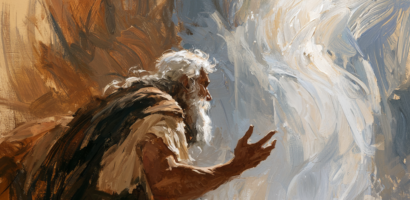
We conclude our comments on this portion with a few thoughts on one of the most mysterious episodes in the entire Bible. In a very famous scene from Exodus 33, when Moses asks God to show him His glory, God answers:
And the Lord said, “Here is a place by Me, and you shall stand on the rock. 22 So it shall be, while My glory passes by, that I will put you in the cleft of the rock, and will cover you with My hand while I pass by. 23 Then I will take away My hand, and you shall see My back; but My face shall not be seen.[5]
We have to admit that we don’t really know what God meant by saying: “you shall see My back”. We have no idea whatsoever what God’s back might be; the Hebrew word Acharay (אחרי), was just translated as “back” in an attempt to make comprehensible something that we cannot comprehend – something that maybe was not even intended for our comprehension.
Does that mean we have no way of knowing what happened there? As I have mentioned several times, there is no better commentary on Scripture than Scripture itself – and to our great surprise, we find almost the same word much earlier, in the book of Genesis. To my even greater surprise, nobody has ever commented on this amazing juxtaposition – at least, to my knowledge. In Genesis 16, when Sarah’s Egyptian maid Hagar flees from her mistress and the angel of the Lord finds her in the wilderness and talks to her, she sums up this epiphany in a few words. In English, she says, “Have I also here seen Him who sees me?”[6] The original Hebrew sentence, however, reads: “I saw after (אחרי) the One (or, the Back of the One) who sees me.” This ‘after’ or ‘back’ part is omitted altogether in most translations; but this is the same exactly word that the Torah uses in our scene with Moses (the vowels are slightly different, but you probably know that the original Hebrew text contained no vowels).
We are all very curious: What exactly did Moses see? What did God show him? Maybe – just maybe – the epiphany of Hagar sheds some light on the scene from Ki Tissa. Maybe, the very fact that Hagar used the same word that God used while speaking to Moses, means that the experience she had during that encounter, had been very similar to the experience of Moses: this epiphany was not about God, after all, it was about Moses’ heart and healing the wounds of this heart. Of course, nobody knows or can adequately describe what happens during an encounter with God—it’s between God and the heart, and it is different for everyone, because only God knows the deepest secrets and wounds of that heart; He is the only One who can touch and heal those wounds. I presume Moses did need some healing and encouragement after the golden calf incident—as did Hagar. As we all do! And when, like Moses and Hagar, we experience the absolutely overwhelming presence of God; when the warmth of His closeness envelops our whole being; when His love, His compassion, His tenderness melts our heart completely and heals our wounds – the only thing we can utter is: “Have I also seen Him who sees me?” El Roi— God-Who-Sees-Me.
[1] Ex.30:11-12
[2] 2 Sam.24:15
[3] Ex. 30:15
[4] Gen. 9:6
[5] Ex.33:21-23
[6] Gen 16: 13
Excerpts from my books are included in this article (and many other posts here), so if you like the articles on this blog, you might enjoy also my books, you can get them here. Also, if these articles whet your appetite for discovering the hidden treasures of the Hebrew Bible, or studying in-depth Parashat Shavua, along with New Testament insights, I would be happy to provide more information (and also a teacher’s discount for new students) regarding our wonderful courses (juliab@eteachergroup.com)