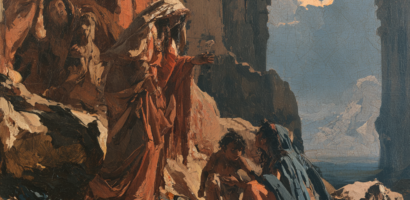



In the story of Joseph in Genesis 42, we read about his first meeting with his brothers:
7 And Joseph saw his brethren, and he knew them, but made himself strange unto them, and spake roughly unto them; and he said unto them, Whence come ye? And they said, From the land of Canaan to buy food[1].
In the English text, nothing strikes us as unusual in this sentence. However, when we read this verse in Hebrew, we discover something very intriguing: The verb for ‘he knew them’ (וַיַּכִּרֵם), and the verb for ‘he made himself strange unto them’ (וַיִּתְנַכֵּר אֲלֵיהֶם) are derived from the same root! Can you imagine? These two actions, not only very different, but in a sense, completely opposite – “to recognize” and “to disguise” – are expressed with verbs coming from the very same root. It is absolutely impossible to translate, and almost impossible to even explain.
This is an exceptionally beautiful example of how deep and multifaceted the Hebrew language is – how profound His Word is. Biblical Hebrew is primarily a verbal language, and the verbs are derived from the roots. Roots are three-consonant groups that comprise the “essence” of the word’s meaning. Most of the verbs in Hebrew are formed from this three-consonant root by changing vowels and by adding different prefixes and suffixes, thus forming different stems. Depending on their stem (binyan), verbs from the same root can have very different meanings, as we see here in our text. Nevertheless, being derived from the very same root, they all have something in common, they all relate to the very same “essence”.
Yes, Joseph made himself a stranger, and yes, he was unrecognizable,- yet, out of his disguise, this amazing root of knowing and recognition touches the hearts of the brothers with something painfully familiar. No wonder, from the very first meeting with this Egyptian viceroy, they knew it was all about Joseph, even though there seemed to be no connection at all between the stories. No wonder, after Joseph’s accusation, and despite its lack of sense and the total absence of any connection between the accusation itself and the demand to bring the youngest brother, they said one to another, We are verily guilty concerning our brother, in that we saw the anguish of his soul, when he besought us, and we would not hear; therefore is this distress come upon us[2]. The Spirit of God is touching their hearts, and their hearts are burning, even though their eyes could not recognize their brother – and this whole incredible dynamic is reflected in those two verbs, opposite in meaning but derived from the same root: hikir – hitnaker.
It’s difficult to find a more beautiful or more profound biblical expression of the mystery of the Hidden Messiah. I’ve been thinking, praying and writing about Hidden Messiah for years, but when I was given these words, once again I stepped back in awe – humbled and overwhelmed by the unsearchable depth of His Word. This interplay between hikir and hitnaker – between “recognized” and “made himself strange” – although completely lost in translation, is incredibly profound. Could the brothers have recognized Joseph from the very beginning? Should they have recognized him from the very beginning? The fact that he ‘made himself strange unto them’, means that he didn’t want them to recognize him, right? Otherwise, his whole plan to bring them to complete repentance, based on bringing Benjamin to him, would have been ruined. We know the story. We know they were not supposed to recognize him, and yet this common root, this common essence tells us that the mystery is even deeper than we thought. Joseph was hidden, but he was “as though” hidden. He made himself a stranger, and did not want them to recognize him, yet their hearts perceived what their eyes did not.
And this brings us back to our story – to the story of the “burning hearts” and the “restrained eyes”; to the story of the Transitional Chapter; to the story of Emmaus. There are striking parallels between these stories that we cannot ignore. Of course, the first parallel is obvious: in both stories, he knows them, but they don’t know, don’t recognize, him. Moreover, if we compare the sentences in Hebrew, we find that the very same expression is used in both cases: in Genesis 42:8 and Luke 24:16 וְהֵ֖ם לֹ֥א הִכִּרֻֽהוּ – they didn’t recognize (know) him. Thus, the story of Joseph foreshadows the same mystery of the Hidden Messiah, that the story on the Emmaus Road gives us the key for.
Speaking about key – in our Key Number Five post, we learned that the only time in the entire Septuagint when the line “and their eyes were opened” occurred, in the same way, and in the very same wording as it is found in Luke: δε διηνοιχθησαν οι οφθαλμοι, was in the third chapter of the Book of Genesis, in one of the most dramatic scenes in Scripture. When Adam and Eve (Hava) sinned – when they violated the command God had given them and ate the fruit of the Tree of Knowledge; when everything changed and everything was turned upside down; at this fateful moment of creation – “their eyes were opened…” [3] Adam and Eve, who had until then only seen God and His reality – and everything else only in the light of His reality – began to see the world with a clouded, sinful vision, which, from that time onward became, and has remained, humanity’s vision of reality. They left His presence – and their eyes were opened to this worldview.
If we apply this Key to the amazing dynamic of Hikir-Hitnaker, as it is expressed in the story of Joseph, we understand that, even before the eyes of the disciples were opened – this time, opened in the reverse direction, to see that which is invisible to common human vision – their hearts were touched with a glimpse of recognition, as were the hearts of Josephs’ brothers.
Once again, this common root, this common “essence” of the two verbs, “recognize” and “disguise”, tells us that this mystery is even deeper than we thought. Yes, Yeshua seems to them a stranger, and yes, they cannot recognize Him, but the mystery of the Hidden Messiah, the mystery of Hikir–Hitnaker, is unfolding here, and therefore this stranger touches the hearts of the disciples with something wonderfully familiar – and their hearts tremble under this touch. The Unrecognized sparks in them a glimpse of recognition of their true destiny – of that pre-Fall reality when man still could see God. That is why their hearts were burning as they walked along. We all have this “pledge of the Spirit”[4] within us, and that is why our hearts also burn when God is near – even when our eyes are restrained and do not recognize him!
Next week, we will sum up all the ideas that we have discussed so far, and we will examine the lessons and the conclusions of the Hidden Messiah series.
[1] Gen. 42:7
[2] Gen. 42:21
[3] Gen .3: 7
[4] 1 Cor.5:5