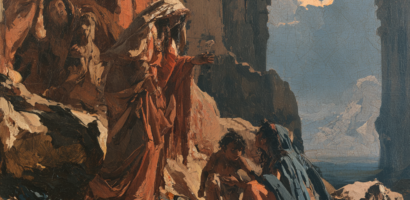



We are coming close to the Thanksgiving Day – and since a great many of my readers are from the United States, first and foremost, I would like to wish everybody Happy Thanksgiving! I think it is a wonderful celebration, it used to be my favorite holiday when I lived in America, and even though I now live in Israel, it is still a very special day for me. And I wanted to take a moment to say a huge Thank you!
I truly appreciate all the wonderful readers and followers of this blog, and I am very thankful to you and for you!
Because of Thanksgiving, I would like to take a break from our main theme – Hidden Messiah – and to talk about Judah today. Yes, Judah from the book of Genesis, Jacob’s son, Joseph’s brother. You might ask, why Judah, what does Judah have to do with Thanksgiving? This is exactly the question that this article is going to address.
We all know that King David was a descendant of Judah: The Book of Samuel makes it very clear that God bestows His anointing, for all time, on a monarchic line arising from the Tribe of Judah in the person of King David. Therefore, Jesus, who is designated ‘Son of David’, is also a descendant of Judah, as it is written: Our Lord arose from Judah, of which tribe Moses spoke nothing concerning priesthood.[1] Have you ever wondered why? Why it was Judah – whose weaknesses, even sins, are revealed so clearly in the book of Genesis, both in the story of Joseph and the story of Tamar – who was honored with this extraordinary privilege? Moreover, if we know that Judah’s tribe was destined to have this very unique honor – to bring forth King David and also Jesus – how do we connect the dots between this glorious destiny and Judah’s questionable behavior in the book of Genesis? And, once again, what does this all have to do with Thanksgiving?
Let’s start from the beginning – from Judah’s birth. When Leah gave birth to her fourth son, she declared: “This time I will praise the Lord”. Therefore she named him Judah.[2] In English, of course, we don’t see a connection: I believe this is one of the greatest losses we experience when reading our Bible in translations only – the meaning of the Hebrew names is completely lost in translation. Translations and adaptations don’t simply change the original meaning, but render the names meaningless. Unless we take time to go back into the Hebrew, the Biblical names of people and places in translation will continue to have no connection at all with the original reference points and ideas buried within the text itself. The connecting words: “therefore”, or “because”, or “so” seem meaningless in these cases – like in Gen. 3:20: And Adam: called his wife’s name Eve, because she was the mother of all living; or in Gen. 25:26: Afterward his brother came out, and his hand took hold of Esau’s heel; so his name was called Jacob. However, when we read these Scriptures in Hebrew, the connections are very evident – and this becomes absolutely clear in the naming of Judah: the verb lehodot (להודות) means “to thank “ or “to praise”, and the Hebrew name for Judah, Yehudah (יהודה), is the noun form of the root Y-D-H (ידה), “to thank” or “to praise”.
Therefore Judah’s Hebrew name, Yehudah (יהודה), can be translated literally as “thanksgiving” – and this is the main reason for us to talk about Judah in connection with Thanksgiving . This is also the first, and very important, lesson of the name Judah: we need to thank the Lord in order to become part of His plan and His story, and in order to bring His blessing upon our descendants.
However, there is something more that we can learn from this name. The verb lehodot has yet another meaning: to admit, to confess. For example, there is a special prayer of Confession read before and during Yom Kippur (Day of Atonement), and the Hebrew name of this prayer, Vidui, comes from the same root. This ‘confession’ aspect provides an important additional insight into the character of Judah, and in order to understand it’s meaning more deeply, let’s turn to the story of Judah and Tamar.
Immediately following the sale of Joseph by his brothers in Genesis 37, we read the story of Judah and Tamar in Genesis 38. In a sense, this story breaks the flow of the Joseph narrative: instead of continuing to tell us about Joseph’s going down to Egypt, the Torah interrupts itself with the story of Judah. We read about Judah separating from his brothers (and wonder why), his marriage, the death of his sons, Tamar’s seduction, and the climax of the story – Judah’s confession.
Let’s read these verses together:
KJV Genesis 38:25 When she was brought forth, she sent to her father in law, saying, By the man, whose these are, am I with child: and she said, Discern, I pray thee, whose are these, the signet, and bracelets, and staff.
Showing Judah’s personal items to him, Tamar said:הַכֶּר־נָא (haker na) “please examine”. Ironically, these are the exact words Judah and the brothers spoke to their father, Jacob –הַכֶּר־נָא “please examine” (Gen. 37:32) – while showing him Joseph’s torn clothes. Then, Judah was a deceiver, now he is the one deceived. Judah’s deception revisits him in his very own words. It is remarkable that, in the entire Torah, this expression appears only in these two chapters: Genesis 37 and 38. In the first case, Judah was a deceiver, but now he is the one deceived, and at this very moment, when Judah is presented with his personal items, his heart is pierced by this recognition. Not only by the recognition of his things, but much more deeply, by the recognition of his guilt. At this moment, Judah had a change of heart:
Gen. 38:26 And Judah acknowledged them, and said, She hath been more righteous than I; because that I gave her not to Shelah my son.
We read a beautiful description of this transformation in Midrash: “Then Judah rose up and said: … I make it known that with what measure a man metes it shall measured unto him, be it for good or for evil, but happy the man that acknowledgeth his sins. Because I took the coat of Joseph, and colored it with the blood of a kid, and then laid it at the feet of my father, saying: Know now whether it be thy son’s coat or not, therefore must I now confess, before the court, unto whom belongeth this signet, this mantle, and this staff”.
Of course, Midrash just fills in the gaps that the Scripture leaves out. Yet, there is a point not to be missed: Judah is the very first Biblical figure who is ready to acknowledge his sin. Instead of saying: ‘she is the one to blame’, like Adam, Judah says: ‘I am the one to blame.’ She is more righteous than I. Judah is the first person in the book of Genesis – and therefore the entire Bible – who confesses his sin, takes responsibility for it, and changes his behavior: he repents.
Now, I think we can understand why it was Judah’s tribe that was chosen by God for such a glorious destiny. Judah’s confession provides an important insight, not only into character of Judah, but also into the character of God: clearly, thanksgiving and repentance are so important for Him, that He establishes the kingly line of Israel from the tribe of Judah.
WISHING YOU AND YOUR LOVED ONES A WONDERFUL THANKSGIVING DAY! MAY YOUR HEARTS BE FILLED WITH THANKS AND YOUR HOME BE FILLED WITH JOY!
[1] Heb. 7:14
[2] Gen. 29:35