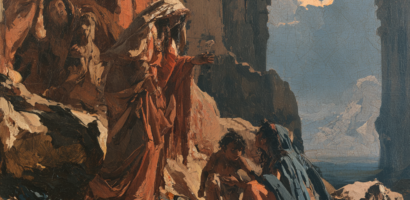


There are chapters in the Bible that are so familiar that we almost stop expecting them to surprise us. Genesis 18 is certainly one of them: Abraham sitting at the entrance of his tent, three mysterious visitors appearing before him, the hurried preparation of the meal, Sarah listening from behind the tent door, and finally the astonishing promise that within a year she will have a son.
And yet, when we slow down and look closely at the Hebrew text, almost from its very first words this familiar chapter seems to invite us to look beyond what is immediately visible.
The chapter begins with heat: “Then the LORD appeared to him by the terebinth trees of Mamre, as he was sitting in the tent door in the heat of the day.”[1]
Anyone even a little familiar with Hebrew would expect the phrase “in the heat of the day” to use the Hebrew preposition ב (be), meaning “in”: behom hayom. Instead, however, the Hebrew text says כְּחֹם הַיּוֹם — kehom hayom, using the particle כ (ke), “like” or “as,” so that literally the expression reads not “in the heat of the day,” but “like the heat of the day.”
Of course, almost every translation renders it “in the heat of the day,” because this is what the context seems to require and because Abraham is obviously sitting there during the hottest part of the day; nevertheless, I have always believed that when the Hebrew text chooses an unexpected word, especially in a passage as carefully constructed as this one, we should at least stop and ask whether something more is being said.
Perhaps the heat here is not only meteorological.
According to Jewish tradition, only a few days separate the events of Genesis 17 from those of Genesis 18, which means that Abraham is sitting at the entrance of his tent not only physically weakened after circumcision, but also carrying the weight of the astonishing promise he has just received: Sarah, at ninety years old, will bear him a son.
Everything Abraham knew from nature, from experience, and from the long history of his marriage seemed to contradict those words. He had waited for decades; Sarah had remained barren; Ishmael had already been born and had grown into a young man, and Abraham had clearly come to think of him as the fulfillment of God’s promise. Then, suddenly, God told him that Sarah herself would bear the covenant son.
Abraham had heard the promise, but nothing visible had changed.
He was still one hundred years old.
Sarah was still ninety.
Their tent was still childless.
And it is precisely there, kehom hayom, in the situation that “like the heat of the day,” that the LORD appears to him.
Perhaps this small Hebrew detail contains a much larger promise, because there are seasons in our lives when circumstances become exactly that—something that can be compared to the heat of the day, oppressive and exhausting (like in Israel), something from which we would naturally wish to escape —and yet Genesis 18 does not tell us that Abraham first came out of the heat and only then encountered God. God came to him there.
But the chapter immediately becomes even more mysterious, because although verse 1 tells us very clearly that “the LORD appeared to him,” when Abraham lifts his eyes, he does not see what we might expect him to see.
He sees three men.
From that moment onward, the Hebrew text begins to move in a very strange way between singular and plural, between the One whom the narrator says has appeared to Abraham and the three whom Abraham can actually see before him.
Abraham runs toward the visitors, bows to the ground, and begins his appeal with the word Adonai — אֲדֹנָי.
This word has been discussed for centuries, because the question is obvious: whom exactly is Abraham addressing? Is he speaking to God and saying, “My Lord,” or is he speaking to the three visitors and saying, “my lords”? The traditional Hebrew vocalization reads it as the sacred form, “My Lord,” and what follows seems to make the mystery even deeper, because Abraham begins in the singular:
“My Lord, if I have now found favor in Your sight, do not pass on by Your servant.”
“Do not pass” is singular.
But immediately afterward, without any explanation, Abraham turns to the plural:
“Wash your feet, and rest yourselves under the tree… that you may refresh your hearts.”
“Wash,” “rest,” and “refresh” are plural.
Abraham speaks to One—and then to three.
English readers can easily miss this movement because the English word “you” serves both singular and plural, but in Hebrew the change is unmistakable, and perhaps it is not merely a grammatical curiosity but part of the deeper movement of the whole chapter.
Only a few days earlier, in Genesis 17, Abraham had been asked to believe something that everything visible contradicted: he looked at Sarah and saw a ninety-year-old woman who had been barren throughout all the years of their marriage, while God looked at Sarah and saw the mother of Isaac.
Now Abraham looks up and sees three travelers, and yet somehow, he responds to One.
Once again, he finds himself standing at the border between what the natural eye can perceive and what God is actually doing.
He sees only the old age; God sees the birth of Isaac.
He sees three travelers; the narrator tells us that the LORD has appeared.
And perhaps this is one of the great lessons of the Bible: faith does not require us to deny what our eyes see, but it does require us to resist the assumption that what our eyes see is all there is.
Then, almost imperceptibly, the center of the chapter begins to shift.
Until this point Abraham has occupied the visible center of everything. He is the one sitting at the tent entrance; he is the one who runs to meet the visitors, bows before them, offers water and food, hurries to Sarah and then to the herd, and finally stands beside the men while they eat.
Sarah, meanwhile, is somewhere else.
She is inside the tent, listening.
“Sarah was listening in the tent door which was behind him.”[2]
It is such a small sentence that we could easily pass over it, and yet once we notice it, the whole scene changes, because while Abraham is standing visibly before the mysterious visitors, Sarah remains behind the tent door, unseen—and still the conversation is about her.
God had already told Abraham in Genesis 17 that Sarah would bear a son, although whether Abraham immediately shared this promise with her Scripture does not tell us; what Genesis 18 does tell us is that now Sarah herself hears the words spoken aloud: “I will certainly return to you according to the time of life, and behold, Sarah your wife shall have a son.”
For us, who know the rest of the story and know that Isaac will indeed be born, it is easy to read this verse as simply another announcement of what is about to happen; for Sarah, however, these words must have carried the weight of an entire lifetime.
She had spent long years living with the pain of barrenness, and in the world in which she lived this was not only a private sorrow but also a source of humiliation and shame, something that could easily be interpreted as evidence that she somehow stood outside God’s favor, perhaps even outside the great promise that had shaped Abraham’s entire life.
Abraham had received the call.
Abraham had built the altars.
Abraham had heard the covenant promises.
Abraham had become the father of Ishmael.
And Sarah had walked beside him through all these years while carrying within herself the one absence that no promise had yet removed.
There had never been children in Abraham and Sarah’s tent.
Then, suddenly, from behind the tent entrance, Sarah hears her own name spoken into the promise.
“Sarah your wife shall have a son.”
And Sarah laughs.
She laughs “within herself,” because everything she knows about herself, about Abraham, about biology, and about the many years already behind them tells her that such a promise is impossible:
“After I have grown old, shall I have pleasure, my lord being old also?”
Of course there is disbelief in this laughter; Scripture itself makes that clear. And yet I have always wondered whether disbelief is the only thing we hear there, because Sarah’s laughter seems to me much more complicated than that.
For years she may have felt that she stood slightly outside the center of the story, that she was the wife of the man to whom God had promised descendants but that the fulfillment itself was somehow moving forward without her. Hagar had conceived. Ishmael had been born. Abraham had a son.
Sarah did not.
And now, after all those years, she suddenly hears that she herself is not merely standing next to the promise, nor merely married to the man who received it.
She is inside it.
Perhaps this is why her laughter contains more than unbelief; perhaps beneath the disbelief there are already the first trembling notes of something she hardly dares to recognize—hope, vindication, even the beginning of faith—because the woman who had lived for so many years with the painful feeling that the promise had passed her by suddenly discovers that God has been speaking about her all along.
In Genesis 18, this laughter is still hidden within her.
In Genesis 21, when Isaac is finally born, it will burst into the open:
“God has made me laugh, and all who hear will laugh with me.”
The private laughter of disbelief becomes the public laughter of fulfillment.
And this makes me think about Sarah’s entire story differently, because in Hebrew we often speak of Elohey Avraham, the God of Abraham, but we do not usually say Elohey Sarah, the God of Sarah; and yet, when we read her story attentively, we discover again and again how personally God acts on her behalf.
He intervenes for her in the difficult wife-sister stories of Genesis 12 and Genesis 20; later, when the conflict over Ishmael becomes unbearable, He tells Abraham to listen to Sarah’s voice; and above all, He Himself accomplishes in Sarah what no human plan and no human substitute could ever accomplish, making the barren woman, against every natural possibility, the mother of the promised son.
Sarah may often seem to stand slightly outside the visible center of the story—sometimes quite literally behind the tent door while Abraham is speaking with God’s messengers—but she is never outside God’s attention.
And perhaps this is where all the strange details of Genesis 18 finally come together: the heat of the day, the three visitors who somehow reveal the presence of One, and the woman listening unseen behind the tent door.
In every case, what the natural eye sees is real, but it is not complete.
Abraham really is sitting in the heat.
The visitors really do appear to be ordinary travelers.
Sarah really is old, barren, hidden behind the entrance of the tent, and apparently far from the visible center of events.
But God sees another reality, one that has not yet become visible.
He comes in the heat.
He hides His presence within an ordinary-looking encounter.
He hears the laughter Sarah does not even speak aloud.
He knows the long years of disappointment behind that laughter.
And He knows that her story is not finished.
Perhaps this is one of the most beautiful invitations of Genesis 18: not to mistake what we can presently see for everything that God is doing.
The natural eye sees the heat and assumes that nothing can grow there; it sees three travelers and does not know that heaven has drawn near; it sees an old barren woman standing behind a tent door and concludes that her part in the great promise has already passed.
God sees Isaac.
The God of Abraham is also, very personally, the God of Sarah.
And the God who came to Abraham in the heat of the day is still the God who enters those places in our lives where, to the human eye, nothing seems capable of changing—and where, perhaps, a story we have already considered finished is only waiting for Him to speak its next sentence.
[1] Gen. 18:1
[2] Gen. 18:10
If you like the posts on this blog, you might enjoy my books, you can find them here: books. As always, I would be happy to provide more information (also, a teacher’s discount for new students) regarding our wonderful courses (juliab@eteachergroup.com)