


Most people experience the Bible through translation. While translations make Scripture accessible to millions, some of the richness of the original language is difficult to fully capture.
Biblical Hebrew contains layers of meaning, word connections, and poetic nuances that often become less visible in English. Learning the Hebrew alphabet is the first step toward discovering those deeper dimensions for yourself.
The good news is that the alphabet is far more approachable than many people expect. With guidance and practice, beginners can start recognizing letters, sounding out words, and engaging with Scripture in its original language sooner than they might imagine.
In this post, you’ll learn what makes the Biblical Hebrew alphabet unique, how its sounds and patterns enrich Bible study, and how to begin reading Scripture one letter at a time.
TLDR:
Bible translations make Scripture accessible, but some of the depth, wordplay, and meaning found in Biblical Hebrew can only be fully appreciated in the original language.
The Biblical Hebrew alphabet consists of 22 letters written from right to left, along with vowel marks that help guide pronunciation. While some sounds may be unfamiliar at first, the system is approachable and beginner-friendly.
Learning the alphabet is the first step toward reading Scripture more closely to the way it was originally written and heard. With guided support, many students begin recognizing Hebrew words surprisingly quickly.
Discovering the Heartbeat of Scripture
Every time we read the Bible in translation, we look through the lens of someone else’s choices. It’s a wonderful lens, but Biblical Hebrew wasn’t just written to pass along facts. It was crafted to make us wonder, feel, and connect deeply with the Creator.
The original language breathes with poetic patterns and layers of meaning that English just can’t quite capture. Behind simple words, entire worlds are waiting to be uncovered.
Think of a word you likely know: Shalom (שלום). We usually translate it as “peace,” but in Hebrew, it’s so much bigger. It’s a wave of wholeness, a promise of total restoration, and the comfort of being completely put back together.
Or consider the famous call to prayer, Shema Yisrael (שמע ישראל), “Hear, O Israel.” Today, hearing is often passive, like listening to background noise. But to shema means to listen with your whole heart, let the words sink into your bones, and move into action. Listening and obeying share the exact same heartbeat.
Reading the Bible in your own language is a gift. But leaning into Biblical Hebrew is like turning a black-and-white photograph into brilliant, living color. It invites you to read these ancient words exactly as they were first whispered, spoken, and felt.
What Is The Biblical Hebrew Alphabet?
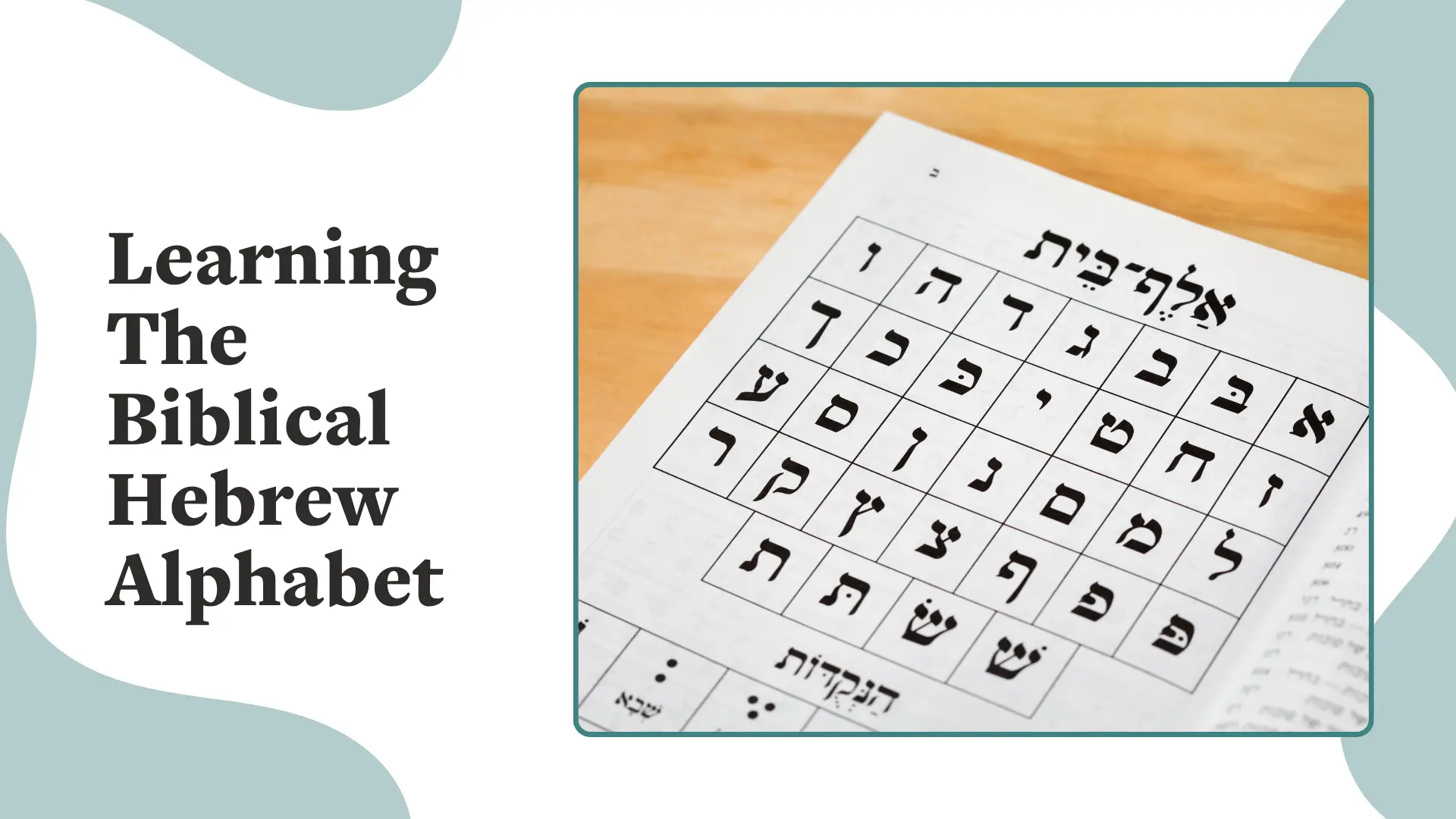
The Biblical Hebrew alphabet, known as the Alef-Bet after its first two letters א (Alef) and ב (Bet), contains 22 consonants written from right to left.
For many beginners, Hebrew looks very different from at first. Instead of using separate vowel letters, Biblical Hebrew traditionally relies on vowel marks called Niqqud to guide pronunciation. The markings make reading much easier and help preserve the sound of the Biblical text. For example, the word תּוֹרָה (Torah, “instruction” or “teaching”) uses vowel marks to show how the word should be pronounced.
Five Hebrew letters (known as final letters) also have special forms that appear only at the end of a word. They help readers recognize word boundaries as they become more comfortable with the language. For example, the letter ן is the final form of נ (Nun) and appears at the end of the word כֹּהֵן (kohen, “priest”).
The letters can also have another purpose. In Hebrew, letters have traditionally been used as numbers, a feature that appears throughout Jewish history and Biblical tradition.
While these differences may seem unfamiliar at first, most learners quickly discover that the Hebrew alphabet follows clear patterns and is more approachable than they expected. Learning the letters is often the first step toward recognizing words directly in Scripture and engaging more deeply with the Biblical text.
Throughout Jewish tradition, Hebrew letters have often been viewed as carrying symbolic and spiritual significance. The alphabet is not only a writing system but also part of the rich cultural and Biblical heritage that has connected generations of readers to Scripture.
What makes this even more meaningful is that the same alphabet is still used in modern Israel today, creating a living bridge between the language of the Bible and the Hebrew spoken across Israel now.
Letters, Sounds, And Meaning
Biblical Hebrew is a language meant to be heard as much as read. Many passages of Scripture were originally experienced aloud through prayer, teaching, and storytelling, with the rhythm and cadence of the spoken words breathing life directly into the text.
Certain pronunciation elements can feel unfamiliar at first. The letter ח (Chet), for example, is pronounced with a deep, throaty sound. Other letters shift their pronunciation entirely based on context. For instance , the letter ב can sound like a “B” or a “V,” depending on where it appears in a word.
As learners become familiar with the alphabet, they start to recognize Biblical words and patterns throughout Scripture.
Words like:
- מלך (Melech): King
- אור (Or): Light
- חיים (Chayim): Life
- שלום (Shalom): Peace, wholeness
- אמת (Emet): Truth
With time, readers also notice deeper connections between words that develop from the same Hebrew root.
For instance, the Hebrew word rechem (רחם), which means “womb,” shares its root with rachamim (רחמים), meaning “mercy” or “compassion.” This linguistic link highlights the deeply nurturing imagery behind Biblical compassion.
Another clear example is the tie between adam (אדם), meaning “man,” and adamah (אדמה), meaning “ground” or “earth.” In Genesis, humanity is sculpted directly from the soil, a relationship that stands out vividly in the Hebrew text.
How To Start Reading And Writing Biblical Hebrew
Many people assume Biblical Hebrew requires years of study before they can begin reading Scripture. In reality, most students start much more simply.
The journey usually begins with:
- Learning the 22 letters
- Practicing common sounds
- Reading simple syllables
- Recognizing recurring Biblical words
- Becoming comfortable reading from right to left
Once you can recognize the letters and understand how they work together, Scripture stops being something you receive secondhand and becomes something you can explore for yourself.
Even early on, students often recognize familiar names and phrases from Scripture. Seeing words like משה (Moshe, Moses) or דוד (David) directly in the Biblical text creates a sense of connection.
And because Hebrew follows recognizable patterns, many learners find the language more approachable than they expected.
Learning With Guided Support
While apps and videos are useful for memorization, many students experienced the most growth through guided instruction and community support.
The Israel Institute of Biblical Studies (IIBS), in partnership with the Hebrew University of Jerusalem, offers guided Biblical Hebrew courses designed for beginners and Bible readers.
Students start with the Biblical Hebrew A course, where they learn the alphabet, pronunciation, and foundational reading skills in a supportive environment. From there, learners can continue into the Biblical Hebrew B and Biblical Hebrew C courses, gradually building confidence while exploring Biblical passages more deeply.
The experience is designed to feel personal and encouraging instead of overwhelming. Students learn through live online sessions, guided practice, and the support of experienced Israeli teachers and Biblical scholars. Ultimately, for many students, the greatest reward isn’t simply learning a language, but rediscovering Scripture through the words in which it was first written.
That said, to take your next step toward rediscovering the biblical text, follow this brief guide, join a course, and begin:
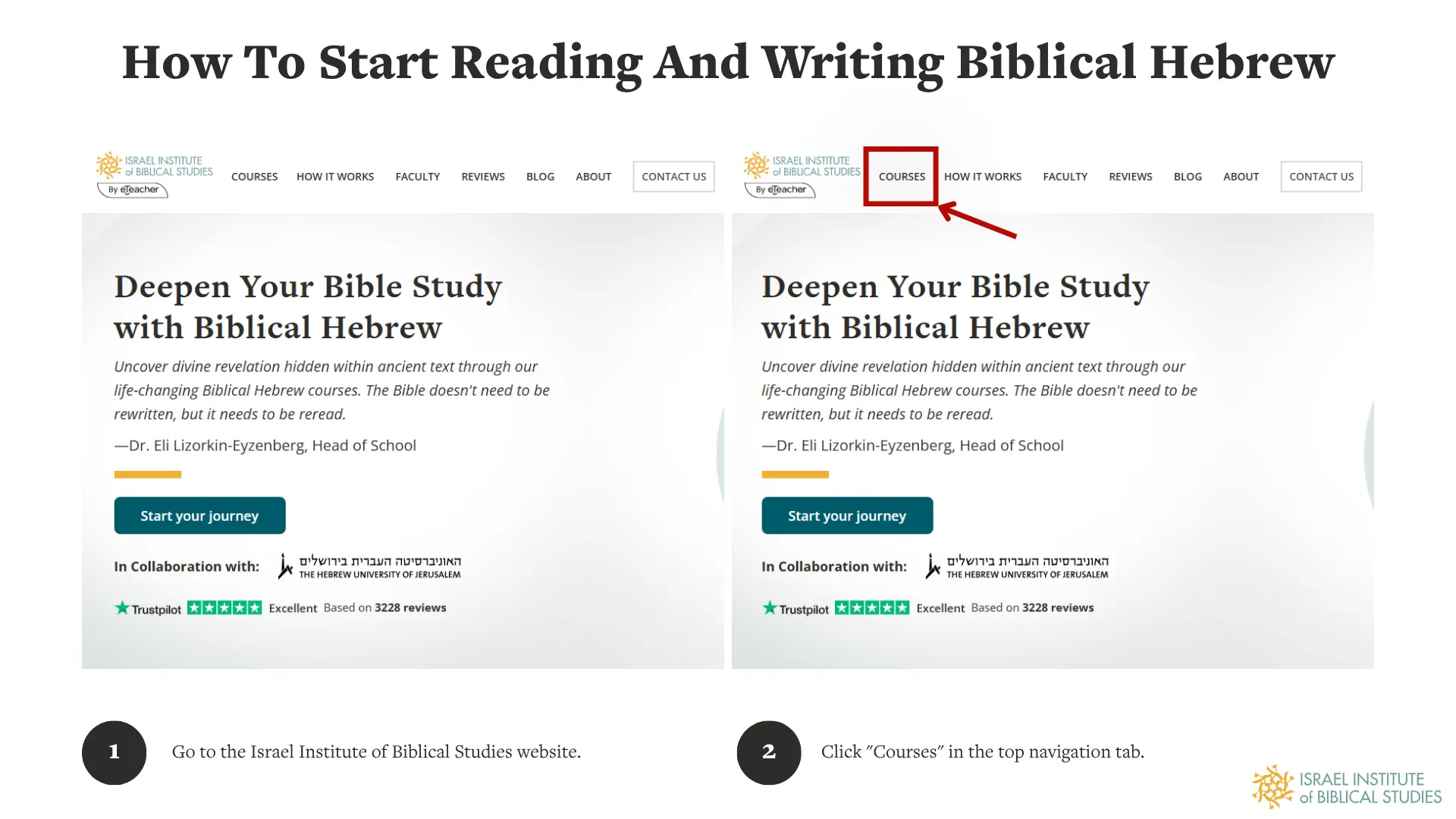
- 1. Go to the Israel Institute of Biblical Studies website.
- 2. Click “Courses” in the top navigation tab.
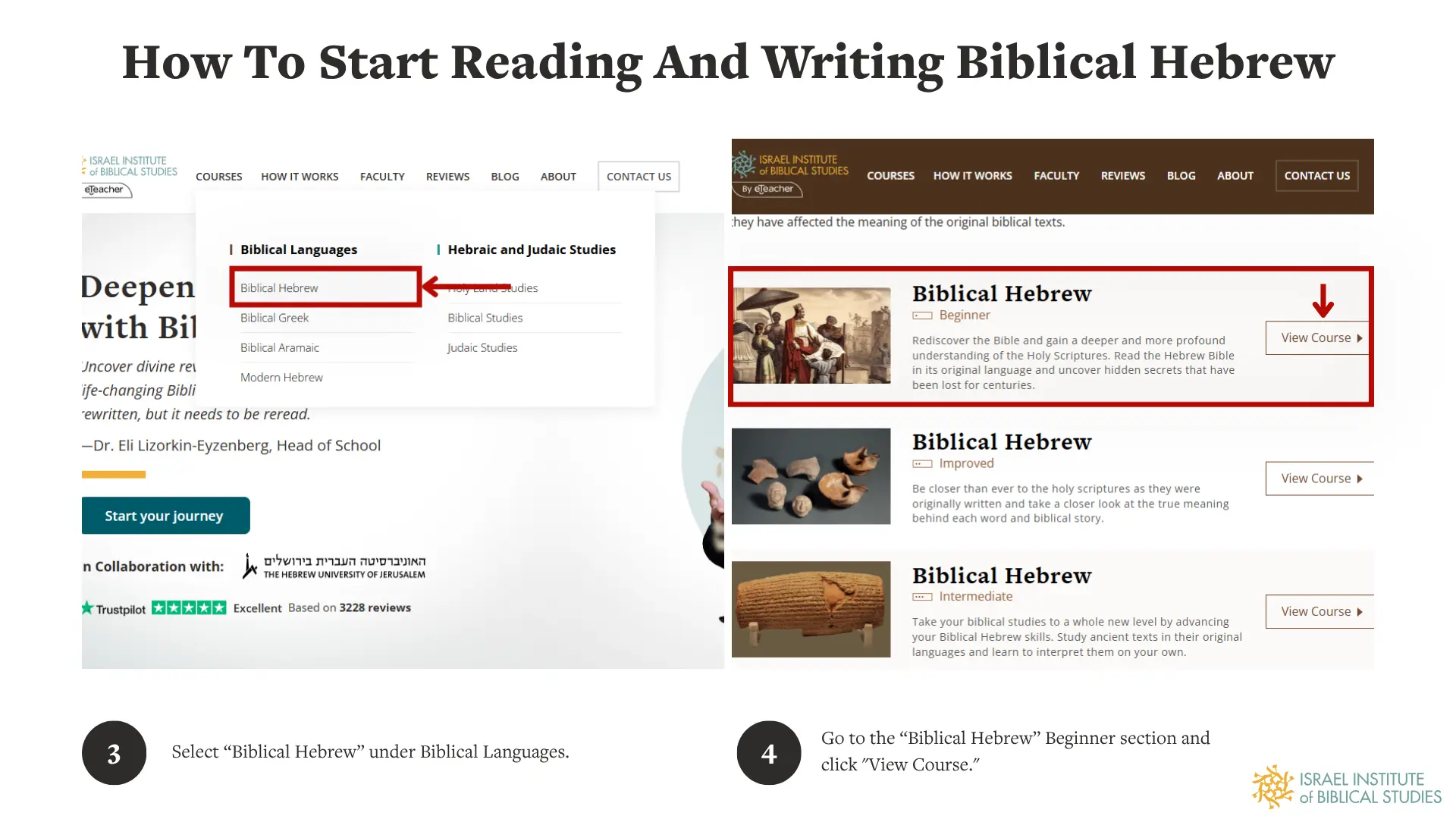
- 3. Select “Biblical Hebrew” under Biblical Languages.
- 4. Go to the “Biblical Hebrew” Beginner section and click “View Course.”
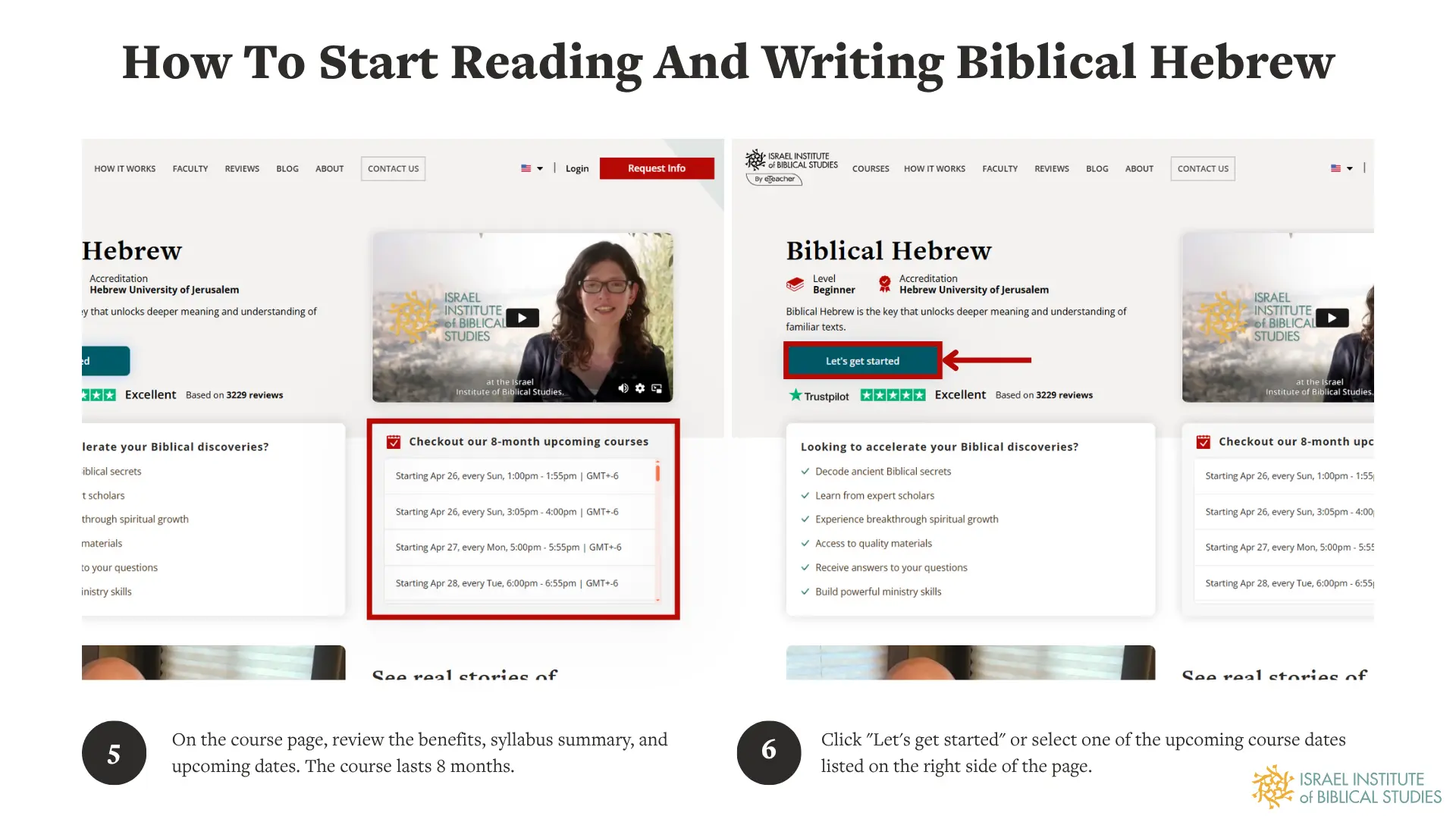
- 5. On the course page, review the benefits, syllabus summary, and upcoming dates. The course lasts 8 months.
- 6. Click “Let’s get started” or select one of the upcoming course dates listed on the right side of the page.
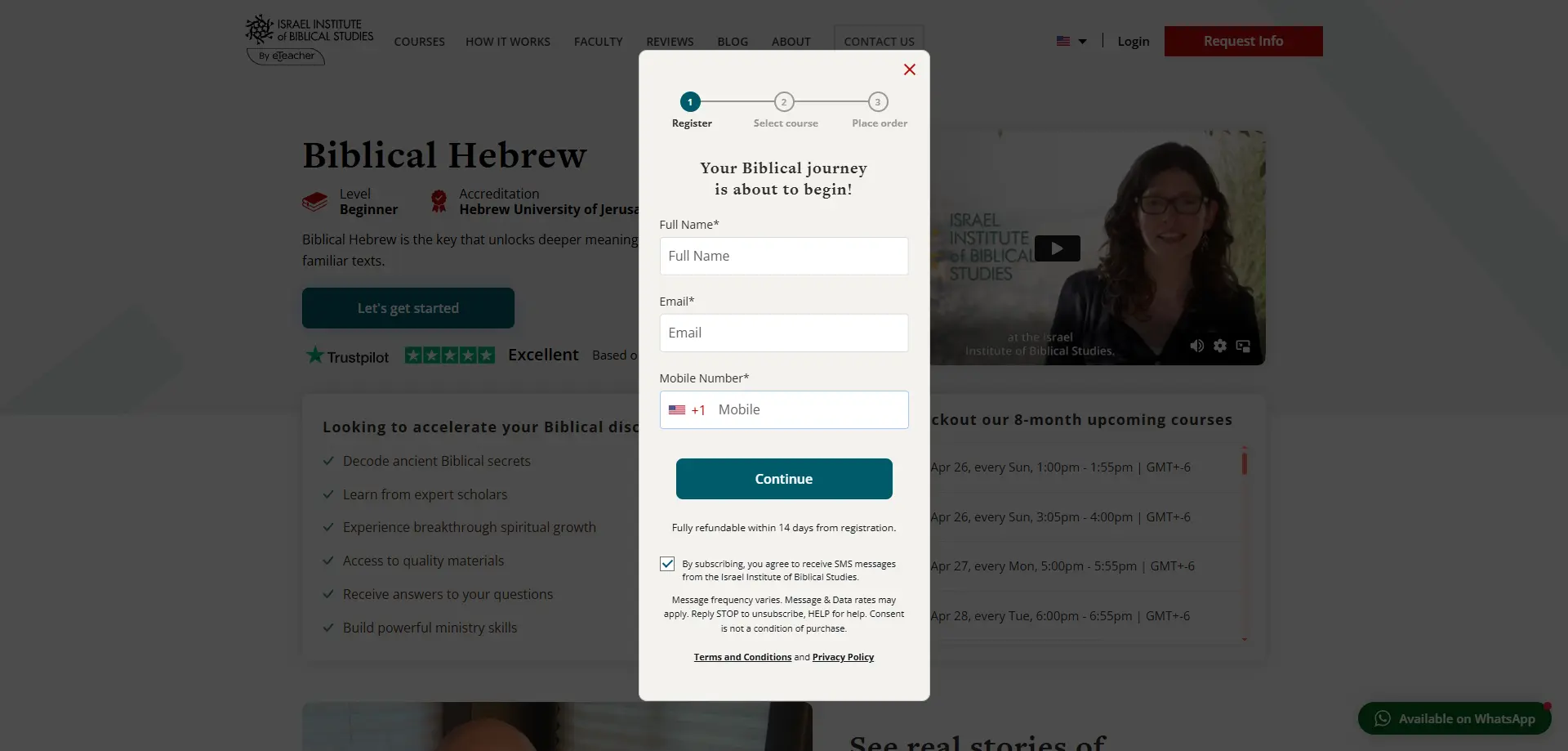
- 7. A registration pop-up will appear. Enter your full name, email address, and mobile number, then click “Continue.” Registration is fully refundable within 14 days.
- 8. Select the date and time that best fit your schedule and place your order.
Are You Ready To Get Started?
The Biblical Hebrew alphabet is not a barrier to Scripture. It’s a doorway.
Every letter you learn brings you one step closer to reading the Bible with fresh eyes and hearing familiar passages in a new way.
Start learning with a guided Biblical Hebrew course. Join us now.
Conclusion
The Biblical Hebrew alphabet has carried the words of Scripture across generations for thousands of years. What may seem unfamiliar at first soon becomes something deeply rewarding and personal.
As you begin recognizing letters, sounds, and recurring Biblical words, the text starts opening in new ways. Familiar verses gain new depth. Hidden connections begin to appear. The Bible no longer feels quite so distant from its original world.
You don’t need to become a scholar to begin this journey. You simply need curiosity, consistency, and the willingness to take the first step.
The Hebrew text is still there, waiting to be discovered.
FAQ:
Do I need to speak Modern Hebrew to learn the Biblical Hebrew alphabet?
No. Biblical Hebrew and Modern Hebrew use the same alphabet, but the courses focus specifically on the language of the Hebrew Bible. No Modern Hebrew background is required.
How long does it take to learn the Hebrew alphabet?
Many learners become familiar with the letters and basic vowel marks surprisingly quickly, often within days of consistent practice. Reading fluently takes longer, but the alphabet itself is very approachable.
Is the Biblical Hebrew alphabet the same as the one used in Israel today?
Yes. Modern Hebrew still uses the same 22-letter alphabet along with the five final letter forms used in Biblical Hebrew.
What is the hardest part for beginners?
For many English speakers, the biggest adjustment is reading from right to left and learning a few unfamiliar Hebrew sounds. With practice and guidance, these patterns become much more natural over time.
Can I read the Bible after learning the alphabet?
Learning the alphabet allows you to begin recognizing and sounding out Hebrew words in Scripture. As vocabulary and reading confidence grow, understanding deepens as well.
Why learn Biblical Hebrew instead of only using an interlinear Bible?
Interlinear Bibles are helpful tools, but they still rely on someone else’s translation choices. Learning Biblical Hebrew allows readers to notice repeated word roots, deeper meanings, and connections that translations often can’t fully show.
Do I need special software or materials to start?
No. A guided course provides everything most beginners need, including lessons, reading practice, and supporting resources.