


When, on Simchat Torah, we complete the Torah Reading cycle, we immediately start a new cycle, reading from the first Torah Portion – Beresheet (In the Beginning). Most of my readers know that I am very passionate about discovering continuity between Tanach (Old Testament) and the New Testament – and that’s why we have already spoken on these pages about the unmistakable parallel between the beginning of the first Portion and the beginning of John’s Gospel. The beginning of the fourth Gospel might be also called “Beresheet” since the language of John clearly and purposely echoes the language of Genesis 1—in both Genesis 1 and John 1:1 we witness God’s perfect order and perfect creation beginning (those interested can read my article on these pages: https://israelbiblicalstudies.com/jewish-studies/new-testament-reflections-beresheet/)
Today, however, we are going to talk about that point in Genesis which ended perfect God’s order. You all know that I speak of that tragic chapter where Adam and Eve (Hava) sinned—where they violated the command God gave them and ate the fruit of the Tree of Knowledge. Everything changed and was turned upside down in Genesis 3; and it is at that fateful moment that we read: And their eyes were opened…
What does this mean, that Adam and Eve’s eyes were opened? Yes, Adam and Eve realized, for the very first time, that they were naked, but it was so much more than just that! According to Scripture, the Fall was not simply one of the events in the history of creation – it was a global cataclysm, a total change in the status of the universe. What the Bible describes as the eyes (of Adam and Eve) being opened is one of the most substantial and fundamental manifestations and consequences of this global change. Adam and Eve, who had until then seen God in His reality, and saw everything only in His light and the light of His reality, then began to see the world with a clouded, sinful vision, which from that time onward became, and has remained, humanity’s vision of reality. Their innate ability to see God grew dim and was lost, and even Adam and Eve, not to mention their descendants, began to see this world the way humanity would continue to see it throughout the ages: weighed down by sin, material, and physical. They left His presence, and their eyes were opened to this worldview. From now on, to see the invisible, man would need faith. That is why the Lord was so concerned that they would not put out their hand and take also of the Tree of Life, and eat, and live forever; that they would not remain forever like that, incapable of seeing the spiritual reality – able to see only material and physical…
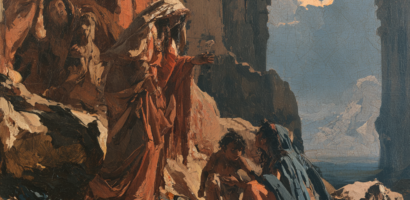
As you would know, I usually share Hebrew insights on these pages, but today, since we will be dealing with the New Testament, we will examine some Greek here, as we look at the Septuagint (Greek translation of Tanach). The phrase the eyes were opened, in Greek, looks like this: δε διηνοιχθησαν οι οφθαλμοι. The verb Δι-ανοιγω means completely, totally opened. This word is found several times in the Septuagint, but the only time in the entire Septuagint when we find this full phrase occurring in exactly the same order as in Genesis 3, is in New Testament! This occurrence is extremely significant: it’s in the last chapter of Luke’s Gospel (Luke 24), in the story of Emmaus – one of the most dramatic and significant stories in the New Testament. I’m sure you are familiar with this story! Two of Jesus’ disciples are going down from Jerusalem, depressed and frustrated by their teacher’s death; the resurrected Jesus joins them; they don’t recognize Him because their eyes are closed; and it is only at the end of this story that we read: their eyes were opened and they knew Him[1]. These are exactly the same words that we find in Genesis 3:7!
What is the meaning of this parallel? First of all, it is important to mention that, according to scholarly opinion, the Greek of Luke is the best of the four gospels. It is likely that Greek was the evangelist’s native tongue. Indeed, he seems to be so comfortable with Greek that he is able to adapt his style to different circumstances and sources. For instance, the Greek of the Prologue (1:1-4) in his Gospel is classical, while the Greek of the infancy narrative is purposely semitized, whilst the Greek of the sermons in Acts seems to be affected by the circumstances of each speaker. There can be little doubt that Luke knew the Septuagint well and was probably influenced by it. Therefore, the comparative analysis of the Greek words used by him, with those of the Septuagint, can be very enlightening.
In this case, Luke seems to purposely repeat the sentence from Genesis, in order to emphasize the major reversal that happens with the death and resurrection of Jesus and to make clear this connection between that moment when Adam and Eve sinned, left His presence, and their eyes were opened to this world in the third chapter of Genesis, and that pivotal moment that we see in the story of Emmaus when their eyes were opened. Opened again—but now they are opened in the opposite direction—opened back to God and His presence. From Luke’s, and the New Testament’s, point of view, God’s entire plan for humanity lies in between these two pairs of opened eyes. Luke wants us to see the connection Paul writes about in Romans, “For as by one man’s disobedience many were made sinners, so also by one man’s obedience many will be made righteous”, and though it is certainly beyond my subject here to deal with the Christian theological understanding of the death and resurrection of Jesus Christ as restoring the original state of the universe, it is important to highlight – and I am not aware that anyone has addressed this fact up to now – this striking symmetry between the phrase their eyes were opened in Luke 24, as against their eyes were opened in Genesis 3 – the symmetry that helps a reader understand the depth and enormity of what happened on the road to Emmaus.
[1] Luke 24:31
I would like to remind you, dear friends, that eTeacher offers a wonderful course, where you can learn from Parashot Shavua commentaries along with their New Testament interpretation. As always, you are welcome to contact me for more information!
Excerpts from my books are included in this article (and many other posts here), so if you like the articles on this blog, you might enjoy also my books, you can get them here .