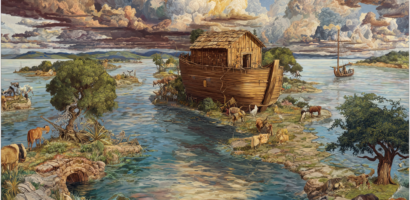



God will provide for Himself the lamb for a burnt offering
Gen. 22:8
Worthy is the Lamb who was slain to receive power and riches and wisdom, and strength and honor and glory and blessing![1] What believer in Jesus has not at least once sung these words from the Book of Revelation? Indeed, the Lamb is one of the central images in this visionary book, written about the end of the first century – we find it almost in every chapter (Rev. 5, 6, 7, 8,13,14 etc). But it would also be right to say that this image is absolutely central for the whole of Christian theology: the idea of the sinless Lamb sacrificed for the sins of the men has been one of the leitmotifs of Christianity throughout its history. Accordingly, one could expect the pages of the Gospels to be filled with imaginary of the Lamb, but surprisingly enough, aside from the book of Revelation, we seldom find this word in the New Testament. We don’t find it in the epistles of Paul, the earliest NT writings, and throughout the Gospels the word “lamb” occurs only twice in the same chapter – in the Gospel of John, the latest of all Gospels, in the account of Jesus’ baptism , “beloved Son” of the Synoptic Gospels is replaced by the “Lamb of God”: “Behold the Lamb of God, which taketh away the sin of the world.” A little further on, John the Baptist repeats: ‘Behold the Lamb of God!’[2] So, we find this title in only one chapter outside of the book of Revelation – and in no other place!
The realization that the Lamb is not mentioned in the other Gospels and is absent from the other books of the New Testament as well, evokes many questions. Where does John take this image from? What did John the Baptist mean by these words? What meaning did the Israelites assign to his words?
This exclamation of John the Baptist in John 1:29 has posed a problem for many NT scholars. Among the different interpretation of the “lamb” which have been proposed, the most plausible is that of the Passover lamb, but even here we have a serious objection: the Passover lamb had not been considered an expiatory sacrifice. The sacrifice of the Paschal lamb was not seen as an atoning death, as a vicarious suffering. How, then, should the expression “the Lamb of God” in the Gospel of John be explained?
The Akedah lamb
Before we explore extra-biblical sources, let us turn to the Tanach (Old Testament) in our search for answers. I think it will surprise you to discover that, even in Tanach, the Hebrew word for ‘lamb’ doesn’t appear many times. However, it is not difficult to recall where we first encounter this word! Of course, this happens in Genesis 22, in the Akedat Itzhak. When Isaac is being led to the mountain by his father, he asks Abraham, ‘Look, the fire and the wood, but where is the lamb for a burnt offering?[3] As with each component of the Akedah story, this conversation between Abraham and Isaac is of vital importance. While it has yet to unfold as a separate theme in the spiritual history of both our people and of mankind as a whole – the word was pronounced, the question was asked, the introductory chord began to sound. Thus, the Lamb looking as though it had been slain,[4] from the Book of Revelation, starts here with Isaac’s innocent, trusting, almost naïve question: ‘Where is the lamb for a burnt offering?
I believe many Christians are perfectly aware of this connection and parallel between Isaac and Jesus. What you are probably not aware of, is a Jewish haggadic tradition that states explicitly that there on Mount Moriah, Abraham offered up two sacrifices: he began with the sacrifice of his son and ended with the sacrifice of the ram. This tradition states that Isaac was slain, or burnt, and then rose from the dead. In midrash Bereshit Rabbah R. Phineas said in R. Banai’s name: “He prayed: Sovereign of the Universe! Regard it as though I had sacrificed my son Isaac first and then this ram instead of him (in the stead, tahat, being understood as in the verse And Jotham his son reigned in his stead [5], where the meaning must be after him)”. Here Isaac is explicitly said to be the lamb of burnt offering:
אתה השה לעלה בני – “You are the lamb, my son“[6].
Different interpretations and foundations of the Aqedah tradition are presented in different rabbinic sources. However, the important common point is that ‘the ashes of Isaac’ and ‘the blood of Isaac’s Aqedah’, though contradictary to the plain meaning of the Scripture, are carefully preserved by this tradition – they are to serve forever as atonement and advocate of Israel in every generation. For instance, we read in Mekilta de-Rabbi Ismael: “And as he was about to destroy, the Lord beheld and He repented Him of the evil”[7]. What did He behold? “He beheld the blood of Isaac’s Aqedah”[8] – and immediately His compassion conquers His anger and He redeems and delivers. This is exactly what Abraham is asking for when he continues his prayer in Bereshit Rabbah: “Even so may it be Thy will, O Lord our God, that when Isaac’s children are in trouble, Thou wilt remember that binding in their favour and be filled with compassion with them!”[9]
This striking similarity between the haggadic tradition of Aqedah and the Christian soteriology has long been observed. Much discussion has been carried out concerning the independence of the Jewish tradition. At some point, scholars managed to dispose of the common notion that Aqedah was basically a Christian innovation.. According to Gesa Vermes, “the two main targumic themes of the Aqedah story, namely Isaac’s willingness to be sacrificed and the atoning virtue of action, were already traditional in the first century AD”.[10] Some time between the middle of the second century BC and the beginning of the Christian era, a new doctrine had established itself: that the atonement for the sins of Israel resulted both from Isaac’s self-offering and from the spilling of his blood. Within this doctrine, the Binding of Isaac was thought to have played a unique role in the salvation of Israel and to have a redemptive effect on behalf of its people.
John 1:29 ceases to be a crux when inserted into this setting. For a Jew in the first century, all lamb sacrifices were understood as a memorial of the Aqedah with its effects of deliverance, forgiveness of sin and messianic salvation. Not only was the Aqedah considered a true sacrifice, but because of the freewill consent of Isaac – a unique feature that one doesn’t find in other sacrifices – it became The Sacrifice, with its redemptive benefits lasting forever. Thus, the Christian image of the Lamb, whose death and resurrection have atoning power and redemptive effect on behalf of the future generations, seems to be indebted – or at least, deeply connected – to the Binding (Aqedah) of Isaac in Jewish tradition.[11]
[1] Rev. 5:12
[2] John 1:29,36
[3] Gen. 22:7
[4] Rev. 5:6
[5] 2 Kings 15:7
[6] Bereshit Rabbah, 56,4
[7] 1 Chron. 21:15
[8] Mekilta de-Rabbi Ishmael, 90-95
[9] Bereshit Rabbah, 56,10
[10] Geza Vermes, Redemption and Genesis XXII, in: Scripture and Tradition in Judaism (Leiden: 1961), p. 204
[11]A detailed discussion of the Christian image of the Lamb can be found in my book “If you are the Son of God”. Click here to get the book :https://readjuliablum.com