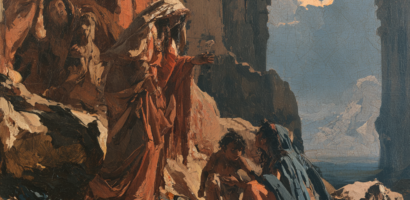


We continue our journey through the book of Genesis . We know already that for thirteen years, Ishmael had been Abraham’s only son—the son Abraham loved, prayed for, and expected to become his heir. Then, finally, the impossible happened: the child whom God had promised for so many years was born to Sarah, and Abraham called his name Isaac.
For a while, perhaps, everything in the family remained relatively quiet. Isaac was only a baby, and the enormous difference between the two sons—the difference that would eventually determine their very different destinies—was probably not yet visible in everyday family life. But babies grow, and eventually Isaac became a toddler, old enough to notice the people around him, old enough to form relationships, old enough for the complicated structure of this family to become part of his world. And it is precisely at this point that Genesis brings us to one of the most difficult and disturbing scenes in the story of Abraham’s family.
“So the child grew and was weaned. And Abraham made a great feast on the same day that Isaac was weaned. And Sarah saw the son of Hagar the Egyptian … scoffing” (Genesis 21:8–9).
Isaac was probably about two or three years old at this point, and Abraham celebrated his weaning with a great feast. Ishmael, on the other hand, was already a teenager of sixteen or seventeen. And then, during the feast—or perhaps simply around this time—Sarah saw Ishmael metzahek.
Immediately afterward she said to Abraham: “Cast out this bondwoman and her son; for the son of this bondwoman shall not be heir with my son, namely Isaac.”
These words sound terribly harsh to us. Therefore, before we try to understand Sarah’s reaction in verse 10, we first have to ask what happened in verse 9. What exactly did Sarah see?
The Hebrew word מְצַחֵק—metzahek—can have several meanings, and nobody can say with certainty what it means in this particular verse. It may mean “laughing,” “playing,” “mocking,” or “scoffing”; some commentators have even suggested that it might have a sexual connotation, because the same word appears later in Genesis 26, when Abimelech sees Isaac metzahek with Rebecca his wife. In that story, some kind of marital intimacy is clearly implied, and therefore it is understandable that interpreters have wondered whether the word might carry a similar meaning here.
However, there is a serious problem with all interpretations that assume that Ishmael was doing something directly to Isaac: Isaac is not mentioned in the sentence at all. The text does not say that Sarah saw Ishmael mocking Isaac, playing with Isaac, or abusing Isaac. It simply says that she saw Ishmael metzahek. Therefore, whatever explanation we propose has to begin with some humility: Scripture does not actually tell us what Sarah saw.
And yet, her reaction is so strong that we cannot avoid the question. Why did this one moment provoke such a drastic demand? Was Sarah merely jealous? Was she simply an angry mother protecting her little son? Had all her old resentment toward Hagar and Ishmael suddenly returned?
All of this would be psychologically understandable. Children have an astonishing ability to destroy even the peace we thought we had finally acquired, and Sarah was certainly no exception. But for me, Sarah’s emotional reaction is not the most difficult question in this story. Sarah could have misunderstood something; Sarah could have overreacted; Sarah had made serious mistakes before.
The truly difficult question is: Why did God support her?
Abraham was deeply distressed by Sarah’s demand, because Ishmael was his son. Yet God Himself told Abraham: “Do not let it be displeasing in your sight because of the lad or because of your bondwoman. Whatever Sarah has said to you, listen to her voice; for in Isaac your seed shall be called.”
This changes everything. If the scene were merely about an irritated mother and a mocking teenager, God’s intervention would be very hard to understand. Humanly speaking, no amount of teenage scoffing would seem to justify sending a boy and his mother away from their family. Evidently, something much deeper was at stake.
And this is where the Hebrew text may give us an unexpected clue.
Look at these two words:
מְצַחֵק — metzahek
יִצְחָק — Yitzhak
Both come from the same Hebrew root, צחק—tz-h-k, “to laugh.”
Isaac’s name, of course, is inseparable from laughter. Abraham laughed when God announced that Sarah would bear him a son; Sarah laughed when she overheard the promise; and after Isaac was born, she exclaimed, “God has made me laugh, and all who hear will laugh with me.” Laughter accompanies Isaac almost from the first moment he appears in the biblical story.
Therefore, when the Hebrew reader comes to Genesis 21 and reads that Sarah saw Ishmael metzahek, something happens that simply cannot be reproduced in translation. The word immediately echoes the name Yitzhak. In a sense—certainly not as a literal translation, but as a way of hearing the Hebrew—Sarah saw Ishmael “Isaacing.”
What could that possibly mean?
We cannot know for sure, but the very next sentence may help us. Sarah does not speak about mockery, bad behavior, or even danger to Isaac. She speaks immediately about inheritance: “The son of this bondwoman shall not be heir with my son, namely Isaac.”
Whatever Sarah saw, she understood it in terms of Ishmael’s place and Isaac’s place. She understood it as something touching the question of who the heir was.
And we have to remember what the previous thirteen years had looked like. Ishmael had not been some distant child whom Abraham hardly knew. He had been Abraham’s only son for thirteen years. All Abraham’s fatherly love, hopes, expectations, and dreams had naturally been concentrated on him. Even after God explicitly promised Abraham a son through Sarah, Abraham cried out, “Oh, that Ishmael might live before You!” Ishmael had occupied the place of the son for a very long time before Isaac was born.
Then suddenly Isaac appeared—the impossible child, the child of promise, the child whose very existence testified that what was impossible for human beings was possible for God.
And now imagine Isaac himself growing up in this family. His parents were very old, while Ishmael was a teenage boy. Would it really be surprising if the little boy adored his older brother? Ishmael could run, shoot a bow, explore the world, and do all those magnificent things that a two- or three-year-old boy could only dream of doing. In my book, I suggest that Isaac’s admiration for Ishmael, and Ishmael’s enormous natural influence over his little brother, may have been precisely what Sarah had begun to see and fear. Pasted text
Of course, this is an interpretation; the Bible does not tell us that Isaac followed Ishmael everywhere or begged him to teach him how to shoot a bow. But the age difference makes such a relationship very easy to imagine, and it also helps us understand why the crisis might have erupted only now, when Isaac was no longer a baby and Ishmael could begin to exercise a real influence over him.
Perhaps Sarah suddenly understood that the issue before her was not merely whether two brothers could live peacefully together. She saw something that touched the very distinction God Himself had made between the sons.
Ishmael was born as the result of a human attempt to fulfill God’s promise. Isaac was born when every human possibility had disappeared. Ishmael was the child Abraham and Sarah could produce through their own plan; Isaac was the child whom only God could give. One was not “bad” and the other “good”—the story is far more painful and complex than that—but they represented two entirely different ways in which Abraham’s family had tried to move toward the promise.
And therefore these two realities could not simply be merged.
This theme—the separation between what comes from God and what human beings try to substitute for it—runs throughout Scripture. From the very first chapter of Genesis, God separates: light from darkness, waters from waters, one realm from another. Even the biblical concept of holiness contains this idea of being set apart. What belongs uniquely to God cannot simply be exchanged for something that looks similar but has a different origin.
Perhaps Sarah, with all her emotion and all her human imperfection, saw this distinction more clearly than Abraham did at that moment. Abraham loved Ishmael—and rightly so. But Sarah saw that Isaac’s unique calling could not be allowed to disappear inside the natural dynamics of the family. This may be why God does not explain Ishmael’s alleged offense when He speaks to Abraham. He says something very different: “For in Isaac your seed shall be called.”
In other words, God’s answer is not about Ishmael’s behavior. It is about Isaac’s calling.
At the same time—and this is extremely important—we should never read God’s choice of Isaac as God’s rejection of Ishmael. Immediately after confirming Isaac’s unique place in the covenant, God promises Abraham that He will also make a nation from Ishmael “because he is your seed.” When Hagar and Ishmael later wander in the wilderness and their water is gone, God hears the voice of the boy, opens Hagar’s eyes to the well, and remains with Ishmael as he grows.
God separates their destinies, but He does not stop loving Ishmael.
And perhaps this is why Genesis 21 remains such a painful chapter. God’s plan is fulfilled, but a family is broken in the process. Sarah may have perceived something true, and God may have confirmed the necessity of separation, but Abraham’s grief was also real, Ishmael’s wound was real, Hagar’s suffering was real. Scripture never asks us to pretend otherwise.
So, what did Sarah see?
We will probably never know exactly. The text leaves the moment deliberately mysterious. Yet Hebrew enables us to hear something that disappears completely in translation. Sarah saw Ishmael metzahek—a word formed from the same root as Yitzhak. She saw him, as it were, “Isaacing,” and whatever exactly that meant, she understood it as a challenge to Isaac’s unique place as the son through whom God had chosen to continue His covenant promise.
Perhaps, then, the deepest question of this passage is not simply, “What terrible thing did Ishmael do?” Genesis itself never tells us that.
The deeper question may be: What did Sarah suddenly understand about Isaac?
And God’s answer to Abraham gives us the direction: “For in Isaac your seed shall be called.”
There could be many sons of Abraham, and indeed there would be. There could be blessing for Ishmael, protection for Ishmael, a future for Ishmael—and there was. But there could be only one Isaac: the son whose very birth proclaimed that the covenant promise did not rest on human ability, but on the faithfulness and power of God.
That, perhaps, is what Sarah saw