



The Battle of Israel’s Shepherds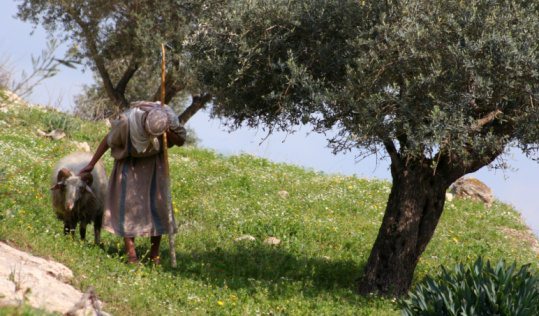
1 “Truly, truly, I say to you, he who does not enter the sheepfold by the door but climbs in by another way, that man is a thief and a robber. 2 But he who enters by the door is the shepherd of the sheep. 3 To him the gatekeeper opens. The sheep hear his voice, and he calls his own sheep by name and leads them out. 4 When he has brought out all his own, he goes before them, and the sheep follow him, for they know his voice. 5 A stranger they will not follow, but they will flee from him, for they do not know the voice of strangers.” 6 This figure of speech Jesus used with them, but they did not understand what he was saying to them.
In ancient times, just like today, all kinds of thievery were practiced. Because the Gospel of John was written when people largely grew their own produce and often times raised their own cattle this illustration was rather familiar. It was widely known that if someone wanted to hurt a sheep owner economically, the worst thing that could be done was to let their sheep out under the cover of night and to disperse them. This would take a great deal of time for their shepherd to gather them into the fold again. They could of course steal a few sheep, but it was not possible to steal most of the sheep by persuading them to follow the thief. Thieves could steal what they could carry only after killing the sheep, thereby destroying the owner’s property. The reason the herd would not follow the thief was simple: They were accustomed to the voice of their shepherd.
As Jesus continued and intensified his polemic discourses with the hoi Ioudaioi, the identity of his person and his mission became abundantly clear. In this very important section, Jesus will recall the image of Israel as God’s sheep, ascribing to the ruling Jerusalemite establishment the role of the evil shepherds of Israel and casting himself as the Good Shepherd of Israel so powerfully described in Ezekiel 34:
“1The word of the Lord came to me: 2 “Son of man, prophesy against the shepherds of Israel; prophesy, and say to them, even to the shepherds, Thus says the Lord God: ‘Ah, shepherds of Israel who have been feeding yourselves!… 6 My sheep were scattered; they wandered over all the mountains and on every high hill. My sheep were scattered over all the face of the earth, with none to search or seek for them… 10 …I will rescue my sheep from their mouths, that they may not be food for them. 11 “For thus says the Lord God: Behold, I, I myself will search for my sheep and will seek them out… 15 I myself will be the shepherd of my sheep, and I myself will make them lie down, declares the Lord God. 16 I will seek the lost, and I will bring back the strayed, and I will bind up the injured, and I will strengthen the weak, and the fat and the strong I will destroy… 23 And I will set up over them one shepherd, my servant David, and he shall feed them: he shall feed them and be their shepherd. 24 And I, the Lord, will be their God, and my servant David shall be prince among them. I am the Lord; I have spoken.” (Ezek.34:1-24)
7 So Jesus again said to them, “Truly, truly, I say to you, I am the door of the sheep. 8 All who came before me are thieves and robbers, but the sheep did not listen to them. 9 I am the door. If anyone enters by me, he will be saved and will go in and out and find pasture. 10 The thief comes only to steal and kill and destroy. I came that they may have life and have it abundantly.
It has been almost habitual to say that here Jesus is speaking about various people who had claimed to be the Messiah before he came. It is true that both before and after Jesus there were a good number of false Messiahs. However, in this context I think this view is misguided. There is no doubt that those who came to the people of Israel before Jesus are the current Jerusalem rulers – the evil shepherds of Israel. They claimed that they alone were the proper entrance. They were the door. If someone was to enter, he must come through them. Jesus says that this is most definitely false. He is the door, not them. He is the only way. If someone will enter through him, he would find refuge (be saved) and sustenance (true life resources). Jesus has only the good of his sheep in mind. Jesus’ very coming had to do with giving new and abundant life.
NOTE: To explore preliminary information about “Introduction to Jewish Studies” 3 months long course with Dr. Eli that will be offered starting February, 2014, please, click HERE.
11 I am the good shepherd.
If we only look at this in the context of a few verses, it is possible to see that only the idea of carrying is involved, but if we consider it in the context of the obvious Old Testament connection with the Ezek. 34, things become clearer: Jesus is Israel’s God who has come to judge and to save.
The good shepherd lays down his life for the sheep. 12 He who is a hired hand and not a shepherd, who does not own the sheep, sees the wolf coming and leaves the sheep and flees, and the wolf snatches them and scatters them. 13 He flees because he is a hired hand and cares nothing for the sheep. 14 I am the good shepherd. I know my own and my own know me, 15 just as the Father knows me and I know the Father; and I lay down my life for the sheep.
As is obvious from this discourse, the basic difference between Jesus and those who currently ruled Israel was this: He owns the sheep and the other shepherds were hired to care for the sheep. In other words, they are only shepherds because they draw an income. He is the complete opposite. He who owns everything made himself poor and became a servant for the good of the sheep.
We must remember that Jesus continued his previous conversation with a mixed group of people, often addressing his comments to the hoi Ioudaioi present (both those who believed and those who did not believe in him).
For better viewing click HERE.
16 And I have other sheep that are not of this fold. I must bring them also, and they will listen to my voice. So there will be one flock, one shepherd.
This section of the Gospel of John is one of the most memorable and quotable passages in the book. It is normal for someone to speculate that this is a discussion about the unity of Jews and the Nations (Gentiles in most translations) in this text. It is understood that Jesus is speaking to a Jewish crowd when he says he also has believers among the Gentiles who also need to be reached and brought in under the mighty hand of the Good Shepherd. I think the message is wonderful, but I think it has nothing to do with the Gospel of John’s context and message.
It is far more likely that something entirely different is in view here. As we have already seen, the author of the Gospel of John has Jesus interacting strongly with the passage in Ezek. 34 (evil shepherds vs. the Good shepherd). Only a few chapters later, Ezekiel describes the incredible regeneration/resurrection of Israel that is yet in the future (the vision of valley of the Dry Bones). It is there that we find the key to Jesus’ words in John 10:16:
“15 The word of the Lord came to me: 16 “Son of man, take a stick and write on it, ‘For Judah, and the people of Israel associated with him’; then take another stick and write on it, ‘For Joseph (the stick of Ephraim) and all the house of Israel associated with him.’ 17 And join them one to another into one stick that they may become one in your hand… Behold, I am about to take the stick of Joseph (that is in the hand of Ephraim) and the tribes of Israel associated with him. And I will join with it the stick of Judah, and make them one stick, that they may be one in my hand… Behold, I will take the people of Israel from the nations among which they have gone, and will gather them from all around, and bring them to their own land. 22 And I will make them one nation in the land, on the mountains of Israel. And one king shall be king over them all, and they shall be no longer two nations, and no longer divided into two kingdoms… 24 “My servant David shall be king over them, and they shall all have one shepherd.” (Ezek.37:15-24).
The case is clear. Jesus comes to unite Israel. All Israel. Will the evil shepherds of Israel stand in his way? They will try? Will they succeed? They will not.
17 For this reason the Father loves me, because I lay down my life that I may take it up again. 18 No one takes it from me, but I lay it down of my own accord. I have authority to lay it down, and I have authority to take it up again. This charge I have received from my Father.”
As the time of great confrontation that will result in Jesus’ crucifixion nears, it becomes apparent that the one of the central themes in John’s Gospel is the question of authority. Who is the true authority? For 3 days entire days while Jesus was dead it looked like he had indeed overstepped his authority by boldly criticizing the establishment. But the Gospel prepares its hearers – Jesus’ death will not be because he lacked authority with this being the cause of his trouble. He had the authority to even lay his life down and to take it up again. He received this authority from his Father, the author of life.
19 There was again a division among the Jews because of these words. 20 Many of them said, “He has a demon, and is insane; why listen to him?” 21 Others said, “These are not the words of one who is oppressed by a demon. Can a demon open the eyes of the blind?”
Again, Jesus managed to create a sense of division among the hoi Ioudaioi. There were those who accepted him and those who rejected him. The theories about Jesus ranged from demon possession to divine servanthood. The hearer was more and more pressed to choose for himself what to believe about Jesus.
Read PART II