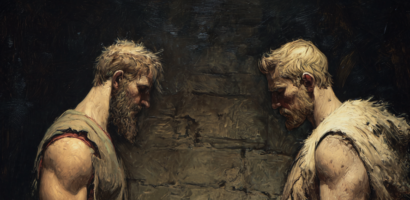


10 He was in the world, and the world was made through him, yet the world did not know him. 11 He came to his own, and his own people did not receive him. 12 But to all who did receive him, who believed in his name, he gave the right to become children of God, 13 who were born, not of blood nor of the will of the flesh nor of the will of man, but of God.
This passage is probably one of the most important passages for discovering the true meaning of the Gospel of John. Why is this passage so important? First of all, this passage is part of the book’s prologue. It is in the prologue where the trajectory for all the material that follows is determined. In other words, the way the interpreter understands the prologue will affect how he reads the rest of what John had to say.
Generally speaking, both Christian and most Jewish scholars after them read this passage as if the unit of thought begins at vs.11 and continues until vs. 13. (We need to keep in mind that when the Gospel was first authored, there were no breaks between chapters and verses.) However, vs. 11 continues to develop the idea that begins in vs.10. This is significant because without verse 10, verse 11 is can be easily misread.
Vs. 11 traditionally is interpreted as follows. “He came unto his own (meaning the Jews), but his own (meaning the Jews) did not accept him.” In this traditional interpretation vs. 12 continues to juxtapose Jewish national unbelief with the faith of universalized/international Christians. However, there are two problems with this interpretation that at least should temper our conclusions until we know more:
1) First it is grammatically problematic. Literally the translation of the first “own” in vs. 11 from the Greek should be rendered as “He came to his own things.” The Greek word is in fact in neuter plural, and therefore cannot in anyway refer to the Jewish people or any people for that matter. It most probably refers to “the world” in vs. 10 that proceeds vs.11 (… the world was made through him, yet the world did not receive him.) The second “own” in vs. 11 can in fact refer to the Jewish people, but does not have to, since it can simply refer to humanity rejecting God’s Kingship. The traditional interpretation argues against the logical and simple flow of text (line of thought) in John’s narrative. If one is careful to distinguish the genders used by the author, the first “own” is neuter and the second “own” is masculine, then the traditional interpretation may be not as certain as previously thought.
2) This interpretation is also problematic historically, because it’s reading in a later history back into a previous history. Before I lose you, please, let me explain. You see whether someone thinks that John was authored extremely early (around 40 C.E.) or fairly late (around 90 C.E.) during all of the first century Jewish followers of Jesus were still very much present in large numbers. Many of the original Jewish leaders of the early Jesus movement and their (Jewish) disciples played an active role in the life of the Early Church.
At this point, I’m not setting forth any conclusive theories; but simply raising problems with the usual assumed reading of this text. If the traditional interpretation of Jn. 1.10-13 is indeed the correct interpretation, then the basic assumption about this Gospel is unavoidable – it is in fact an early Christian anti-Jewish document, regardless of its very rich Christian spiritual message. However, I am suggesting that there is at least one alternative way to read the Gospel of John. But more about this in later sections of this commentary.
To receive more information about learning Biblical Languages with Hebrew University of Jerusalem/eTeacher Biblical program online at affordable cost, please, click here.
© By Eli Lizorkin-Eyzenberg, Ph.D.
To sign up for weekly posts by Dr. Eli, please, click here. It is recommend by Dr. Eli that you read everything from the begining in his study of John. You can do so by clicking here – “Samaritan-Jewish Commentary”.