

16 For from his fullness we have all received, grace upon grace. 17 For the law was given through Moses; grace and truth came through Jesus Christ. 18 No one has ever seen God; the only God, who is at the Father’s side, he has made him known.
From the first century on, the Christian believers continued to debate, mostly with each other, the importance of the Mosaic Law. While both vs.16 and vs.18 have much that is important and certainly worth being discussed at length, we will concentrate on vs. 17 – “For the law was given through Moses; grace and truth came through Jesus Christ.” (ESV)
As the Protestant Christian movement emerged, one of the biggest disagreements between those who would one day become Protestants, and those would remain Roman Catholic was the issue of the function of the law in the life of the believer.
Two of the four most important theological shortcut phrases of Reformation were “by faith alone” and “by Christ alone.” These phrases indicated how one was “saved” from God’s eternal judgment. The intention was to highlight “Faith alone” as opposed to “faith and good works of the believers” and “by Christ alone” as opposed to “by Christ and good works of the believers.”
This conflict between Protestants and Catholics was, some scholars asserted,[1] later read back into the Pauline writings and projected back into Paul’s own words and critique of Judaism. The argument was simply that Paul had wholly different concerns and therefore did not mean to say what he was interpreted to say. The present commentator is not fully persuaded that this was indeed the case, at least to the degree to which N.T. Wright and others have argued. However, it is true that sometime after, the emphasis on the juxtaposition of Law and Grace became dominant. The opposite of Grace became Law, the opposite of Law, perhaps, naturally by now became Grace.[2]
In all reality the opposite of “law” was never “grace”, but “lawlessness”. Just as the opposite of “grace” was – “disgrace”.
For better or for worse, post-Reformation Christians have begun to emphasize this juxtaposition in their teaching (though it actually did not reflect the views of the key Reformers). This juxtaposition many of them argued was Paul’s directive. This, “Paul’s directive,” was then indiscriminately read into other books of New Testament collection, including the Gospel of John that we’re studying.
So, for example, some important versions of English Bible translations (King James Version[3] and the New Living Translation[4]) insert the additional word “but.” This word is not present in the Greek text that highlights this juxtaposition in John 1.17. Moreover, even when the translations used do not add the word “but” (see the English Standard Version quoted above) the verse is normally understood as if the “but” was implied.
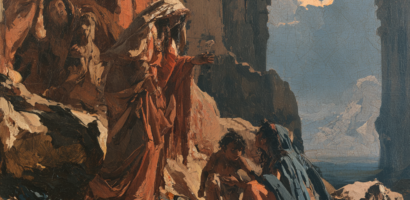
The Torah, he stated, came through Moses. “Grace and Truth” came through Jesus Christ. Now… do your best not to read “grace and truth” as the opposite of anything. And, if we can do this, then perhaps, we can track the author’s logic in a different trajectory than we usually follow.
So, once again, the Bible does not need to be rewritten, but it does need to be reread.
To receive more information about learning Biblical Languages with Hebrew University of Jerusalem/eTeacher Biblical program online at affordable cost, please, click here.
© By Eli Lizorkin-Eyzenberg, Ph.D.
To sign up for weekly posts by Dr. Eli, please, click here. It is recommend by Dr. Eli that you read everything from the begining in his study of John. You can do so by clicking here – “Samaritan-Jewish Commentary”.
[2] In reality the opposite of Grace should have always been disgrace, while the opposite of the concept of law should have always been the concept of lawlessness.
[3] For the law was given by Moses, but grace and truth came by Jesus Christ.
[4] For the law was given through Moses, but God’s unfailing love and faithfulness came through Jesus Christ.
[5] Jesus as second Moses is a widely used and well-known theme in Christian writings