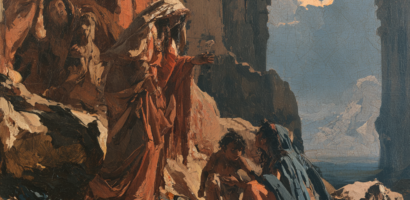


19 And this is the testimony of John, when the Jews sent priests and Levites from Jerusalem to ask him, “Who are you?” 20 He confessed, and did not deny, but confessed, “I am not the Christ.” 21 And they asked him, “What then? Are you Elijah?” He said, “I am not.” “Are you the Prophet?” And he answered, “No.” 22 So they said to him, “Who are you? We need to give an answer to those who sent us. What do you say about yourself?” 23 He said, “I am the voice of one crying out in the wilderness, ‘Make straight the way of the Lord,’ as the prophet Isaiah said.” 24 (Now they had been sent from the Pharisees.)
Here for the first time we encounter one of the key characteristics of those whom John calls – hoi Iudaioi. In most translations hoi Iudaioi is simply translated as – “the Jews.” In this section, as in most appearances in this Gospel, the key characteristic of this group is their authority. In fact, most disputes that Jesus has with his opponents in this Gospel are in some way connected with this concept. “The Jews” are in a position of authority to send a commission of Levites and priests from Jerusalem to investigate the activity of John the Baptist. Not only do they send the delegation, but John the Baptist gives them his reluctant answer, thereby begrudgingly acknowledging their authority.
It must be kept in mind that Jerusalem had only one spiritual center – the Temple. There was also a larger council of sages, the Sanhedrin, who governed the affairs of the Jewish community. The Sanhedrin consisted of the Temple priests, the high priests (many of whom were Sadducees), and also a large number of leading representatives of the Pharisaic movement (regular people tended to favor Essenes and Pharisees over against Sadducees).
In Jn 1:24 we are told that the priests and Levites mentioned Jn 1:19 were sent by Jerusalem’s Pharisees. Here, the Gospel of John is specifying which of the ruling fractions initiated the commission of inquiry into John’s actions and preaching. It was the Pharisaic fraction.
You may remember in previous discussions we mentioned the possibility that John (Yohanan) the Baptist was the same Yohanan mentioned in the writings of the Qumran Community who departed Qumran. We concluded that while possible, this hypothesis was unlikely. We additionally noted that the Essene community, according to Josephus, was almost as large as that of the Pharisees and was somehow connected with Qumran. It is likely that Qumran was spiritual center of the Essene movement. In other words, all Qumranites were probably also Essenes, but not all Essenes were Qumranites.
The fact that John the Baptist was particularly targeted for investigation by the Pharisees supports the idea that he was in fact connected to the larger Essene movement. (Remember, the Essenes were the arch enemies of the Pharisees). John, still recognizing to some degree the authority of “the ones that sent” the delegation from Jerusalem, provides his answers. However, we can see (particularly evident in the Greek) that his answers become shorter and shorter as he replies to the commission’s questioning (Jn 1:20-21).
To receive more information about learning Biblical Languages with Hebrew University of Jerusalem/eTeacher Biblical program online at affordable cost, please, click here.
© By Eli Lizorkin-Eyzenberg, Ph.D.
To sign up for weekly posts by Dr. Eli, please, click here. It is recommend by Dr. Eli that you read everything from the begining in his study of John. You can do so by clicking here – “Samaritan-Jewish Commentary”.