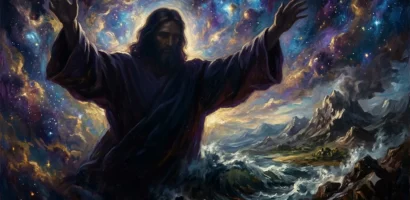



… and His face was like the sun shining in its strength.17 When I saw Him, I fell at His feet like a dead man. And He placed His right hand on me, saying, “Do not be afraid; I am the first and the last, 18 and the living One; and I was dead, and behold, I am alive forevermore, and I have the keys of death and of Hades. (Rev 1:16-18)
The picture of royal authority and magnificence is further amplified by the shining sun-like light emanating from the Son of Man. In Mathew 17:1-2 at the transfiguration event of Christ similar description was used. There we read,
“Six days later Jesus took with Him Peter and James and John his brother, and led them up on a high mountain by themselves. And He was transfigured before them; and His face shone like the sun, and His garments became as white as light.”
The difference between the book of Revelation and the Matthew’s account is simple – in the gospels Jesus’ transfiguration is a temporary glance, but in the Letter of Revelation it is permanent. So overwhelming was the vision of John that he found himself on the floor struck and paralyzed with fear. This is what happened to the disciples at the appearance of the cloud during Jesus’ transfiguration. The hand of the Son of Man quickly touched John and the words of comfort followed. The Son of Man told him not to be afraid, since he was once dead, but now is alive forever. Not only that, but the ultimate authority over death itself and the entire kingdom of darkness now belonged to the resurrected Son of Man (the keys of death and of Hades were now in his hand).
Holding keys to a particular domain is a clear sign of ability to exercise authority connected to that domain. Keeping doors closed or opening them always restricts or allows access. During this time in Jewish religious though we see many references to this general idea. In Matt 16:19 Peter is promised the keys to the Kingdom of Heaven. In Matthew 23:13 Jesus speaks of Pharisees and Scribes not entering the Kingdom and keeping others locked out as if they had the authority and ability to do so. In Luke 11:52 parallel the Pharisees have taken away the “key of knowledge” so people cannot enter. In 3 Baruch 11:1-3 Michael the archangel is described as holding the keys to the Kingdom of Heaven,
1 And the angel took me and led me thence to a fifth heaven. 2 And the gate was closed. And I said, Lord, is not this gate-way open that we may enter? And the angel said to me, We cannot enter until Michael comes, who holds the keys of the Kingdom of Heaven; but wait and thou shalt see the glory of God. 3 And there was a great sound, as thunder. (3 Baruch 11:1-3)
Not only the Kingdom of Heaven has gates that can be locked and unlocked, but also the Kingdom of Hell (Hades), the underworld has gates as well (Mat 16:18). A Midrash ascribed to Rabbi Akiva cites this tradition,
“In that hour the Holy One, blessed be He, takes the keys of gēhinnōm and gives them to Michael and Gabriel before the eyes of all the righteous, and says to them: Go and open the gates of ḡhinnōm … Forthwith Michael and Gabriel go and open the 40,000 gates of ḡhinn̄om”.
Jesus as the resurrected Son of Man, one whose face radiates God’s glory has the authority and control not only in heaven, but also in Hell (Hades). A passage often mistakenly published in the appendix of Josephus’ writings that was written by Hyppolitus of Rome (beginning of 3rd century CE) explains about the idea of the Hades as understood by him,
“Hades is a place in the world not regularly finished; a subterraneous region, wherein the light of this world does not shine; from which circumstance, that in this region the light does not shine, it cannot be but there must be in it perpetual darkness.” (Discourse on the Greeks concerning Hades, Dissertation V, 1).
In the light of this popular idea that hades are associated with deep darkness, it makes perfect sense that the face of Jesus shines like the sun at its strength (vs.16). Moreover, it is understandable why John is told not to be afraid.
Lastly, Jesus calls himself the first and the last possibly referring to the Alpha and Omega title. But he is also the risen one, the one who is alive right now. One can see the three aspects (past, future and present) in this symbolic statement. This phrase is similar to the skillfully veiled reference of יהוה, the one “who is and who was and who is to come” in Rev.1:8-9.