

 A film watched on a visit to friends in Sweden
Warsaw 1939, peril charges the atmosphere;
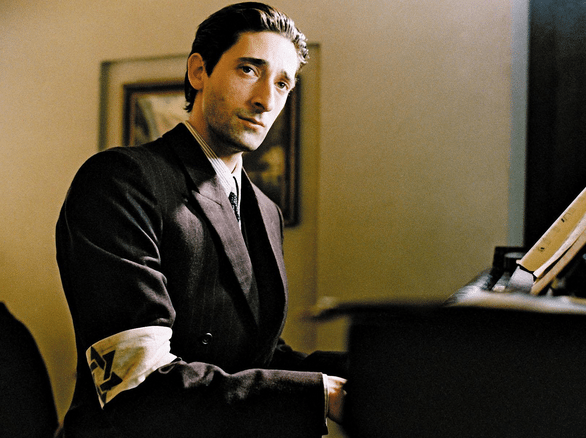
A pianist lives there amongst a people dwelling in fear.
The very air is bristling with malevolence.
Talented and young, this Jewish Pole,
Along with millions of others,
Is about to fall foul of invading Nazi devils,
Determined to rip out of the people its very soul.
The pianist’s recreated story yet lingers
As the camera alternates between reality
And his giftedly dancing fingers.
To make a comment or to visit original post, please, click HERE. To read more about the movie, click HERE.
Storm clouds bring storm troopers,
A most bloody bunch of merciless murderers.
Reality crushes all connection with the word ‘free.’
On those like the Jews without protection,
The wicked rush with cords and fetters to bind,
On perceived weak segments of humanity,
Who please not the evil mind.
The Jewish catastrophe, as portrayed
Through the suffering soul of the pianist,
Has not disappeared into time’s mist:
The film amply relates the eternal story of Jewish fate.
Pathos bathes the narrative: strongly it speaks to me.
First rate as a tragic tale, dexterous fingers play skillfully.
It communicates the longing in the human breast to be free,
Particularly of Europe’s doomed Jewry. A good illustration,
Recreating a plighted picture of the desperate Jewish situation,
The greatest onslaught to blot out Israel’s name forever,
To bring the people down to dust, reduce us to nought,
Destroy us completely as part of the human race.
Almost successful in Satan’s eternal endeavor,
It became Germany’s perpetual disgrace.
If in the wrong place I’d been born
Ten years too early, runs my thought,
Night would have imprisoned my dawn.
I’d have been captured and caught
In the wicked whirlpool which over the Continent spread.
It would have sucked up me and my extensive family:
We’d have been part of the millions of maimed and dead.
The reflection, too much to entertain, I put aside.
The tale engrosses me, interwoven in the nation’s genocide.
The Pianist captures the savagery of the inflicted wound
On the Jewish soul; will we ever again be healthy and sound
After the all-time attempt to swallow our people whole?
A more savage wound could not have been wrought
By the willing executioners of the Devil’s thoughts,
Who succeeded in the tertiation of our small, abused nation.
Excellently playing their parts, the actors reconstruct that hell.
It’s not for the viewer who wants his sensitivities spared:
Omnipresent danger creates a hard film to watch.
A recent segment of Jewish history it well tells:
All-pervading, the hateful Nazi spirit charges the air.
Ugly fulfillment in morbid imagination’s dread deeds,
The camera catches: it portrays a people of broken reeds.
But it’s not overdone.
The pianist desires to live and have fun:
His romance with a Polish girl turns forlorn,
Terminates under evil’s lengthening shadow;
The ‘final solution’, pregnant in hate-filled readiness,
Awaits to unleash on Europe its saddest morn.
Radical racial laws forbid ‘mixing,’
Seal all Jews inside the ghetto,
Lock all doors of life to the condemned Jews;
Their dire fate psychopaths are at liberty to choose.
I wonder in the Germany of Hitler’s generation,
If total mental and moral derangement
Wasn’t the condition of the entire population.
The transported viewer in his mind’s eye
Visits war-torn Warsaw and the ghetto people
Doomed to die. Endlessly the question rhetorically implores:
Why, oh why, the closing of all human doors
As torrents of blood from butchers’ knives pour?
Great theologians and historians, writers of every hue,
Strike explanational dumbness by evil’s mystery,
At eternity’s producing Israel’s greatest all-time enemy,
At worldwide indifference to the eradication of the Jew.
I find difficulty in facing that part of Jewish history:
The film’s sensitivity solemnly speaks to me,
Another never-to-be-forgotten reminder
Of what it meant to be a Jew in Nazi-occupied Europe,
A continent for twelve protracted years devoid of hope.
Certain memories dominate my recall:
The child smuggler in his lower body beaten to death
Half-way through the dividing wall,
Men called out of roll-call
line, ‘Du! Du! Du!’
A bullet through the brain for each
For the crime of being a Jew.
Scenes of the ghetto perishing in flames,
A smoldering mass of burned out rubble,
Cruelty exalted as the highest of aims,
Germany bringing on our people
Indescribable, unparalleled trouble.
Frequent return to the pianist’s playing,
His nimble fingers and oh so sensitive face,
Pull on the viewer’s heartstrings.
Much is spoken without words telling:
The young man ably acts out the receiving side
Of the supreme barbarism of the master race.
Some Poles, people with human souls,
Help him escape to the wall’s Aryan part.
There he finds a few ‘safe’ houses of fear,
Frightened by his loud palpitations of heart.
A fate of staying alive acts as his sole safeguard;
He returns to the ghetto to dust-crumbling hideouts,
Waiting for fate to deal his final card.
The film’s end an unlikely angel sends:
A German officer. He gets him to play
A piano conveniently placed nearby.
The pianist plays for all his worth;
Desperation gives birth to inspiration,
Truly a hunted creature of the sorry earth.
He plays as if it’s his way out of trouble,
In that haunted site of devastation and rubble.
Verily almost dead from fear,
Mercy is presented as drawing near.
The officer brings the starving pianist food,
Gives him his coat. He is good,
An angel of mercy amongst the demons,
A human being amongst anti-humans.
His personality carries a kindly stamp,
But later he dies in a Soviet prison camp.
His compassion comes as a surprise of course:
A Nazi officer, what an unlikely source!
Who would take mercy on a despised Jew
Of whom only a handful remain alive, a pitiful few?
Introduced late as a ray of light,
He appears as daybreak glimmering in total night,
When complete destruction forms the ghetto’s plight.
Nothing is said of if he agrees with Hitler’s plan,
But here is a Nazi officer presented as human.
Dying recently at eighty eight,
The pianist bore a heart torment over-great.
Doubtless his music kept him semi-sane
In wandering through a world of emotional pain,
But a normal man’s life tends to revive and live again.
An excellent short story, it seeks at its core
To capture a period of time, relive it once more,
And by its creative power enable the viewer to imagine
Life in Warsaw at this time.
To the historical moment it lays hold,
Recreating with passion the all-time crime,
As I watch a segment of the Holocaust unfold.
Power indwells the story, speaking strongly to me.
Through the presentation of a slice of history and place,
It reconstructs the offense, meets the requirement:
Tearfully we view the incurable wound in reenactment,
Which down through the decades reverberates
Of the Jews’ darkest hour, climax of a climate of hate,
Clutched by evil’s ruthless power.
The pianist after the war continues in Warsaw,
A living monument to the fate of the Jews.
His generation of survivors are mostly gone
But the memory undying lives on.
Necessity cries, ‘learn from yesterday’s sorrow,
If not, you will repeat it again tomorrow.’
The Pianist belongs in Holocaust literature,
Highlighting man’s cruelty to his fellows
As a permanent, not to be forgotten feature.
It’s been like that from days of old;
May the story not be hidden but retold.
The Jewish people will perpetually recall
How a fearsome fate on an unprotected people fell.
The poem was written by David Ben Haim in 2005. It was originally published as part of authors book “Journey of a Soul” (PDP International Press, 2012).