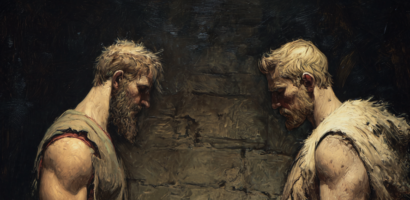



 They went each to his own house, but Jesus went to the Mount of Olives. 2 Early in the morning he came again to the temple. All the people came to him, and he sat down and taught them. 3 The scribes and the Pharisees brought a woman who had been caught in adultery, and placing her in the midst 4 they said to him, “Teacher, this woman has been caught in the act of adultery. 5 Now in the Law Moses commanded us to stone such women. So what do you say?” 6 This they said to test him that they might have some charge to bring against him. Jesus bent down and wrote with his finger on the ground. 7 And as they continued to ask him, he stood up and said to them, “Let him who is without sin among you be the first to throw a stone at her.” 8 And once more he bent down and wrote on the ground. 9 But when they heard it, they went away one by one, beginning with the older ones, and Jesus was left alone with the woman standing before him. 10 Jesus stood up and said to her, “Woman, where are they? Has no one condemned you?” 11 She said, “No one, Lord.” And Jesus said, “Neither do I condemn you; go, and from now on sin no more.”
In other portions of this commentary we spoke about how the science of textual criticism can help Christian believers to know which texts of the Bible are authentic and which are not, which belong to the Bible, and which constitute editorial additions or subtractions by scribes who handled the transition of Holy Writ before the invention of printing press. Since we don’t have a single original manuscript or scroll of any of the books of the Bible and since there exist multiple versions (most of them with minor differences) of most biblical books, textual criticism/analysis through various methods of dating can help to determine which versions of the available textual witnesses are more faithful than others to the Biblical original.
In the passage we are considering, as we come upon one of the most famous and beloved Gospel stories, we are very much in need of textual analysis. So what is the issue? It is rather simple. All the earliest and most reliable manuscripts of the Gospels do not contain this beautiful story that is otherwise so magnificently consistent with the rest Gospel of Christ.
All modern translations of the Bible, with a disclaimer that this story is not found in early manuscripts, still include it in their printed texts. What is perhaps even more intriguing for our discussion is that this story is often passed on orally more often than many other stories even today! This implies that while the textual criticism scholars have made a strong and even convincing (to my mind) argument that this text was not part of the original of John’s Gospel; the living church of God has generally not accepted the implications of their argument.
Before we continue let me surprise you a bit. I think that this is an authentic story. In other words I think it really did take place and therefore must be told and retold in Gospel proclamation. However, I agree with most scholars that it does not belong to John’s Gospel. Please, let me explain.
There could be several ways to explain why this true story is not found in the original Gospel texts.
First of all, we do know that not everything Jesus taught and did was included in the Gospels (John 21:25). It is therefore fully possible that Jesus said things that were not written down. Like all books of the Bible, the Gospels are highly selective. They only give enough information to make the point that the author of a particular Gospel is seeking to make. The Gospels are not like cameras that simply record what happened around Jesus. They are literary works setting forth the arguments of the Gospel writers about Jesus on the basis of what they and their witnesses remembered had really happened. Therefore selectivity of presentation is unavoidable.
Secondly, most things that Jesus taught and said were not written down immediately. They were circulated orally as they were passed on from one person to another. There is no reason to think that this story is fabricated only because it entered the Gospel textual tradition later. It may have only been transmitted orally until the issue was raised among the copyists about the need to include it in one of the Gospels (this story is found only in fourth century manuscripts and later).
Thirdly, textual criticism like any other scientific enterprise is a work in progress. It certainly can be mistaken. In other words, it has limitations and there can be issues that textual scholars did not take into consideration or were in error. For example, we must keep in mind that from time to time new discoveries of ancient texts are made. We certainly cannot be dogmatic about these issues (Discovery of Dead Sea Scrolls has proved this point convincingly).
Personally, however, I am almost 100% persuaded that we will never find an early manuscript with this story. Why? To my mind there are at least three main reasons.
1) Ancient scribes rarely cut texts down, normally, they expanded them, clarifying or explaining, and as such expending the text. One of the insights of textual criticism is in fact called “the priority of the shorter manuscript.” This means that shorter manuscripts are considered to be earlier than longer ones. There are of course other factors involved, but it is an important factor.
2) For the sake of discussion, if we only read through John 7:52 and skip immediately to John 8:12, we will see that the text reads very smoothly. In fact, the story under consideration seems rather awkwardly inserted into the flow of the John 7-8. There could be many reasons why Christian scribes decided to place it in the Gospel of John. Most of the reasons would be too speculative for us to seriously consider.
3) The story makes use of the pair that is never mentioned together in the Gospel of John – “scribes and Pharisees”. This phrase over abounds in other canonical Gospels, but it is never used in the Gospel of John. On several occasions John features his own couple – “hoi Ioudaioi and Pharisees” instead.
As always let us continue to think together! I, therefore, invite you to share your thoughts, opinions and comments about this commentary section.
To receive more information about learning Biblical Languages with Hebrew University of Jerusalem/eTeacher Biblical program online at affordable cost, please, click here.