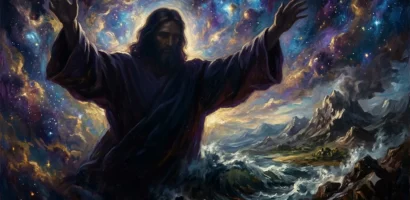



16 …and out of His mouth came a sharp two-edged sword; and His face was like the sun shining in its strength. (Rev 1:16)
As dozens of artists attempted to recreate this picture in their art works and mostly without much success, we are pointed to the awkwardness of John’s further description of the Son of Man – “from his mouth came a sharp two-edged sword”. Sword is the ultimate symbol of armed strength and victory in the ancient world. There are many different kinds of swords. The swords that were two-edged were particularly deadly since they were able to cut from both side of the blade.
Understanding the genre of Revelation we know that the double-edged sword is a metaphor. The imagery is trying to convey that the mouth of the Son of Man wields great power, like that of a double-edged sword. It is able to wound and to slay the enemies. In 1 Enoch 62:2 we read:
“And the Lord of Spirits seated him on the throne of His glory, and the spirit of righteousness was poured out upon him, and the word of his mouth slays all the sinners, and all the unrighteous are destroyed from before his face.”
The Second Temple literature and Bible has a number of passages showing that the mouth can be a very deadly weapon. In some places merely words slay, in other passages it is fire and sometimes it is the breath. In 4 Ezra 13:3 we read:
“And I beheld, and lo! The wind caused to come up out of the heart of the seas as it were the form of a man. And I beheld, and lo! This Man flew with the clouds of heaven. And wherever he turned his countenance to look everything seen by him trembled; and with the voice that went out of his mouth, all that heard his voice melted away, as the wax melts when it feels the fire.”
The Son of Man has immense power in this depiction. Like in Daniel he comes “with the clouds of heaven”. His gaze alone makes things tremble. The sound of his voice makes things melt as if he is breathing fire. Though this is not a sword, the idea is the same. This angel-like being is powerful enough to destroy with his voice alone. Prophet Isaiah writes similar words:
“And He will delight in the fear of the Lord, And He will not judge by what His eyes see, nor make a decision by what His ears hear; but with righteousness He will judge the poor, and decide with fairness for the afflicted of the earth; and He will strike the earth with the rod of His mouth, and with the breath of His lips He will slay the wicked.” (Isaiah 11:3-4)
Whether it is a double-edged sword in the mouth of the Son of Man, or his voice melts all things, or he strikes the earth with the rod of his mouth the effect it of this description is very intentional. The overall idea here is that this heavenly being described by John in verse 16 is full of power as evidenced by him holding the seven starts and a potent sword preceding forth from him presumably to assure the seven assemblies of their safety.
One very important but additional detail is that the sword comes out of his mouth. If we ponder this issue a little, we will be struck by this small, but extremely significant detail. Swords are always held by the hands of the worriers. To be precise, the sword is always held in the strongest hand (usually the right hand), signifying full control over the weapon.
The point in this text is not that the hands of the Son of Man are already full, but that the powerful sword under consideration here is God’s Words. The writer of the so-called Epistle to the Hebrews, who likely wrote before the Revelation was composed, put it this way:
“For the word of God is living and active and sharper than any two-edged sword, and piercing as far as the division of soul and spirit, of both joints and marrow, and able to judge the thoughts and intentions of the heart.” (Heb.4:12)
There seems to be a little doubt that the Book of Revelation was composed at the time of persecution of early Christ-followers by the Roman government. The letter of Revelation was a right message at the right time. This apocalyptic message is a bright hopeful future amidst difficult times. When the fate of Jesus-worshiping congregations (both newly planted among non-Jews and those who already existed among the Jews) was not at all clear, John is shown what must soon take place. Before he is able to see all of the heavenly drama prophetically enacted he is already overcome by this heavenly being that he sees.