

 For better viewing click HERE.
“Then (after the Ascension) they turned back to Jerusalem from the hill called the Mount of Olives, which is within a Sabbath’s day journey, near Jerusalem. When they entered, they ascended to the upper room where they were staying…” (Acts 1:12-13)
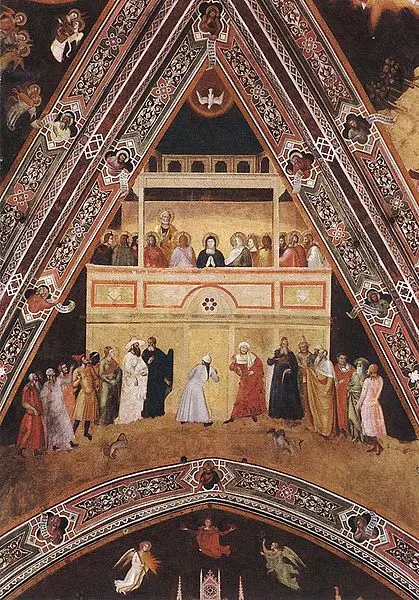
Painting by Andrea da Firenze, 14th c., Descent of the Holy Spirit. The Apostles are in the “upper room” and the Jews are in costumes indicating they had arrived in Jerusalem from different countries (2:5-11). There are many depictions of the Pentecost in art, but this is the only one exactly illustrating the verses in Acts.
There are two questions to be asked about this “upper room”: where was it, and what was its significance? The Greek word in the New Testament is a special and not frequently used term: τὸ ὑπερῷον, “the hypero-on”. “Hyper”, as in hyperactive, or hyperbolic, refers to something over, beyond or above. In ancient Greece, it had referred to the upper part of the house, where the women resided. Here, after the disciples gather after the Ascension, it is where the Holy Spirit descends upon them, on the day of the Pentecost (pictured above). It is also considered the site of the Last Supper, the cenaculum in Latin, along with many other important events described in the NT as happening there. But this particular Greek word occurs only here and once later, in Acts (9:37-40), as the place where Tabitha lies dead until Peter enters and brings her back to life. If one looks for the same word in the Greek version of the Hebrew Bible, the Septuagint (LXX), it refers to a similar miraculous event: in 2 Kings 4:8-17, it is the “upper room” which the Shunamite woman prepares for Elisha in her house, where he announces to her that she will give birth. And then what happens? This very son later becomes ill and dies, is placed back in the “upper room” on the bed of the “Man of God”. Elisha is summoned, enters, and brings him back to life with his breath! So, it is the womens’ room, the space where the Holy Spirit descends and the site of healing breath and resurrection. This can’t be coincidental. It is indeed a “hyper” room, above and beyond this world.
An important note from Dr. Eli: Judith Green (the author of this article) is also the principle author of Biblical Greek course that is being offered now through eTeacherBiblical. To explore the possibility of taking a course in Biblical Greek, please, click HERE.
Today, the upper room is in a 12th c. Crusader structure, built on the upper level above the supposed “tomb of King David”, called a “cenotaph”, from the Greek κενός + τάφος, meaning “empty tomb” – which it is, as the Crusaders put an empty sarcophagus there, since the original tomb had disappeared. According to the Hebrew Bible, David had been buried in the “City of David” presumably to the southeast of the Old City (I Kings 2:10). The tomb of David itself was probably destroyed at the time of the Bar Kokhba revolt (135 C.E.), and afterward the exact location of the site was forgotten.
In Part Two, we will hear more about the history of this building and why the “upper room” was above the “lower room”, the cenotaph of King David. Stay tuned it will be published next week.
To explore the possibility of taking a course in Biblical Greek, please, click HERE.