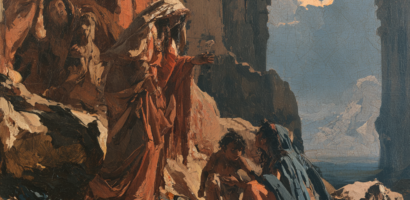



The voice in the wilderness is one of the favorite badges of identity for both New Testament Gospels in its featuring of John the Baptist, and the sectarian writings of Qumran community.
1-3 As it is written in Isaiah the prophet, “Behold, I send my messenger before your face, who will prepare your way, the voice of one crying in the wilderness: ‘Prepare the way of the Lord, make his paths straight.’
Once the previous verse in the Gospel of Mark declared the main theme, the author quickly introduces the character that has come to be known as John the Baptist. As a side note, a fast pace is one of the characteristic features of this gospel. Before he does introduces John the Baptist, Mark’s deeply Israelite mind could not conceive of skipping a very important point – stating the foundational reference to the words of God spoken through the prophets of old.
The quotation in verse 2 does not only come from Isaiah, but also from Mal.3:1 and probably from Ex.23:20. Older manuscripts of this Gospel, according to the traditional Israelite pattern, refer only to the greater prophets, in this case Isaiah. Medieval manuscripts of this Gospel show Christian scribal copyists discomfort with this and they exchange the reference to Isaiah with the clarifying reference to “the prophets”.
In the Masoretic version of Isaiah 40:3 we read:
ק֣וֹל קוֹרֵ֔א בַּמִּדְבָּ֕ר פַּנּ֖וּ דֶּ֣רֶךְ יְהוָ֑ה יַשְּׁרוּ֙ בָּעֲרָבָ֔ה מְסִלָּ֖ה לֵאלֹהֵֽינוּ׃”
In first part of this Hebrew version, this quotation can be translated as “A voice calling in the wilderness” or as “voice of the one calling in the wilderness.”
The Judeo-Greek Septuagint opts for one of these options, imagining someone in the wilderness who is calling out:
Φωνὴ βοῶντος ἐν τῇ ἐρήμῳ Ἑτοιμάσατε τὴν ὁδὸν Κυρίου, εὐθείας ποιεῖτε τὰς τρίβους τοῦ θεοῦ ἡμῶν.
Which translated means: “A voice of one crying in the wilderness, “Prepare the way of the Lord, make straight the paths of our God”.
Make sure to read my article “Was the New Testament written in Hebrew?” (click the link) where I argue that pre-Septuagint texts found in Qumran show that the Septuagint was legitimately used by the authors of New Testament as the core Biblical text.
This nuance becomes very important when we turn our attention to the possible connection between the early Jewish Jesus movement and the Essenes, who apparently had a branch in Qumran. The Qumran community and its larger Essene movement had a large number of similarities with the early Jewish Jesus movement. They also had an equal number of differences. In fact, it is the cumulative amount of similarities and differences that justify us in thinking that the early Jesus movement (including John the Baptist’s ministry) had some roots/or at least experiences in the Qumran community. In time, however, the Jesus community developed a polemical relationship with the Qumran community.
One notable similarity and difference between the Qumran materials and the Gospels is this: Qumran presents its community stationed in the wilderness (about 20 km from Jerusalem) as the voice calling out in the wilderness, while the Gospels speak of the fulfillment of Isaiah 40:3 only in terms of the ministry of John the Baptist.
We read in 1QS 8.12b-16b: “…they (community members) shall separate from the habitations ungodly men and shall go into the wilderness to prepare the way of Him; as it is written, Prepare in the wilderness the way of… make straight in the desert a path for our God. This is the study of the Law which He commanded by the hand of Moses… and as the Prophets have revealed by His Holy Spirit.”
In fact the term Holy Spirit rarely(if at all) appears in the Hebrew Bible and in wide variety of Jewish literature with two notable exceptions – the New Testament Gospels and sectarian documents of the Qumran.
John appeared, baptizing in the wilderness and proclaiming a baptism of repentance for the forgiveness of sins. 5 And all the country of Judea and all Jerusalem were going out to him and were being baptized by him in the river Jordan, confessing their sins.
Could it be that John the Baptist once belonged to the Qumran community? Yes. His emphasis on the water purification ceremony, his priestly origins, his ascetic life-style, his near identical missional justification (the voice in the wilderness), his curious diet (which we will discuss next), his apocalyptic message as well as his general location would certainly lead us in this direction.
Was John the Baptist/Baptizer a Qumranite by affiliation? Most certainly not. Qumran had a very stringent leadership structure. John, as best we can tell, worked alone. It is, therefore, much safer to conclude that John may have had an earlier connection with Qumran (as one Qumran reference very tentatively suggests) and then over time, parted company with them, developing his own ministry in a very different direction. We must not forget that our knowledge of Ancient Jewish movements is still fragmentary and it is entirely possible that John was affiliated in some way with another, unknown to us, movement of Jews calling other Jews to repentance. His affiliation is not the point. The fact that his was ‘the voice of the one calling in the wilderness” certainly is.