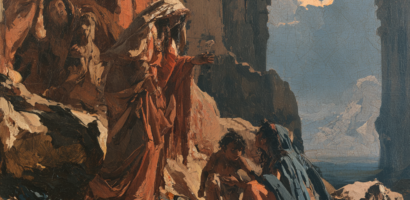



Corona-virus has changed the plans of millions – and this blog, of course, has not been exempted from this unfortunate influence. Originally, I planned to have my BEGINNING series from the beginning of 2020 through Passover – but as you know, that’s not what happened. This article resumes this series; and I am reminding you that we are now in Genesis 3, and we are dealing with the consequences of the Fall. It’s a challenging task to write about this chapter – Genesis 3 is one of the most well-known stories in the world. Might it be, however, that we still miss something here?
Who was cursed?
First of all, let us talk about the curses and the punishments. Somehow people often think that everybody was cursed in this story. However, when we read the text closely, we see that this was not the case. The curse was not upon humans. Adam was never cursed. Neither was Eve cursed – she was punished, as was Adam; he was punished by having to work on the cursed ground – because the ground, the soil, was cursed indeed! We mentioned it previously when we spoke about the word “adam”: the etymological connection between “man” and “ground” is very evident in Hebrew, even though one cannot really see this in English. In Hebrew, when you say “Adam” you almost hear the word adamah in this name: they correspond and correlate one to another as masculine and feminine nouns in Hebrew do. And here in Genesis 3 we see another powerful proof of this connection: when God punishes Adam, it’s the adama that is cursed! This curse was probably felt so strongly by the early generations of Adam’s descendants that everyone was longing for it to be removed; we hear this very clearly in the prophetic words of Noah’s father Lamech, when he chooses a name for his son. Evidently Lamech felt the burden of toil upon an earth which God had cursed, and regarded his son as the one who should bring deliverance from the curse – as one who should provide comfort and rest. “And he called his name Noah, saying, “This one will comfort us concerning our work and the toil of our hands, because of the ground which the Lord has cursed.”[1] We will talk more about this when we will get to these chapters.
Besides the adama, the only one who received the curse was the serpent, the snake. The LORD pronounced a permanent curse upon the serpent: “Because you did this, more cursed shall you be than all cattle and all the wild beasts: On your belly shall you crawl and dirt shall you eat all the days of your life.”[2] It’s important to know that the Hebrew Bible doesn’t identify the serpent with Satan. It was not until the late first century Jewish document – the Book of Revelation – that the “serpent” was clearly identified with the Satan: “that serpent of old, who is the Devil and Satan “[3]
Blame-shifting
We know that, when answering God’s question, Adam points his finger at his wife: she is the one to blame. When God questions Eve, He gets a similar response from her: the Serpent was to blame. After that, the LORD pronounces His punishment – but was it only for eating the fruit that Adam and Eve were punished?
Of course, we all are aware of this blame-shifting game in Genesis 3 and of the fact that God didn’t like it. However, nobody ever sees in it a problem as crucial as their disobedience to God’s command. And yet, Scripture gives us reason to believe that this was indeed a very grave sin in God’s eyes – that God’s subsequent punishment was not only for disobedience, but for blame-shifting as well. How do we know that?
Have you ever wondered why the monarchic line of David came from the tribe of Judah—why this particular son of Jacob was honored with this amazing privilege? We find an answer in Genesis 38, in the story of Tamar: here Judah becomes the first person in the Bible to take responsibility for his own deeds and repent. Unlike Adam, who said: “she is the one to blame”, Judah said: “I am the one to blame!”
“She has been more righteous than I.”[4] Judah is the first person in the book of Genesis – and therefore the entire Bible – to confess his sin, take responsibility for it, and change his behavior: he repents. I believe this is the reason why God blesses Judah’s tribe with such an amazing privilege. Even the name Yehudah (Judah) comes from the verb lehodot, which means not only “to thank” (as probably many of my readers know), but also “to admit, confess”. (For example, the name of a prayer of confession, Vidui, comes from this root.) And once we understand how important in God’s eyes confession is, we will also understand what a terrible sin this blame-shifting game in Genesis 3 was!
Garments of skin instead of garments of light
We read in Genesis 3 that before God expelled Adam and Eve from the garden, He made them clothes of skin. Some Jewish commentators say that before Adam and Chava (Eve) sinned, their bodies were clothed with light. and that as a result of their sin, the garments of light were replaced by garments of skin. Does the text support this concept?
If you read it in Hebrew, it becomes clear why Jewish sages said that. The Hebrew word for “skin” is “OR” (עוֹר): “ayin vav resh”. The Hebrew word for “light” is also “OR” (אור) but spelled “aleph vav resh”. Originally, God clothed Adam and his wife in the garments of celestial light. Why did they lose them?
This is one of the amazing features of Hebrew: the profound messages of its letters should not be missed! Hebrew words for light and skin differ in one letter only: aleph for light, and ayin for skin. The numeric value of aleph is 1, of Ayin is 70. The difference between them is 69, represented by the Hebrew letters Samech (ס) and Tet (ט). The root of the word, samech, means “to lean upon”, “to support”. The pictograph for tet looks like a snake. By leaning upon the snake, Adam and Eve lost their garments of light (אור) and had to be clothed in garments of skin.
[1] Gen.5:29
[2] Gen.3:14
[3] Rev.20:2
[4] Gen.38:26
Excerpts from my books “Biblical Portraits:Judah” and “Unlocking the Scriptures” are included in this post. If you like the articles on this blog, you might enjoy also the books, you can get them from my page on Amazon : https://www.amazon.com/Julia-Blum/e/B00LUY0JN8?ref_=dbs_p_ebk_r00_abau_000000
Some of the books are also available on my page on this blog : https://israelbiblicalstudies.com/blog/author/juliablum/
Also, if these articles whet your appetite for discovering the hidden treasures of the Hebrew Bible, or studying in depth Parashat Shavua, along with New Testament insights, I would be happy to provide more information (and also a teacher’s discount for new students) regarding amazing eTeacher courses (juliab@eteachergroup.com) .