


First meeting
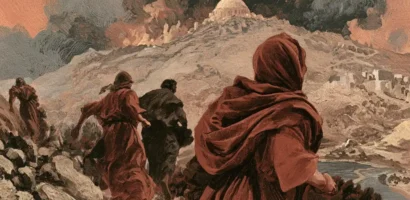
Last time, we spoke of this amazing young girl being able to make, so quickly and so boldly, the incredible life-changing decision of faith: to leave her home and her family for good, and to follow Abraham’s servant to Canaan. All of this happens in Genesis 24 – and at the very end of this long and eventful chapter we witness a fascinating scene. When Rebekah sees Isaac for the first time, coming up out of the desert, just at that moment, she literally falls off her camel. In English, it is usually translated as “alighted” or “dismounted” – however, the English expression, she dismounted from her camel,[1]does not correctly portray the original Hebrew, ותפל מעל הגמל –and she fell down, fell off the camel. Although we don’t see this particular verb, “to fall down,” in this verse in English, the Jewish commentaries discuss precisely this verb, ליפול juxtaposing it, for example, with the words of Psalm 37:24: “Though he fall, he shall not be utterly cast down; For the Lord upholds him with His hand.”
Why did Rebekah fall? In order to understand that, let us recall the events of Genesis 22, Aqedat Itzhaq. Some of my readers might know that Aqedat Yitzhaq, the story of the sacrifice of Isaac, contains – among its many other enigmas – one more mystery that our sages have long pointed out. After everything that happened on Mount Moriah—after the raised knife was stopped by the voice from heaven—Genesis 22:19 states: So Abraham returned to his young men, and they rose and went together to Beersheba; and Abraham dwelt at Beersheba. Isaac is not mentioned there at all. Where did he disappear to? What happened to him after the Aqedah? Historically, this circumstance has triggered numerous discourses and speculations, which are laid out in a wide variety of works by our sages and rabbis. Where did Isaac go? Wouldn’t it be right for us to expect, after the trauma the son had experienced, for Abraham to have remained obsessively close to him, showing him even greater love and concern? Especially since ultimately, Abraham himself (though not by his own will, but by God’s) had caused his son such trauma? Wouldn’t it be right for us to expect a story about how the father and son, after undergoing their joint testing, would have returned home together to the worried sick Sarah? (Remember: back in those days, there were no phones, and Sarah would not have had the slightest idea what had transpired on Mount Moriah.) But we find nothing of the sort here: no expressions of the family’s emotions on the occasion; no description of a cheery unity between the jointly tested father and son. The Scriptures inform us only about Abraham’s return. In the next chapter, Sarah dies (out of worry for Isaac, Jewish tradition says). However, Isaac is nowhere to be seen, he has vanished, and he next appears in God’s Word only at the end of Genesis 24, in the scene that we are witnessing now, right before the first meeting with Rebekah, his future wife. Where had Isaac been?
This is a wonderful example of the things that can only be understood in Hebrew. Genesis 24:62 tells us that Isaac came from the way of Beer Lahai Roi. If we don’t know Hebrew, this name means nothing, but one who understands Hebrew will be astounded by its profound meaning: The Well of The One Who Sees Me Lives – that is how I would translate it. This profound name occurs for the first time in Genesis 16: Hagar gives this name to the well where the Angel of the Lord met her. Since the name is connected to Hagar, Midrash Genesis Rabbah suggests that Isaac had gone there to bring Hagar to Abraham his father, that he should marry her.[2] However, I think this name means much more than that in Isaac’s story: it tells us that, even after the Aqedah, after what he had experienced on Mount Moriah, when Isaac disappears from both his family, as well as our field of vision – when no one could see Isaac or knew where he was – the Lord still saw him; that while Isaac disappeared from everyone else’s sight, he did not disappear from God’s sight. God had His Own reason and plan for Isaac’s temporary absence: this was surely a time of very close relationship between Isaac and the Lord—a time when not his earthly father, but his Heavenly Father Himself, restored him after the terrible shock he had gone through—The One Who Sees Me Lives.
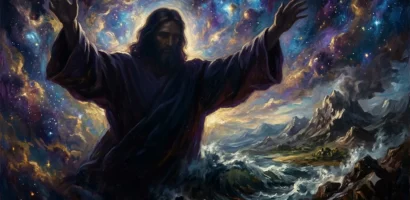
Now, back to our original question: Why did Rebekah fall? I believe that, after the experience of Mount Moriah, and after the time he had spent with God, when God was the only One who saw him, Isaac must have been resplendent with God’s light and shining with God’s glory. Rashi writes about Rebecca and this initial meeting: “She saw his majestic appearance, and she was astounded by him.” When the heart humbles itself before God in the fire of testing, it is cleansed and filled with God’s glory. Isaac is coming up out of the desert, radiating God’s light.
And maybe this is an additional reason why, in Genesis 24:65, we read: “So she took her veil and covered herself.” Of course, we all know that she covered herself both out of modesty, and as a token of subjection to her future husband: according to Oriental custom, the bride has to be brought veiled into the presence of the bridegroom. However, the very fact that she fell down from the camel hints that there was even more to it than that. Isaac was dazzling Rebekah as she laid eyes on him for the first time – and both her falling down from the camel, and covering herself begin to make more sense as we think of Isaac radiating God’s glory as he approached her.
[1] Gen. 24: 64
[2] Gen. Rabbah, 60:14