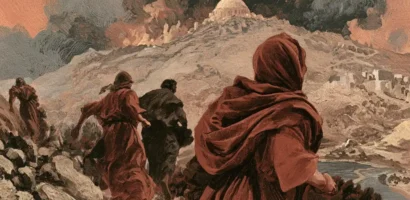


Since you are reading this blog carefully, you are most probably a thoughtful and well-read Christian interested in Jewish Background of New Testament and multitude of related issues. If that is the case, I know that you will enjoy this article by my friend Dr. Anders Runesson. It explores the dynamic of early Apostolic Judaism among other issues, setting forward some crucial and critical terminological trajectories that are necessary to grasp how it all began, as well as how and why Christianity developed as it did into a religion that defined itself as being outside Judaism. So, get ready to engage in some significant historical and theological reflection. Click here to start – Inventing Christian Identity. If you want to read more go to Dr. Runesson’s website. It can be found here.
The following is Dr. Anders Runesson bio written by him.
I was born in the coastal town of Åhus in Sweden in 1968. Between high school and university I enrolled in a one-year program on the economies of the two-thirds world and global trade, politics, and culture at Jämshögs folkhögskola, including travel and study in India. Among other things, I also worked one year as a teaching assistant in the village of Kidugala in south-western Tanzania (1987-1988).
At Lund University, where I began my undergraduate education in 1989, I earned a B.A. (Jewish Studies, 1995), an M.Div. (1995), an M.A. (Religious Studies, 1996), a Licentiate (New Testament Exegesis, 1997; thesis: The Judgment According to Matthew), and a Ph.D. (New Testament Exegesis, 2001; thesis: The Origins of the Synagogue: A Socio-Historical Study).
My undergraduate and graduate studies focused on the New Testament, the Hebrew Bible and early Judaism (including rabbinics), with special attention to intra- and inter religious relations. I have worked with theological themes as well as with socio-historical analysis, and my research on the ancient synagogue also led me to archaeology and the study of inscriptions and papyri.
Obviously, such academic interests relate closely to the Middle East and, especially, Jerusalem. Over the years, I have been fortunate enough to have been able to spend some time there studying, teaching, and researching. In 1990 I took part in the excavations at Tel Yisreel, and my undergraduate years also included one semester of study at the Swedish Theological Institute in Jerusalem (1993). I returned to Israel and the Palestinian territories in 1999 for work related to my doctoral thesis on ancient synagogues.
Later, in 2003, I co-taught a course on religious dialogue (Christianity, Judaism, and Islam) at Lund University, which included a field trip to Jerusalem and the Swedish Theological institute. In 2009-2010 I was a visiting Professor at the Institute of Archaeology at Hebrew University during a research leave from McMaster University.
I have always been interested in learning about life from cultures around the globe. In addition to academic historical and theological studies, I have travelled (independently) in more than 40 countries in Asia, Africa, North and Central America, the Middle East, and Europe. This has meant encounters with a wide variety of religious traditions, which have influenced my understanding of inter-religious relations as well as deepened my reflection on the relationship between society and academia. I am an ordained pastor in the Church of Sweden (Lutheran), which means I also have an active interest in relating what I have encountered and learned to church life and (contextual) theology, as well as to contemporary religious dialogue and theologies of religion.
Many of my journeys around the globe I have made together with my wife Anna, and some of them also with our three children. In 2003 I was appointed to the faculty at McMaster University, the Department of Religious Studies, and we moved to Canada the same year.
I specialize in New Testament studies and early Judaism, and supervise students on all levels within these fields: from 4th-year undergraduate honours theses to M.A. and Ph.D. theses. My teaching on both undergraduate and graduate levels include a range of traditional topics, such as the historical Jesus, the Gospels, and Paul and Christian Origins, as well as more specialized courses on, e.g., inter-religious relations in antiquity, and the synagogue as the birthplace of two world religions.
I currently work on several projects, including a book on the Gospel of Matthew entitled Judgment as Good News: Rethinking Divine Wrath in Matthew’s Gospel (with Fortress, scheduled for 2013) as well as a book on Paul as a first-century Jew who never revoked his Jewish identity (co-authored with Mark Nanos, Rockhurst University).
On a private note, I enjoy long-distance running (Marathons, half-Marathons, and, especially, the oldest road race in North America: the annual 30K Around the Bay in Hamilton) and, more generally, the great outdoors: everything from the sandy beaches where I was born and grew up, to mountains, deserts, and forests, from the Rockies to the Middle East, from the Himalayas to Dundas Conservation Area and the Hamilton Waterfront Trail.