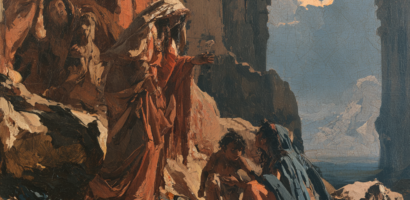



Jesus as the High Priest of the Heavenly Tabernacle in Rev. 1:10-13
(by Dr. Eli Lizorkin-Eyzenberg and Peter Shirokov)
10 I was in the Spirit on the Lord’s Day when I heard behind me a loud voice like a trumpet, 11 saying: “Write in a book what you see and send it to the seven churches—to Ephesus, Smyrna, Pergamum, Thyatira, Sardis, Philadelphia, and Laodicea.” 12 I turned to see whose voice was speaking to me, and when I did so, I saw seven golden lampstands, 13 and in the midst of the lampstands was one like a son of man.
John saw his vision on the Lord’s Day (see comments to the previous section as to the identity of the day). John was looking ahead, when suddenly he heard a voice speaking from behind him. John compared the voice to the sound of a trumpet. It is not easy to imagine what trumpet sound is meant here. Is it an Israelite “shofar,” a trumpet made of goat’s horn? Is it a type of bronze trumpet also known in the Mediterranean region? It is not possible to tell what the sounds were that John actually heard, but the fact that he described it as a trumpet sound lets us know that the message John received was connected with how the trumpet was normally used – a call to prepare for action.
When John turned back to look in the direction of the voice speaking to him, he first saw the Temple menorah – a seven-branched lamp that was once located in the Holy Place in the Temple in Jerusalem. The presence of the Temple menorah showed John’s audience that his visionary experience took place, at least partially, in the vicinity of the heavenly temple/tabernacle, or, more precisely in the section of the temple that is known as the Holy Place. We read about the existence of the heavenly temple in Hebrews 8:1-5:
“Now the main point in what has been said is this: we have such a high priest, who has taken His seat at the right hand of the throne of the Majesty in the heavens, a minister in the sanctuary and in the true tabernacle, which the Lord pitched, not man. For every high priest is appointed to offer both gifts and sacrifices; so it is necessary that this high priest also have something to offer. Now if He were on earth, He would not be a priest at all, since there are those who offer the gifts according to the Law; who serve a copy and shadow of the heavenly things…”.
The idea of a heavenly temple first surfaces in the books of Moses. Moses ascended Mt. Horev and received instructions for the construction of the tabernacle (mishkan), the tent of God’s presence when Israel was in the wilderness. As Moses did this, he was “shown” the temple in the heavenly realm (Ex 25:9, 40) and his job was to somehow reflect in the earthy structure what he had seen in the heavenly realm. Ezekiel 40 offers an elaborate vision of the heavenly temple that was yet future. The idea of a heavenly temple is also mentioned in the Testament of the Twelve Patriarchs, an apocalyptic Jewish work from the 2nd century BCE, and is quoted in several of Paul’ letters.[1]
“And thereupon the angel opened to me the gates of heaven, and I saw the holy temple, and upon a throne of glory the Most High. And He said to me: Levi, I have given thee the blessings of the priesthood until I come and sojourn in the midst of Israel (Testament of Levi 5:1-3).[2]
The fact that the Son of Man walks among the seven heavenly lamps (menorah), means that he (Jesus), as the heavenly high priest, was the source of this revelation. In various Jewish traditions, the figure of Metatron, who is if not identical, is very similar to the Son of Man, acts as the high priest of the heavenly temple. This temple is located in close proximity to the heavenly chariot at the base of God’s throne.
We read in 3 Enoch 15B (also known as Hebrew Enoch or Sefer Hekhalot):
Metatron (the name means “the one next to the throne”) is the Prince over all Princes, and stands before him who is exalted above all gods. He goes beneath the throne of glory, where he has a great heavenly tabernacle of light, and brings out the deafening fire, and puts it in the ears of the holy creatures, so that they should not hear the sound of the utterance that issues from the mouth of the Almighty.
The writer of Hebrews expressed similar ideas to those found in the Qumran scrolls, namely that Melchizedek is the heavenly high priest (11Qmelch). We read in Hebrews 7:1-3:
For this Melchizedek, king of Salem, priest of the Most High God, who met Abraham as he was returning from the slaughter of the kings and blessed him, 2 to whom also Abraham apportioned a tenth part of all the spoils, was first of all, by the translation of his name, king of righteousness, and then also king of Salem, which is king of peace. 3 Without father, without mother, without genealogy, having neither beginning of days nor end of life, but made like the Son of God, he remains a priest perpetually.
It becomes clear that here in the book of Revelation, the Jewish apocalyptic figure, who previously appeared in a variety of Jewish Son of Man and Metatron traditions, is in fact Jesus Christ – the eternal heavenly high priest. This connection in Revelation is intentional and definite.
[1] 1 Thess. 2:16 is a quotation of Test. Patr., Levi, 6:10; Rom. 12:19 is taken from Gad, 6:10; Rom. 12:21 is taken from Benjamin, 6:3; 2 Cor. 12:10 is a quote from Gad, 5:7.
[2] Pseudepigrapha of the Old Testament, ed. Robert Henry Charles (Bellingham, WA: Logos Bible Software, 2004), Enoch 108:15.