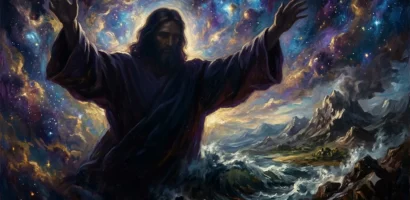



14 His head and His hair were white like white wool, like snow; and His eyes were like a flame of fire. 15 His feet were like burnished bronze, when it has been made to glow in a furnace, and His voice was like the sound of many waters. 16 In His right hand He held seven stars…
As John continues to describe his vision we are reminded of a similar description of angel-like encounter that we read about in another (partially) apocalyptic Jewish work – The Book of Daniel. There we read in Dan.10:4-6:
“On the twenty-fourth day of the first month, while I was by the bank of the great river, that is, the Tigris, I lifted my eyes and looked, and behold, there was a certain man dressed in linen, whose waist was girded with a belt of pure gold of Uphaz. His body also was like beryl, his face had the appearance of lightning, his eyes were like flaming torches, his arms and feet like the gleam of polished bronze, and the sound of his words like the sound of a tumult.”
Both encounters testify, though somewhat differently, that both men (in Daniel and in Revelation) wore white linen robe with a golden girdle, both had eyes like flaming torches, feet of burnished bronze, face that shone like a sun and voice that sounded like a sound of rushing waters. This is a remarkable similarity indeed.
However, other than this remarkable similarity, there are also other striking differences. The Son of man in Revelation is seen with the hair that is white like wool and snow (vs.14) and in the middle of the description two more important visual descriptions are added – he held in his hand seven stars and from his mouth proceeded the two-edged sword.
The whiteness of the hair evokes another text curiously also located in the Book of Daniel. The Almighty God of Israel is described as the Ancient of Days, who does not only wear white robe, but also has head of white hair. We read of that magnificent encounter in Daniel 7:9-10:
“I kept looking until thrones were set up, and the Ancient of Days took His seat; His vesture was like white snow and the hair of His head like pure wool. His throne was ablaze with flames; its wheels were a burning fire. “A river of fire was flowing and coming out from before Him; Thousands upon thousands were attending Him, and myriads upon myriads were standing before Him; the court sat, and the books were opened.”
So an interesting feature that appears in the Book of Revelation can be noted the description of angel-like heavenly being (Son of Man) is in some important detail (white robe and hair) is mixed with the description of the Ancient of Days. We cannot yet speak of full merger of the characters, but certain expressed resemblance is nevertheless becomes evident.
The Book of Enoch contains much of the language similar to Revelation. In Enoch God is called Head of Days (instead of Ancient of Days in Daniel) and also the Lord of the Spirits. In this passage God is described to have white hair like wool. In 1 Enoch 46:1-3 we read:
“And there I saw One who had a head of days, and His head was white like wool, and with Him was another being whose countenance had the appearance of a man, And his face was full of graciousness, like one of the holy angels. And I asked the angel who went with me and showed me all the hidden things, concerning that Son of Man, who he was, and whence he was, (and) why he went with the Head of Days? And he answered and said unto me: This is the Son of Man who hath righteousness, with whom dwells righteousness, and who reveals all the treasures of that which is hidden, because the Lord of Spirits hath chosen him, and whose lot hath the pre-eminence before the Lord of Spirits in uprightness forever.”
As in many apocalyptic passages the Son of Man figure is in the presence of the Lord of the Spirits. In this passage (which John probably knows) he is not the one with white hair. Perhaps this is John’s way of intentionally blending the Father and the Son.
The angel-like heavenly being in the Book of Revelation is also seen by John holding seven stars in his right hand. While it is important to try and identify as much as possible that symbolism behind the seven stars, it is more important to see that the fact that he is holding them all in his right hand speaks of his great authority and power. When we get to vs. 20 we discuss in more details the interpretive options for the phrase “stars are the angels of the seven assemblies”, but for now the important point is that these seven starts, no matter what they represent, are under full and unquestionable control of the heavenly being that speaks to John.