

 “Brothers, I can speak confidently to you about our forefather David, that he both died and was buried, and his tomb is with us to this day…” Acts 2:29
For better viewing click HERE.
Various sites for David’s tomb were suggested by popular traditions over the ages and the one which became generally accepted was the place now called Mt. Zion. The name “Zion” appears in the Hebrew Bible in reference to the original, ancient Jerusalem, not to the present hill of that name. But, in the Middle Ages, Byzantine pilgrims mistakenly thought that this hill, located south of the Armenian Quarter of Jerusalem’s Old City, was part of the ancient city and named it “Mount Zion.” In fact, during the middle of the second century CE, the time of the Bar Cochba Revolt, Jerusalem was razed, Jews were banished from the area, and knowledge concerning the true location of King David’s Tomb and Mt. Zion was lost. So, the present tradition concerning the location of the tomb is only about 1,000 years old, first being recorded in Crusader times, and then accepted in Jewish, Muslim, and Christian traditions. The Spanish Jewish traveler, Benjamin of Tudela (c. 1173), reports a story about the miraculous discovery of David’s tomb on Mt. Zion during the repairing of a church on the site. The present building housing the cenotaph was erected in 1335, but it is built on top of what is probably a second- to fourth-century building whose purpose is not known. The site passed between Muslims and Christians at various periods and came under Jewish control after 1948. It became a special center for Jewish pilgrims in the period from 1948 to 1967, because it was the only site in divided Jerusalem from which they could see the Western Wall. Jews made pilgrimages to the site on Shavuot, the traditional date of David’s death. According to the Talmud Yerushalmi, David was born and died on the holiday of Shavuot, the Feast of Weeks which is the 50th day after Passover, the Greek “Pentecost” (πεντηκοστή = 50th).
An important note from Dr. Eli: Judith Green the author of this article is also the principle author of Biblical Greek course that is being offered now through eTeacherBiblical. To explore the possibility of taking a course in Biblical Greek, please, click HERE.
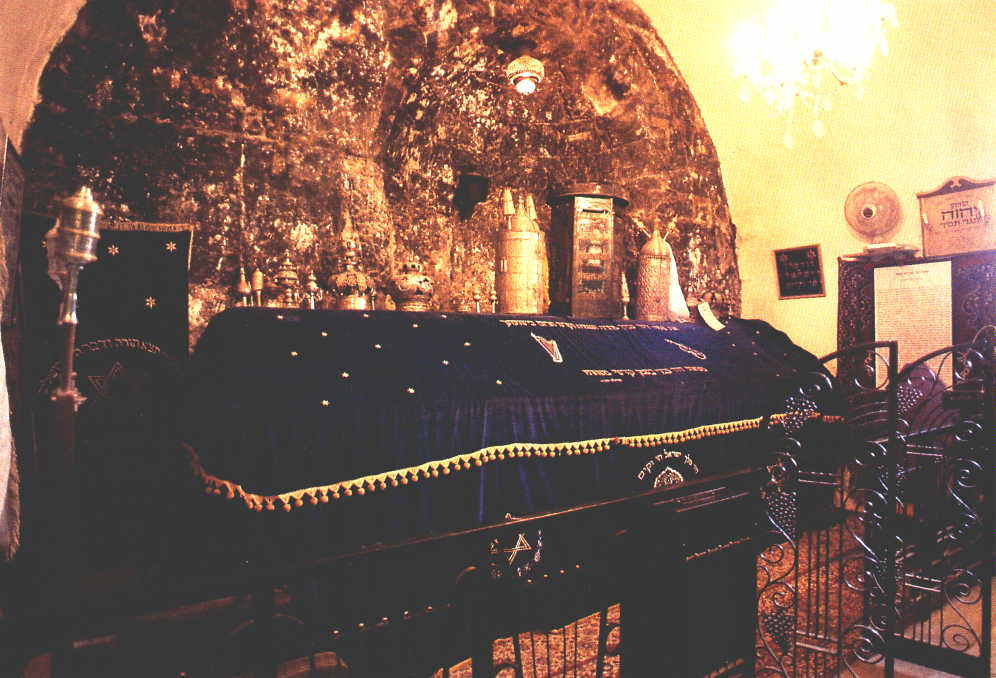
David’s Tomb today, with embroidered mantel quoting Psalm 150.
Which brings us back to the scene of the giving of the Holy Spirit to the disciples, on Shavuot, in the Upper Room. Although everything we have said, from a historical or archaeological point of view, indicates that David was not buried there, or that the first Christian Pentecost happened there, there is another, spiritual truth in the account in Acts. Peter’s speech to the large assembly is full of reference to King David – quoting his Psalms (16:8-11;89:3; 110:1), and interpreting them as prophecy concerning the death and resurrection of Jesus. And all this is being said consciously in a building housing David’s tomb (see quote above, Acts 2:29). Wherever exactly this event took place, on the Pentecost/Shavuot after the Resurrection, we can be sure that King David’s Tomb was nearby, as Peter says, in the “Lower Room”.
To explore the possibility of taking a course in Biblical Greek, please, click HERE.