


Imagine holding a letter written by a dear friend, but you can only read a summary written by someone else. You still get the core message, but you miss the unique tone, the subtle wordplay, and the deep emotion of the original voice.
For many bible enthusiasts, reading the Old Testament in translation feels exactly like that. You have probably tried to piece things together from random books, disconnected videos, and generic language apps, only to end up overwhelmed, stuck, or unsure if you are even learning correctly.
You are not alone. Most beginners go through this exact cycle. The most fulfilling way to learn Biblical Hebrew is not through isolated memorization, but through a structured, expert-guided journey that builds your skills naturally. This roadmap turns an intimidating ancient script into an approachable, deeply spiritual adventure.
TLDR:
Reading Scripture in its original language uncovers profound depth hidden by translations. While an ancient language requires steady practice, Biblical Hebrew is beautifully logical, built on consistent three-letter roots and poetic patterns.
The most effective way to start is through a guided, step-by-step program instead of scattered resources. Your first two months focus on learning the alphabet and vowels. By month three, you will explore how words connect, and by months four through nine, you will naturally transition into reading beautiful biblical narratives from books like Genesis and Ruth.
The Gift Of The Original Text
Learning Biblical Hebrew opens a doorway into the original culture and worldview of the Bible. English versions often have to smooth over beautiful idioms and poetic structures embedded in the Hebrew text. When you step into the original language, those translation limitations simply melt away.
Consider the famous priestly blessing in Numbers 6:25: “The Lord make His face shine upon you.” In the ancient Semitic mind, a “shining face” is a beautiful concrete analogy for a warm, radiant smile. Learning Hebrew allows you to see these vivid, visual images directly, making your personal study transformative and deeply personal.
A beautiful realization happens when you look at a word like shemesh (שֶׁמֶשׁ), which means “sun.” It’s structurally related to ancient words for serving or ministering. To the biblical writers, the sun wasn’t just a ball of hot gas; it was created as a faithful minister, serving the earth daily by providing light and life. This completely shifts how we experience creation passages, transforming a dry natural element into a vivid picture of divine design.
What Makes Biblical Hebrew So Beautifully Logical?
Biblical Hebrew is an ancient Semitic language that evolved over hundreds of years, yet it possesses a striking, mathematical elegance. Instead of memorizing thousands of unrelated words, you will find that Hebrew operates like a majestic tree branching out from simple seeds.
The language is shaped by three core elements:
· A consonantal alphabet: The original text consists of 22 expressive consonants written from right to left. Centuries later, dedicated scribes added a system of tiny dots and dashes called niqqud to preserve the vowels, acting like musical notes to guide our pronunciation.
· The root system: Almost every noun, verb, and adjective is built from a simple three-letter core root. Once you learn a single root, an entire family of related meanings suddenly clicks into place.
· Action-focused grammar: Unlike English, which is highly fixated on strict time (past, present, and future), Hebrew grammar focuses heavily on the nature of an action, whether a beautiful deed is completed or still ongoing.
What To Expect During Your First Months Of Learning
Progressing through the language is a deeply rewarding climb. Here is a clear look at how your understanding unfolds over a classic nine-month foundational journey.
Months 1-2: Learning The Alphabet And Reading Basics
Your journey begins with the Hebrew alphabet and vowel system. You’ll learn to recognize the letters, understand their sounds, and become comfortable reading from right to left.
At first, the script may seem unfamiliar, but you’ll be surprised by how quickly the letters become recognizable with regular practice. During this stage, you’ll also begin reading simple words and short phrases from Scripture.
One of the most memorable moments comes when you successfully read your first Hebrew word without assistance. What once looked like a collection of unfamiliar symbols suddenly begins to make sense.
Months 3-4: Building Vocabulary And Understanding Patterns
Once you’re comfortable reading, you’ll start expanding your vocabulary and exploring how Hebrew words connect.
Instead of memorizing tedious word lists, you’ll learn to spot the beautiful, recurring patterns woven throughout the text. This organic approach makes new vocabulary much easier to absorb and reinforces what you’ve already learned.
Best of all, you’ll also begin reading short passages from Scripture, applying your growing knowledge to real biblical texts.
Months 5-6: Engaging More Directly With Scripture
As your confidence grows, you’ll dive into books like Genesis and Ruth. This stage is incredibly rewarding because you’ll move past analyzing individual words and start flowing with the narrative, understanding how ideas connect across a passage.
Familiar stories will feel more vivid and personal as you encounter them directly through the very language in which they were originally written.
Months 7-9: Growing In Confidence And Fluency
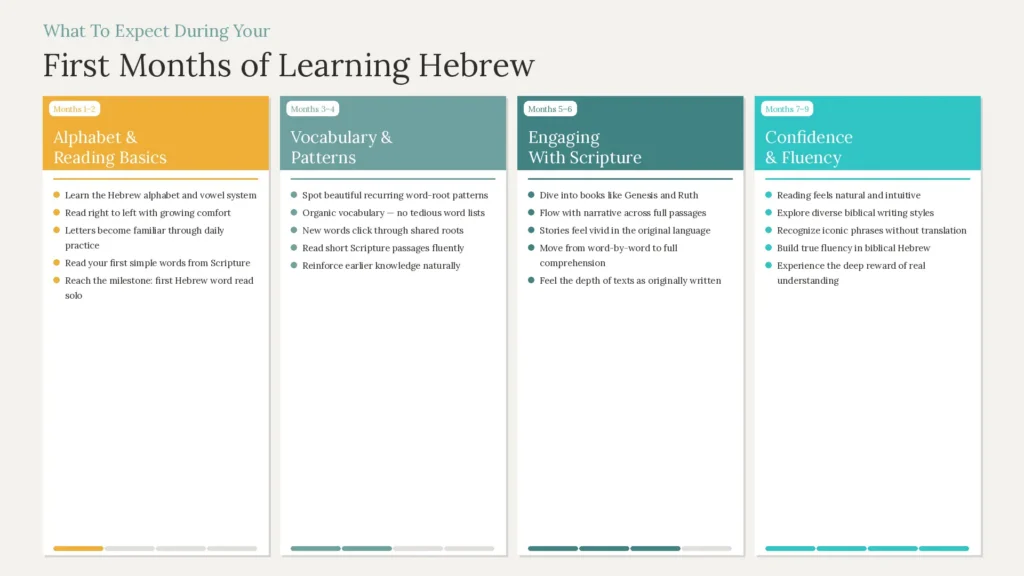
Now, reading starts to feel natural and intuitive. You’ll build true fluency, explore different biblical writing styles, and experience the thrill of recognizing iconic phrases, like וַיֹּאמֶר יְהוָה (“And the Lord said…”), without needing to lean on a translation. By the end of this stage, you’ll have a beautiful, lasting foundation to engage with Scripture deeply and independently.
How To Start Learning Biblical Hebrew
The internet is packed with resources for learning Biblical Hebrew. With just a few clicks, you can find endless videos, apps, podcasts, and study groups.
While having options is great, many beginners find that piecing together random resources can quickly get confusing. It’s easy to skip important steps, progress can feel a bit scattered, and you’re often left wondering what to study next.
That is why the most rewarding way to start your journey is with a structured course that guides you step by step. A clear, well-designed program builds your reading skills, vocabulary, and understanding in a logical sequence. Instead of stressing over creating your own curriculum, you get to simply focus on learning and enjoying the experience.
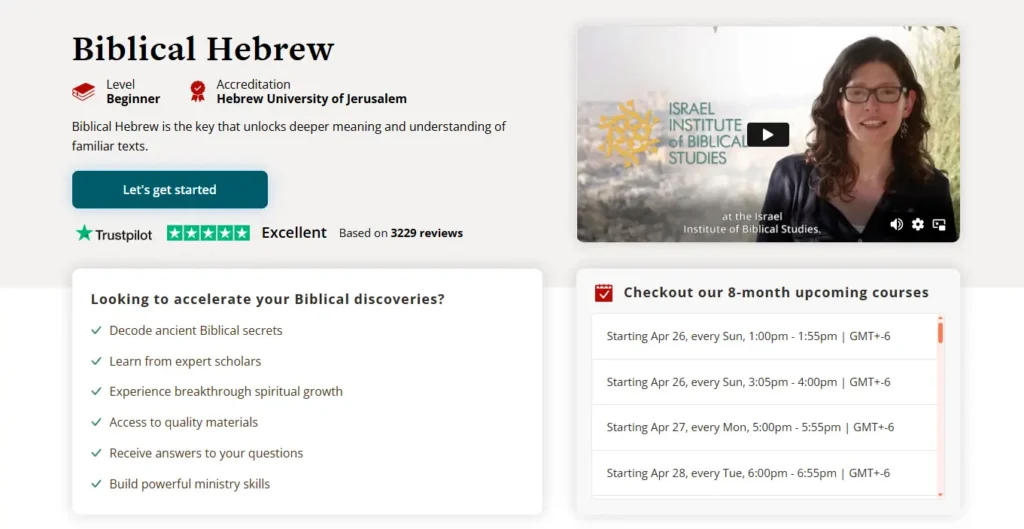
Programs like Biblical Hebrew A from the Israel Institute of Biblical Studies represent the ideal Biblical Hebrew first steps, combining expert guidance with a clear path forward to help you move from a complete beginner to a confident reader of the texts you love.
Common Mistakes To Avoid
Learning Biblical Hebrew is a rewarding journey, but avoiding a few common mistakes can make the process much smoother.
· Rushing the alphabet: The alphabet is your foundation. Take the time to get truly comfortable with how the letters look and sound to avoid constantly second-guessing yourself later.
· Studying inconsistently (Cramming): Exhausting weekly study blocks strain your memory. Spending just 20 to 30 minutes a day is far more effective for reinforcing progress and keeping the language fresh.
· Memorizing vocabulary in isolation: Learning words without context makes reading feel mechanical. Study vocabulary right inside meaningful biblical passages to see how the words work together and improve retention.
· Reading silently: Biblical Hebrew is a vibrant spoken language full of oral rhythm. Reading the verses out loud helps your brain process the words naturally and builds effortless recognition.
· Being afraid of mistakes: Worrying about reading too slowly or mispronouncing words will only stall your progress. Mistakes are a natural part of the journey that ultimately strengthen your confidence.
Your First Eight Weeks At A Glance
The first two months of study focus on building the foundation you’ll use throughout your learning journey:
Weeks 1-2: Learn the Hebrew alphabet and begin reading simple words.
Weeks 3-4: Develop reading fluency and become comfortable with the vowel system.
Weeks 5-6: Build vocabulary and discover how Hebrew words connect through shared meanings.
Weeks 7-8: Read simple biblical passages and begin recognizing common sentence patterns.
By the end of this stage, you’ll already be engaging with portions of Scripture that once seemed completely inaccessible.
Take The First Step Today
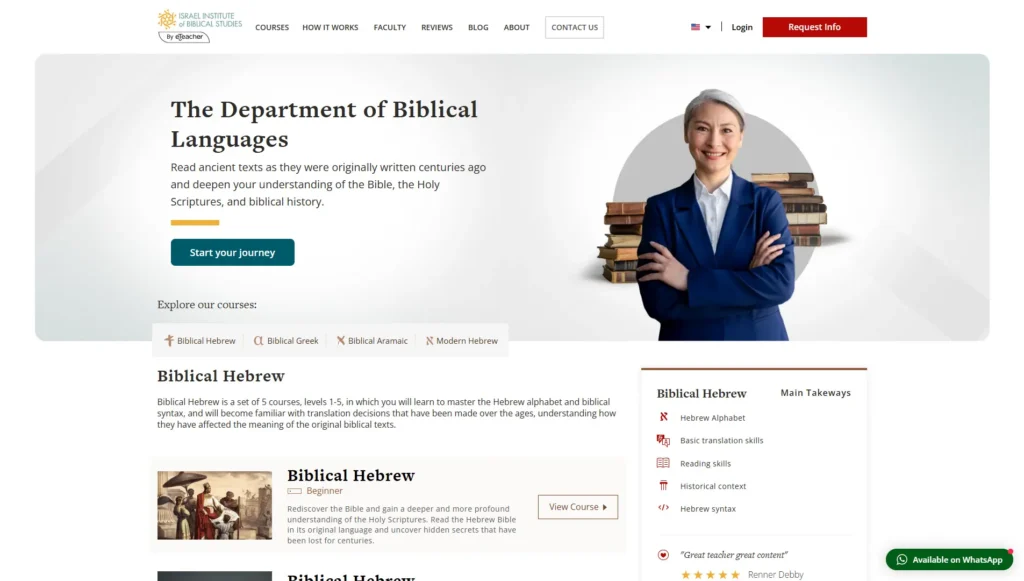
Start with a structured course to avoid gaps in knowledge. Explore the Biblical Hebrew courses at the Israel Institute of Biblical Studies and take the first step toward reading Scripture in the language it was written in.
Conclusion
Learning Biblical Hebrew is about more than learning a language. It’s about drawing closer to Scripture and encountering familiar passages in a fresh and meaningful way.
As you learn the alphabet, recognize recurring words, and begin reading biblical texts for yourself, you’ll discover insights that deepen your understanding of God’s Word. Small breakthroughs accumulate over time, turning what once felt unfamiliar into something increasingly accessible.
The journey begins with a single letter, then a word, then a verse. Before long, you’ll find yourself engaging with the biblical text in a way that can enrich your study, strengthen your faith, and deepen your connection to the world of Scripture.
FAQ:
How long does it take to learn Biblical Hebrew?
A structured beginner course typically takes about 7 to 9 months to complete. During that time, you’ll build a strong foundation in reading, vocabulary, and biblical interpretation while gaining experience with real passages from Scripture.
Do I need to know Modern Hebrew to learn Biblical Hebrew?
No. Many students begin learning Biblical Hebrew without any prior knowledge of Hebrew. A beginner-friendly course will introduce everything you need step by step.
Is Biblical Hebrew difficult to learn?
Like any new skill, learning Biblical Hebrew requires practice and patience. However, many students find that once they become familiar with the alphabet and reading system, the language feels much more approachable than they originally expected.
Can I learn Biblical Hebrew on my own?
Self-study resources can be useful, but many learners benefit from a structured course that provides guidance, accountability, and a clear progression from one stage to the next.
What will I be able to read after a beginner course?
Most students can read narrative passages from books such as Genesis and Ruth with the help of reference tools while continuing to build fluency and confidence.
How much time should I study each week?
Most learners benefit from a weekly class combined with regular daily practice. Even 20 to 30 minutes a day can lead to steady progress over time.
What materials do I need?
Most structured courses provide learning materials, exercises, and online resources. As you progress, a Biblical Hebrew lexicon or dictionary can also be a valuable companion for your studies.